MAI-Thinking-1: Why Microsoft’s Reasoning Model Matters
MAI-Thinking-1 has become one of the most important Microsoft Build 2026 announcements because it shows Microsoft is no longer depending only on partner models for advanced AI. The company has launched its own in-house reasoning model, built for software engineering, enterprise workflows, and cost-efficient deployment.
This matters because the AI market is moving from “who has the smartest model?” to “who can deliver useful intelligence at the best price, speed, and reliability?” Enterprises do not only want benchmark wins. They want models that are secure, affordable, fast, and easy to use inside real tools.
Therefore, MAI-Thinking-1 is not just another AI model launch. It is Microsoft’s direct entry into the enterprise API war.
Why MAI-Thinking-1 Matters in 2026
MAI-Thinking-1 matters because Microsoft is building a stronger independent AI stack. The Verge reported that Microsoft unveiled its first advanced reasoning model at Build 2026, alongside other in-house models for image, voice, transcription, and coding.
Axios reported that MAI-Thinking-1 is a midsized model with 35 billion active parameters, designed for cost-efficiency rather than simply chasing the biggest frontier-model size.
This is important because enterprise AI adoption depends heavily on cost. If a company wants AI inside every developer workflow, support desk, document system, and productivity tool, the model must be affordable enough for daily use.
In simple words, Microsoft is trying to make reasoning AI practical, not only impressive.
What Is MAI-Thinking-1?
MAI-Thinking-1 is Microsoft AI’s flagship reasoning model. It is designed to handle complex thinking tasks, especially software engineering and agentic enterprise workflows.
Microsoft describes MAI-Thinking-1 as a 35B-active, ~1T-total parameters sparse Mixture of Experts model. A sparse Mixture of Experts model activates only some expert parts during a task, which can reduce inference cost compared with using the full model every time.
The model focuses on:
- Software engineering
- Mathematical reasoning
- Enterprise workflows
- Agentic task planning
- Coding assistance
- Copilot integration
- Cost-efficient inference
- Secure enterprise deployment
- Reasoning-heavy tasks
- API competitiveness
This makes it a practical enterprise model, not only a research showcase.
MAI-Thinking-1 and the Enterprise API War
MAI-Thinking-1 enters the enterprise API war at a time when companies are comparing OpenAI, Anthropic, Google, DeepSeek, Mistral, xAI, and Microsoft models for business use.
The enterprise API war is about more than model quality.
It includes:
- Price per token
- Latency
- Security
- Reliability
- Developer tools
- Coding performance
- Compliance
- Data privacy
- Integration
- Vendor trust
Microsoft already owns major enterprise channels through Azure, GitHub, Visual Studio Code, Microsoft 365, Teams, and Copilot. Now, with MAI-Thinking-1, it can push its own model deeper into that ecosystem.
That creates pressure on rival API providers.
MAI-Thinking-1 vs Claude Sonnet 4.6: What “Parity” Means
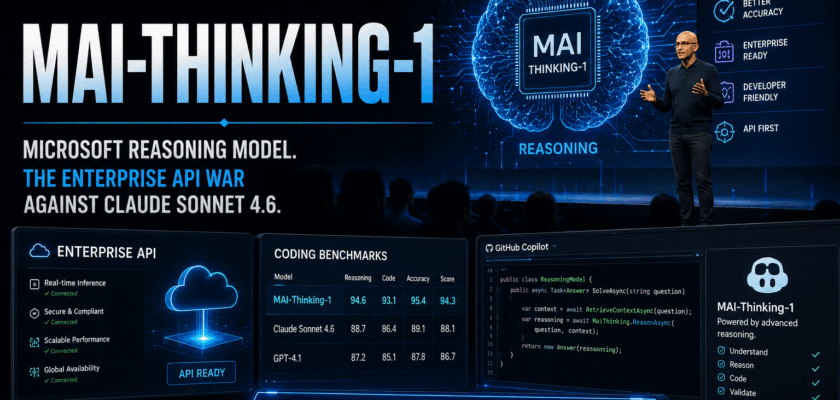
The title says MAI-Thinking-1 achieves parity with Claude Sonnet 4.6. Microsoft’s official announcement says MAI-Thinking-1 reaches human preference parity with Sonnet 4.6 in blind side-by-side evaluations.
This does not mean MAI-Thinking-1 beats Sonnet 4.6 in every benchmark or every use case.
It means that, in Microsoft’s blind human preference tests, users preferred MAI-Thinking-1 and Sonnet 4.6 at similar rates.
That is still important because enterprise teams often care about real user preference, not only leaderboard numbers.
However, independent third-party testing will be needed before the market fully accepts Microsoft’s claim.
MAI-Thinking-1 vs Claude Opus 4.6 on Coding
Microsoft’s official MAI-Thinking-1 page says the model is toe-to-toe with Claude Opus 4.6 on SWE-Bench Pro.
This matters because SWE-Bench-style tests measure software engineering ability. Enterprises care about coding models because developer productivity is one of the fastest AI use cases to monetize.
A strong coding model can help with:
- Bug fixing
- Code review
- Test generation
- Refactoring
- Documentation
- Pull request support
- API integration
- Legacy code migration
- DevOps support
- Agentic coding workflows
If MAI-Thinking-1 performs strongly at lower cost, it can become attractive for large developer teams.
Why Microsoft Is Building Its Own Models
Microsoft is building its own models because full dependence on external models can create strategic risk. The Verge reported that Microsoft’s Build 2026 AI announcements signal a move to become one of the top AI labs while still maintaining cloud relationships.
Having in-house models gives Microsoft more control over:
- Pricing
- Deployment
- Product roadmap
- Safety tuning
- Enterprise compliance
- Model integration
- Latency optimisation
- Copilot features
- Developer tools
- Long-term AI strategy
This does not mean Microsoft will stop using partner models. But it means Microsoft now has more bargaining power and product flexibility.
Why Model Size Matters for Enterprises
Model size matters because larger models can be expensive to run. A huge model may perform well, but if every query costs too much, companies cannot use it widely.
MAI-Thinking-1’s medium-sized sparse design suggests Microsoft is targeting a practical balance between performance and cost.
Enterprises want models that can support:
- Many employees
- High request volume
- Daily coding use
- Internal knowledge search
- Customer support
- Compliance reviews
- Workflow automation
- Agentic tasks
- Low latency
- Predictable cost
A model that is “good enough and cheaper” can beat a model that is slightly smarter but too costly for daily use.
Sparse MoE: Simple Explanation
Sparse MoE means sparse Mixture of Experts. Think of it like a team of specialised experts inside one model. Instead of using every expert for every task, the model activates only the experts needed for that request.
This can help reduce compute cost.
For example:
- Coding task may activate coding experts
- Math task may activate reasoning experts
- Text task may activate language experts
- Planning task may activate strategy experts
The full model may have around one trillion total parameters, but only part of it runs actively for a given request. Microsoft says MAI-Thinking-1 has 35B active parameters with around 1T total parameters.
That design is useful for enterprise cost control.
Why Software Engineering Is the First Big Battlefield
Software engineering is the first big battlefield because developers use AI directly in daily work. Coding assistants already have clear business value.
AI coding tools can reduce time spent on:
- Boilerplate code
- Debugging
- Unit tests
- Documentation
- Code explanation
- API usage
- Migration tasks
- Security checks
- Pull request reviews
- Repetitive scripts
Microsoft has a major advantage here because GitHub Copilot and Visual Studio Code are already widely used by developers.
If MAI-Thinking-1 and related Microsoft coding models integrate deeply into these tools, adoption can grow fast.
MAI-Code-1-Flash and the Copilot Strategy
Microsoft did not launch only MAI-Thinking-1. It also announced MAI-Code-1-Flash, a coding model designed for inference efficiency and developer workflows. The Microsoft Build 2026 MAI keynote transcript says MAI-Code-1-Flash is priced cheaper than Claude Haiku 4.5 in GitHub Copilot’s new token-based billing.
This shows Microsoft’s strategy clearly.
It wants multiple model tiers:
- Strong reasoning model for hard tasks
- Fast coding model for daily coding
- Voice model for speech
- Transcription model for audio
- Image model for visual tasks
This multi-model strategy can reduce cost by sending each task to the right model.
Why Cost Routing Is the Future of Enterprise AI
Cost routing means using different models for different tasks instead of sending everything to the most expensive model.
For example:
- Simple rewrite: cheaper model
- Coding autocomplete: fast coding model
- Complex debugging: reasoning model
- Meeting transcript: speech model
- Image generation: image model
- Enterprise agent task: reasoning + tools
This approach saves money.
A company using AI at scale may process millions of requests per month. Even a small cost difference can become huge.
MAI-Thinking-1 gives Microsoft another model in this routing stack.
MAI-Thinking-1 and GitHub Copilot
MAI-Thinking-1 can strengthen GitHub Copilot because complex coding tasks often need reasoning, not just autocomplete. Developers increasingly want AI to understand repositories, plan changes, edit multiple files, and explain trade-offs.
A reasoning model can help Copilot with:
- Multi-step bug diagnosis
- Architecture suggestions
- Complex refactoring
- Test strategy
- Codebase exploration
- Pull request planning
- Security review
- Dependency analysis
- Agentic coding
- Developer onboarding
If Microsoft can make this cheaper and faster, Copilot becomes more valuable for enterprise teams.
MAI-Thinking-1 and Visual Studio Code
Visual Studio Code is one of Microsoft’s strongest developer distribution channels. A model does not win only because it is smart. It wins when developers can use it easily.
Deep integration into VS Code can support:
- Inline reasoning
- Code explanation
- Debug assistance
- Terminal help
- Agentic workflows
- Project-wide edits
- Test generation
- Natural language commands
- Extension ecosystem
- Enterprise policy controls
This is where Microsoft has a major ecosystem advantage.
A rival API may be strong, but Microsoft owns the workflow surface.
Why Clean Data Claims Matter
Microsoft says MAI-Thinking-1 was trained from the ground up on clean data and without distillation from third-party models.
This claim matters because AI training data has become a legal, ethical, and competitive issue.
Enterprises may ask:
- Was copyrighted data used properly?
- Was the model distilled from a rival?
- Is the model legally safer?
- Can the vendor explain training practices?
- Does the model meet compliance needs?
- Can it be used in regulated industries?
Clean-data positioning can help Microsoft sell to cautious enterprise buyers.
Enterprise Trust as a Competitive Weapon
Enterprise trust is a major competitive weapon. Businesses do not choose AI tools only by benchmark scores. They also choose vendors they believe can handle security, compliance, billing, privacy, and support.
Microsoft already has deep relationships with enterprise IT teams.
That gives it an advantage in:
- Procurement
- Security review
- Legal approval
- Compliance
- Identity management
- Admin controls
- Data residency
- Support
- Integration
- Billing
MAI-Thinking-1 can benefit from this trust layer.
Why Claude Sonnet 4.6 Remains a Serious Competitor
Claude Sonnet 4.6 remains a serious competitor because Anthropic models are widely respected for coding, writing, reasoning, and enterprise safety. Microsoft’s parity claim does not remove Anthropic’s strength.
For enterprises, Claude may still win in some areas.
Possible strengths include:
- Long-context reasoning
- Natural writing quality
- Coding workflows
- Safety reputation
- Claude Code ecosystem
- Enterprise API adoption
- Strong developer trust
- Anthropic brand momentum
The real market will compare these models task by task.
No single benchmark settles the entire debate.
Why Independent Benchmarks Matter
Independent benchmarks matter because vendor claims are useful but not final. Microsoft’s claims about parity and coding performance come from its own evaluations. These claims need independent testing across real-world workloads.
Enterprises should test models on:
- Their own codebases
- Real support tickets
- Internal documents
- Compliance tasks
- Latency targets
- Cost limits
- Safety requirements
- Multilingual prompts
- Long-context tasks
- Agentic tool use
The best model for one company may not be best for another.
AIME, SWE-Bench, and Real-World Tasks
Benchmarks like AIME and SWE-Bench are useful, but they do not cover every business use case. Gigazine reported that MAI-Thinking-1 beat Claude Sonnet 4.6 on AIME 2025, a math reasoning benchmark, while Microsoft also highlighted software engineering strength.
However, business users should not rely only on public benchmarks.
A model that performs well on math may not automatically be best for:
- Customer support
- Legal review
- Hindi-English content
- Sales automation
- Financial analysis
- Medical admin tasks
- Data extraction
- Enterprise search
- Agent reliability
- Long workflows
Benchmarks guide testing. They do not replace it.
MAI-Thinking-1 and Microsoft’s Multi-Model Stack
Microsoft’s Build 2026 announcement included more than one model. According to The Verge, Microsoft announced models for reasoning, image, voice, transcription, and coding.
This matters because enterprise AI needs many capabilities.
A full AI platform may need:
- Text reasoning
- Coding
- Speech-to-text
- Text-to-speech
- Image generation
- Document understanding
- Tool calling
- Agent orchestration
- Security controls
- Workflow automation
Microsoft is trying to build a complete stack, not only one model.
Why API Pricing Will Decide Adoption
API pricing will decide adoption because enterprises use AI at scale. A model can look great in demos, but if usage becomes too expensive, companies limit deployment.
AI cost includes:
- Input tokens
- Output tokens
- Reasoning tokens
- Tool calls
- Retrieval cost
- GPU inference
- Storage
- Monitoring
- Security layer
- Support
A cost-efficient model can unlock more use cases.
This is why MAI-Thinking-1’s size and routing strategy matter.
Latency Is Also Part of the API War
Latency means how fast the model responds. In enterprise workflows, slow AI can break user experience.
Low latency matters for:
- Code completion
- Customer support
- Voice agents
- Real-time collaboration
- Search assistants
- Internal chatbots
- Meeting tools
- Sales workflows
- Security alerts
- Agent execution
A slightly weaker but faster model may win some use cases.
Microsoft can optimise latency through Azure infrastructure and product integration.
MAI-Thinking-1 and Agentic Workflows
Agentic workflows are tasks where AI does not only answer but also plans, uses tools, checks results, and completes multi-step work.
MAI-Thinking-1 can support agentic workflows because reasoning models are better at planning and step-by-step problem solving.
Enterprise agents may handle:
- Code fixes
- Ticket triage
- Report generation
- Meeting follow-ups
- Data cleanup
- Compliance checks
- Security investigation
- Sales research
- Customer onboarding
- Knowledge-base updates
This is where reasoning models can create business value.
Why Microsoft Scout Matters
Axios reported that Microsoft introduced Scout, a personal AI agent built on top of MAI-Thinking-1.
This is important because it shows Microsoft wants to turn MAI-Thinking-1 into user-facing agent products, not only backend APIs.
A personal agent can help with:
- Planning
- Research
- Work coordination
- Document handling
- Email support
- Scheduling
- Code tasks
- Data review
- Decision support
- Follow-up automation
If Scout works well, it can become a showcase for Microsoft’s model stack.
Why Microsoft’s OpenAI Relationship Still Matters
Microsoft’s relationship with OpenAI still matters because OpenAI models remain important across the AI ecosystem. Microsoft may use both OpenAI and its own models depending on product, cost, and performance needs.
The Verge reported that Microsoft’s Build 2026 announcements signal more competition with OpenAI, even though Microsoft remains deeply connected to the AI cloud ecosystem.
This creates a new dynamic.
Microsoft can be:
- OpenAI partner
- OpenAI competitor
- Azure provider
- Model developer
- Enterprise AI platform
- Copilot owner
That makes the AI market more complex.
Why This Is Good for Enterprise Customers
This competition can be good for enterprise customers. More strong models can reduce vendor lock-in and improve pricing.
Customers may benefit from:
- Better model choice
- Lower pricing pressure
- More specialised models
- Better enterprise controls
- Faster innovation
- Improved coding tools
- Better compliance features
- More deployment options
- Stronger API competition
- Better support
The enterprise API war may force vendors to improve faster.
Risks for Microsoft
Microsoft still faces risks with MAI-Thinking-1.
Risks include:
- Overstated benchmark claims
- Weak independent validation
- Enterprise hesitation
- Strong Anthropic/OpenAI competition
- Developer trust gap
- High infrastructure cost
- Safety concerns
- Integration bugs
- Latency issues
- Model hallucination
A model launch is only the beginning. Real adoption depends on performance inside daily work.
Risks for Enterprises
Enterprises also face risks when adopting new reasoning models.
They should watch for:
- Data leakage
- Wrong code suggestions
- Compliance errors
- Hallucinated answers
- Over-automation
- Vendor lock-in
- Hidden costs
- Weak monitoring
- Poor audit trails
- Employee overdependence
AI adoption should be managed carefully.
A reasoning model can help, but it should not replace review, testing, and governance.
What Developers Should Test First
Developers should test MAI-Thinking-1 on real tasks before trusting it fully.
Test it on:
- Bug fixes
- Pull request reviews
- Unit test generation
- Legacy code explanation
- Refactoring suggestions
- API migration
- Security warnings
- Documentation generation
- Multi-file changes
- Build error diagnosis
Compare it with Claude Sonnet 4.6, Claude Opus 4.6, GPT models, and other coding models using the same tasks.
The best model is the one that performs well on your code.
What CIOs Should Watch
CIOs should watch whether MAI-Thinking-1 reduces cost while maintaining quality.
Important questions:
- Is it cheaper at scale?
- Does it meet security rules?
- Can it run inside existing Microsoft tools?
- Is latency acceptable?
- Can usage be audited?
- Does it support compliance?
- Does it reduce developer time?
- Does it improve ticket resolution?
- Can it integrate with internal data?
- Does it avoid vendor lock-in?
For CIOs, AI is no longer a demo. It is an operating cost and productivity system.
What Startups Should Watch
Startups should watch MAI-Thinking-1 because API pricing and model access can affect product margins. If Microsoft offers strong reasoning at lower enterprise cost, startups may build on Azure and Copilot ecosystems more easily.
Startups should compare:
- API cost
- Model quality
- Latency
- Developer tools
- Startup credits
- Deployment options
- Enterprise sales support
- Safety filters
- Fine-tuning or customization
- Ecosystem reach
A cheaper reasoning model can make AI products more sustainable.
Why Microsoft’s Distribution Advantage Is Huge
Microsoft’s biggest advantage is distribution. A new model can reach millions of users quickly if it enters Copilot, GitHub, Visual Studio Code, Microsoft 365, Windows, Teams, or Azure.
This is different from a standalone AI startup.
Microsoft can place MAI-Thinking-1 into workflows where users already work.
Distribution channels include:
- GitHub Copilot
- VS Code
- Microsoft 365 Copilot
- Azure AI Foundry
- Teams
- Windows
- Dynamics
- Power Platform
- Security products
- Enterprise admin tools
This distribution can turn MAI-Thinking-1 into a serious market force.
Future of the Enterprise API War
The enterprise API war will likely move toward specialised model portfolios. Companies may not choose one universal model. They may choose many models for different tasks.
Future competition will focus on:
- Reasoning quality
- Coding ability
- Price
- Latency
- Tool use
- Security
- Compliance
- Multimodal capability
- Agent reliability
- Ecosystem integration
MAI-Thinking-1 positions Microsoft strongly in this future.
It gives Microsoft a first-party reasoning engine for its enterprise AI layer.
Final Verdict
MAI-Thinking-1 is a major Microsoft AI milestone because it shows the company is serious about building its own reasoning models. With a 35B-active sparse MoE design, strong software engineering positioning, and claimed human preference parity with Claude Sonnet 4.6, Microsoft is entering the enterprise API war with a practical, cost-focused strategy.
The biggest point is not only benchmark performance. The bigger point is integration. Microsoft can place its models inside GitHub Copilot, VS Code, Azure, Microsoft 365, Teams, and enterprise workflows.
In simple words, MAI-Thinking-1 is Microsoft’s message to the AI market: reasoning models must become useful, affordable, and deeply embedded in daily work.
If independent testing supports Microsoft’s claims, MAI-Thinking-1 could become one of the most important enterprise AI models of 2026.


