
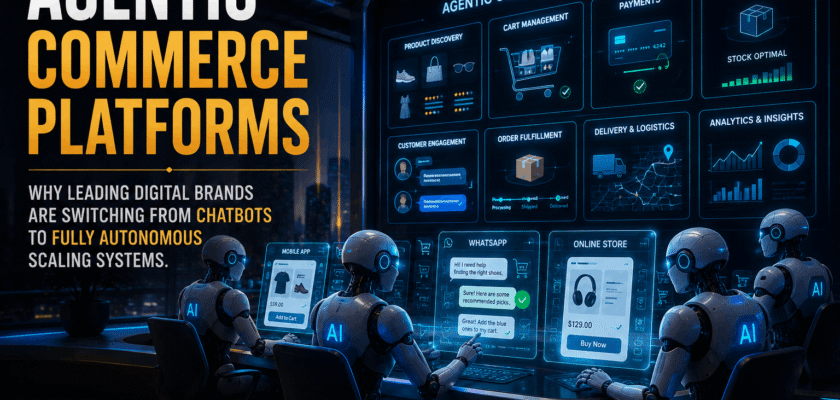
Agentic Commerce Platforms: Why Chatbots Are No Longer Enough
Agentic commerce platforms are changing how digital brands sell, support, and scale online. Earlier, brands used chatbots mainly to answer simple questions like order status, delivery time, refund rules, or product details. These bots were helpful, but they were limited.
Now, the market is moving toward autonomous AI agents that can understand intent, compare products, qualify leads, create carts, book appointments, trigger workflows, and hand complex issues to humans when needed.
This is why agentic commerce platforms matter in 2026. They are not just customer-service tools. They are becoming autonomous business architectures for digital brands.
Why Agentic Commerce Platforms Matter in 2026
Agentic commerce platforms matter because customers now expect fast, personal, and action-ready experiences. A normal chatbot can answer, “Where is my order?” But an agentic commerce system can do much more.
It can help a shopper choose the right product, check stock, apply offers, build a cart, process checkout, arrange delivery, and follow up after purchase.
Meta’s 2026 AI Business Agent is a clear example. Reuters reported that Meta’s new tool can support WhatsApp, Messenger, and Instagram, while helping businesses answer customer questions, qualify leads, book appointments, and close sales.
This shows the shift clearly.
Brands no longer want bots that only reply. They want agents that act.
What Are Agentic Commerce Platforms?
Agentic commerce platforms are AI systems that can act on behalf of customers or businesses in commerce workflows. They are designed to move beyond static replies and complete useful steps across the buying journey.
Salesforce defines agentic commerce as AI that can act for users or businesses by making personalised recommendations, managing inventory, interacting with customers, finding products, negotiating, or managing purchases.
In simple words, agentic commerce means AI does not only suggest. It works.
It can support:
- Product discovery
- Product comparison
- Cart creation
- Lead qualification
- Customer support
- Appointment booking
- Checkout help
- Inventory updates
- Returns support
- Post-purchase follow-up
This makes it much more powerful than a basic chatbot.
Agentic Commerce Platforms vs Chatbots
Agentic commerce platforms and chatbots are not the same.
A chatbot usually answers questions.
An agentic commerce platform completes tasks.
Basic Chatbot
A chatbot may say: “This product is available.”
Agentic Commerce Platform
An AI agent may say: “This product is available in your size, I found a better bundle, added the discount, and created your checkout link.”
That difference is huge.
Digital brands are moving toward agentic platforms because they reduce friction between customer interest and final purchase.
Autonomous Business Architectures: What It Means
Autonomous business architectures mean brands build systems where AI agents can run parts of sales, support, marketing, and operations with limited human intervention.
This does not mean humans disappear. It means humans focus on higher-value decisions while AI handles repetitive and structured workflows.
Autonomous business architecture can include:
- AI sales agents
- AI support agents
- Inventory agents
- Pricing agents
- Marketing agents
- Customer success agents
- Return management agents
- Personal shopping agents
- Fulfilment coordination agents
- Analytics agents
Together, these agents create a more scalable digital brand.
Why Leading Digital Brands Are Switching
Leading digital brands are switching because old ecommerce funnels are getting expensive. Ads cost more. Customer attention is lower. Support teams are overloaded. Consumers compare more before buying.
Agentic commerce platforms can help brands reduce friction at every stage.
They can improve:
- Conversion rate
- Customer response time
- Cart completion
- Lead quality
- Repeat purchase
- Support efficiency
- Personalisation
- Upselling
- Cross-selling
- Customer satisfaction
This is why brands are exploring autonomous scaling systems.
The goal is not only automation. The goal is smarter growth.
Meta AI Business Agent: Why It Matters
Meta’s AI Business Agent matters because many digital brands already sell through WhatsApp, Instagram, and Messenger. In India and many emerging markets, customer conversations often happen before purchase.
Reuters reported that Meta’s Business Agent can work across WhatsApp, Messenger, and Instagram, and earlier versions had already been used by more than one million businesses.
This is important because commerce is becoming conversational.
Many customers do not want to browse a full website. They want to message, ask, compare, and buy inside the same chat.
Meta wants to turn that chat into an agentic sales channel.
Shopify and Agentic Commerce Infrastructure
Shopify is also moving toward agentic commerce. Shopify explains that agentic commerce is a new ecommerce model where AI agents shop on behalf of consumers by researching products, comparing options, and helping with purchases.
McKinsey also notes that Shopify is developing agentic shopping infrastructure that lets agents connect to its merchant catalog and build carts across merchants.
This matters for merchants because future shoppers may not visit every store manually.
Instead, an AI agent may ask merchant systems:
- What products match this need?
- What is the price?
- Is it in stock?
- Can it be delivered fast?
- Is there a discount?
- What is the return policy?
- Can this be added to cart?
Brands must prepare for AI agents as buyers.
Why AI Agents May Become the New Storefront
AI agents may become the new storefront because customers may begin shopping through ChatGPT, Google AI Mode, Gemini, Microsoft Copilot, WhatsApp, Instagram, or personal AI assistants.
McKinsey says OpenAI, Google, PayPal, Mastercard, Amazon, Shopify, Stripe, and others are building agentic shopping services and payment infrastructure.
This means the store visit may not always start on a website.
It may start with a prompt like:
“Find me a good office backpack under ₹2,000 with laptop protection and fast delivery.”
The AI agent may then compare multiple brands and bring only the best options.
So, brands must become agent-readable.
Agent-Readable Commerce: The New SEO
Agent-readable commerce may become the new SEO. Earlier, brands optimised websites for Google search. Now, they may need to optimise product data for AI agents.
This means product pages should have:
- Clear titles
- Accurate descriptions
- Structured specifications
- Real stock status
- Transparent prices
- Shipping details
- Return policy
- Reviews
- Size charts
- Product images
- Schema markup
If agents cannot understand a product, they may not recommend it.
In the agentic commerce era, messy product data can reduce sales.
Why Product Data Quality Becomes Critical
Product data quality becomes critical because AI agents compare options quickly. If your product information is incomplete, vague, or misleading, the agent may choose a competitor.
Good product data should include:
- Exact product name
- Use case
- Material
- Size
- Colour
- Weight
- Warranty
- Delivery time
- Return rules
- Compatibility
For example, “premium bag” is weak data.
“Water-resistant 25L laptop backpack for 15.6-inch laptops with padded straps and 1-year warranty” is better data.
AI agents need clarity.
Personal Shopping Agents Are Rising
Personal shopping agents are becoming more common. Axios reported that Gopuff partnered with SpaceXAI to introduce an AI-powered personal shopping assistant called “Go,” which uses memory and context from past purchases to help fill shopping carts through voice and text.
This shows how commerce is becoming more automated.
A user may soon say:
“Order my regular snacks, add something healthy, and keep it under ₹800.”
The agent can understand preference, budget, past behaviour, and delivery need.
That is much more advanced than a chatbot.
Why Memory Matters in Agentic Commerce
Memory matters because shopping is personal. Customers repeat habits, brands, sizes, budgets, allergies, colours, and delivery preferences.
A good commerce agent can remember:
- Preferred brands
- Clothing sizes
- Past orders
- Budget limits
- Dietary choices
- Delivery address
- Payment preference
- Return behaviour
- Favourite categories
- Gift occasions
This can improve personalisation.
However, memory also creates privacy risk. Brands must handle customer data carefully.
Privacy Risk in Agentic Commerce
Privacy risk is serious because agentic commerce platforms may access purchase history, messages, personal preferences, payment data, location, and identity.
Brands must protect:
- Customer consent
- Data storage
- Payment details
- Chat history
- Personal preferences
- Address data
- Identity verification
- Third-party integrations
- AI training data
- Deletion rights
Trust will decide adoption.
If customers feel watched or manipulated, they may reject agentic shopping.
Security Risks Are Bigger Than Chatbots
Security risks are bigger than chatbots because agentic systems can take action. A bad chatbot answer is a problem. A bad agent action can create financial loss.
A 2026 research paper on autonomous LLM agents in agentic commerce warns that autonomous agents can negotiate, purchase services, manage digital assets, and execute transactions, but this creates new risks around agent integrity, transaction authorisation, trust, market manipulation, and compliance.
This is why agentic commerce needs strong guardrails.
An AI agent should not buy, refund, discount, or share data without proper rules.
What Guardrails Should Brands Add?
Brands using agentic commerce platforms must add clear guardrails.
Important guardrails include:
- Spending limits
- Human approval for high-value actions
- Refund rules
- Discount limits
- Identity checks
- Payment authorisation
- Audit logs
- Escalation to human support
- Fraud detection
- Data access controls
Without guardrails, autonomous systems can create expensive mistakes.
Automation should be controlled, not blind.
Agentic Commerce and Payments
Payments are central to agentic commerce. If an agent can recommend but cannot help complete a purchase, the experience remains incomplete.
McKinsey notes that OpenAI announced an Agentic Commerce Protocol, co-developed with Stripe, allowing users to complete purchases within ChatGPT without leaving the chat.
This shows where the market is going.
Future shopping may happen in one flow:
- User asks
- Agent searches
- Agent compares
- User approves
- Payment completes
- Delivery is tracked
The checkout page may become less important than the agent interface.
Why Brands Need Human Handoff
Human handoff is still necessary. Not every issue should be handled by AI.
Human support should take over when:
- Customer is angry
- Payment fails
- High-value order is involved
- Legal issue appears
- Product safety issue exists
- Medical or financial advice is requested
- Fraud is suspected
- Agent confidence is low
- Customer asks for human
- Complaint is complex
The best agentic commerce systems combine AI speed with human judgement.
Customer Support Will Change
Customer support will change because AI agents can resolve many simple issues instantly.
They can handle:
- Order tracking
- Return request
- Product exchange
- Delivery update
- Warranty information
- Size guidance
- Store policy
- Invoice download
- Complaint routing
- Follow-up reminders
This can reduce support load.
However, brands must make sure AI support feels helpful, not robotic.
Tone and accuracy both matter.
Sales Teams Will Change Too
Sales teams will also change. AI agents can qualify leads before humans speak to them.
For example, an agent can ask:
- What product are you looking for?
- What is your budget?
- When do you need delivery?
- Are you buying for personal or business use?
- Do you want a demo?
- Should I book a call?
Meta’s Business Agent is designed to qualify leads and support sales actions across business messaging channels.
This helps sales teams focus on serious buyers.
Marketing Becomes More Intent-Based
Marketing in agentic commerce becomes more intent-based. Instead of pushing ads to everyone, brands may compete when an AI agent detects real buying intent.
For example, a customer may ask:
“Find a birthday gift for my brother under ₹1,500.”
That is high-intent commerce.
Brands must prepare content and offers for such agent-led discovery.
Marketing will shift from loud promotion to clean data, trust signals, reviews, delivery quality, and agent compatibility.
Inventory Agents Can Improve Operations
Agentic commerce platforms can also help behind the scenes. Inventory agents can monitor stock, predict demand, and alert teams before products go out of stock.
Salesforce says agentic commerce can help manage inventory and boost operational efficiency.
Inventory agents can support:
- Stock alerts
- Reorder planning
- Dead stock detection
- Demand forecasting
- Warehouse coordination
- Product availability updates
- Store transfer suggestions
- Seasonal planning
- Supplier reminders
- Pricing decisions
This turns AI from front-end chatbot into business operations engine.
Pricing Agents and Discount Control
Pricing agents can help brands adjust offers, but they must be used carefully. Wrong discounts can damage margins.
A pricing agent may track:
- Demand
- Competitor pricing
- Stock levels
- Customer segment
- Festival season
- Cart abandonment
- Repeat customer value
- Shipping cost
- Margin limits
- Campaign goals
However, pricing should always have guardrails.
AI should not start discount wars without business rules.
Why Agentic Commerce Helps Scaling
Agentic commerce helps scaling because brands can handle more conversations, orders, and support requests without hiring huge teams.
It supports scaling by:
- Automating repetitive tasks
- Reducing response time
- Increasing conversion
- Improving lead quality
- Personalising recommendations
- Reducing abandoned carts
- Managing support tickets
- Updating inventory
- Supporting multilingual customers
- Running 24/7 workflows
This is why the title says fully autonomous scaling systems.
For digital brands, growth needs automation.
Why Chatbots Failed Many Brands
Many older chatbots failed because they were too rigid. They could answer only fixed questions and often forced users into menus.
Common problems included:
- Poor understanding
- Repeated wrong answers
- No real action
- No human handoff
- Weak product knowledge
- No memory
- No payment flow
- No inventory access
- Frustrating scripts
- No brand voice
Agentic commerce platforms try to fix these issues by connecting AI with real business systems.
Brand Voice Still Matters
Brand voice still matters even when AI handles conversations. A luxury brand, streetwear label, SaaS company, and grocery app should not sound the same.
AI agents should match:
- Brand tone
- Customer segment
- Product category
- Region
- Language
- Formality level
- Support style
- Sales approach
- Cultural context
- Trust level
Meta says its AI Business Agent can be tailored to reflect a company’s brand voice.
That is important because customers interact with the brand, not just the software.
Multichannel Commerce Will Become Agentic
Multichannel commerce means customers interact across website, app, WhatsApp, Instagram, marketplace, email, and physical stores. Agentic commerce can connect these channels.
A good platform should know:
- Customer history
- Cart status
- Recent messages
- Store availability
- Delivery options
- Loyalty points
- Open complaints
- Product preferences
- Payment status
- Return history
This creates a smoother customer journey.
The customer should not repeat the same issue on every channel.
Agentic Commerce for Small Businesses
Agentic commerce is not only for large enterprises. Small businesses can benefit too, especially on WhatsApp and Instagram.
A small business agent can:
- Reply to FAQs
- Show product catalog
- Take order details
- Confirm availability
- Share payment link
- Book appointment
- Send delivery update
- Collect feedback
- Handle repeat orders
- Escalate complex cases
For small teams, this can save time and increase sales.
However, small businesses must still monitor AI output.
Agentic Commerce for D2C Brands
D2C brands can use agentic commerce to increase conversion and repeat purchase.
Agents can help with:
- Product recommendations
- Bundle suggestions
- Subscription reminders
- Skincare routine matching
- Size guidance
- Ingredient explanation
- Refill reminders
- Loyalty offers
- Cart recovery
- Return handling
D2C brands often depend on customer education. AI agents can explain products at scale.
That is valuable for categories like beauty, wellness, fashion, gadgets, food, and home goods.
Agentic Commerce for B2B Brands
B2B brands can also use agentic commerce. In B2B, buying is often complex. Customers need quotes, stock checks, delivery timelines, documents, and approval workflows.
An agent can help with:
- Quote creation
- Product configuration
- Bulk pricing
- Stock visibility
- Invoice support
- Order status
- Reorder reminders
- Vendor comparison
- Contract routing
- Sales rep handoff
This can reduce friction in business buying.
Agentic commerce is not only consumer shopping. It can reshape B2B sales too.
Why Delivery Decides Who Wins
Delivery will decide winners because AI agents can recommend and sell, but customers judge the final experience by delivery quality.
If delivery fails, the agent’s smartness does not matter.
Brands must improve:
- Inventory accuracy
- Delivery speed
- Packaging
- Tracking
- Returns
- Refunds
- Customer updates
- Last-mile reliability
- Address accuracy
- Support response
Agentic commerce cannot hide weak operations.
It exposes them faster.
Risks of Over-Automation
Over-automation can hurt brands. If AI handles everything without human review, customers may feel ignored or manipulated.
Risks include:
- Wrong recommendations
- Unwanted purchases
- Bad refunds
- Discount mistakes
- Privacy concerns
- Biased suggestions
- Hallucinated policies
- Poor escalation
- Angry customers
- Brand trust damage
The best strategy is controlled autonomy.
Let AI act where rules are clear. Use humans where judgement matters.
What Brands Should Do First
Brands should not jump blindly into agentic commerce. They should prepare their systems first.
Start with:
- Clean product catalog
- Updated inventory
- Clear policies
- Structured FAQs
- Secure payment flow
- CRM integration
- Human handoff process
- Brand voice guide
- Data privacy rules
- Performance dashboard
Without this foundation, an AI agent may create confusion.
Good automation needs good data.
How to Measure Agentic Commerce Success
Brands should measure agentic commerce with business metrics, not only AI activity.
Track:
- Conversion rate
- Average order value
- Cart recovery
- Customer satisfaction
- Support resolution time
- Human handoff rate
- Refund errors
- Lead quality
- Repeat purchase
- Cost per resolved query
If the agent does not improve business results, it is only a fancy chatbot.
Future of Agentic Commerce Platforms
The future of agentic commerce platforms will likely include personal shopping agents, payment protocols, AI-readable catalogs, autonomous support, AI sales agents, and smart inventory systems.
Future customers may say:
“Find the best product, compare reviews, check delivery, use my coupon, and buy if it fits my budget.”
The agent will handle most of the work.
Future brands will need to compete not only for human attention, but also for AI agent preference.
That is the biggest shift.
Final Verdict
Agentic commerce platforms are pushing digital brands beyond basic chatbots. They allow AI to understand customer intent, recommend products, qualify leads, manage workflows, create carts, support checkout, and improve post-purchase service.
This shift is already visible through Meta’s AI Business Agent, Shopify’s agentic commerce infrastructure, Salesforce’s autonomous agent strategy, and broader market moves from OpenAI, Stripe, Google, PayPal, Mastercard, Amazon, and others.
In simple words, ecommerce is moving from “click and browse” to “ask and act.”
The brands that win will not only have good products. They will have clean data, trusted AI agents, secure payments, strong delivery, and human support where it matters.
Agentic commerce platforms are becoming the next operating system for digital brand growth.


