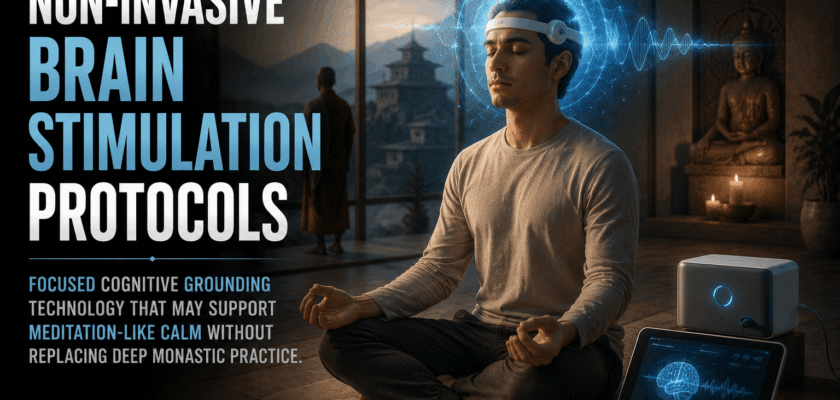
Non-Invasive Brain Stimulation Protocols: Why Spiritual Tech Is Entering a Serious New Phase
Non-invasive brain stimulation protocols are becoming a serious discussion because modern workers, students, founders, creators, and high-pressure professionals want deep calm without leaving daily life. Many people want the focus of a monk, the emotional stability of a meditator, and the mental clarity of a retreat — but they want it inside a modern schedule.
This is where focused cognitive grounding tech enters the conversation.
Brain stimulation tools such as TMS, tDCS, tACS, and transcranial focused ultrasound are being studied for mood, cognition, pain, mindfulness, and psychiatric care. But the important point is this: these tools are not magic spiritual machines.
They may help certain brain circuits shift state, but they do not replace discipline, ethics, meditation practice, breathwork, sleep, silence, and long-term inner training.
Therefore, non-invasive brain stimulation protocols should be understood as support tools, not shortcuts to enlightenment.
Why Non-Invasive Brain Stimulation Protocols Matter in 2026
Non-invasive brain stimulation protocols matter because neuroscience is moving from general wellness advice toward targeted brain-circuit modulation. A 2026 review described transcranial ultrasound stimulation as a close non-invasive analogue to deep brain stimulation and part of a larger movement toward personalized neuromodulation.
This matters for spirituality because many deep meditation states involve attention, self-referential thinking, emotional regulation, sensory awareness, and body-mind integration.
At the same time, updated safety and ethical guidelines for low-intensity transcranial electrical stimulation summarize 2017–2025 safety data and provide expert recommendations for human use.
So, the field is becoming more mature.
But maturity does not mean hype should replace caution.
The right question is not “Can a device make me a monk?”
The right question is “Can technology support focus, grounding, and emotional training when used safely?”
What Are Non-Invasive Brain Stimulation Protocols?
Non-invasive brain stimulation protocols are structured methods that use external devices to influence brain activity without surgery.
Common methods include:
- Transcranial magnetic stimulation, or TMS
- Transcranial direct current stimulation, or tDCS
- Transcranial alternating current stimulation, or tACS
- Transcranial focused ultrasound, or tFUS
- Static magnetic stimulation
- Neurofeedback-linked stimulation
- Meditation-engaged stimulation
These tools may target brain regions linked with mood, attention, pain, self-reference, motor control, or cognition.
In simple words, they try to guide brain circuits from outside the skull.
That makes them powerful, but also sensitive.
They should not be treated like casual gadgets.
Deep Monastic States: What People Are Trying to Replicate
Deep monastic states are not just “relaxation.” They can include stable attention, reduced ego-centred thinking, compassion, equanimity, silence tolerance, sensory clarity, and deep self-regulation.
Long-term meditation research has shown unusual brain patterns in experienced practitioners. A classic study by Lutz and colleagues found that long-term Buddhist meditators could self-induce high-amplitude gamma synchrony during meditation, suggesting trained attention and mental practice can strongly shape brain activity.
Other meditation research suggests that meditation is often associated with reduced activity in the default mode network, a brain network linked with self-referential thinking and mind-wandering.
This matters because “monastic calm” is not just a mood.
It is a trained brain-body pattern.
Why Technology Cannot Simply Copy a Monk’s Mind
Technology cannot simply copy a monk’s mind because monastic states are built through years of practice, moral discipline, lifestyle, community, silence, sleep rhythm, diet, teacher guidance, and repeated attention training.
A stimulation device may influence one circuit.
A monk’s training reshapes the whole life.
Deep contemplative development includes:
- Daily meditation
- Ethical discipline
- Reduced distraction
- Simple living
- Breath awareness
- Body awareness
- Compassion practice
- Teacher correction
- Community support
- Long-term repetition
A device may support focus for a short time.
It cannot give the wisdom, humility, patience, and inner stability created through practice.
That is why this topic should be treated with respect.
Focused Cognitive Grounding Tech: Simple Meaning
Focused cognitive grounding tech means tools designed to support attention, calm, body awareness, and emotional regulation. These tools may be digital, behavioural, or neurotechnological.
They may include:
- Guided meditation apps
- Breathwork devices
- Neurofeedback
- TMS paired with mindfulness
- tDCS paired with cognitive training
- tFUS meditation research
- HRV biofeedback
- EEG headbands
- Sleep and stress tracking
- Focus timers
The best grounding tech does not replace the human mind.
It helps the person practice better.
Transcranial Focused Ultrasound and Meditation Research
Transcranial focused ultrasound, or tFUS, is attracting attention because it may target deeper or more precise brain areas than some other non-invasive methods. A 2025 Harvard/MGH meditation paper described tFUS as a possible way to support meditative development by modulating brain structures with high spatial precision, especially areas linked with self-referential processing.
A 2026 preprint also investigated tFUS as a way to augment a two-week at-home meditation training course.
This is exciting, but it is still early.
Preprints and early-stage studies should not be treated as final proof.
The responsible interpretation is simple: tFUS may become a meditation-support research tool, but it is not a guaranteed shortcut to advanced spiritual states.
Ultrasound Brain Stimulation and Mindfulness Effects
Scientific American reported that ultrasound brain stimulation research found participants experienced time distortion, fewer negative thoughts, and greater detachment from feelings after a non-invasive ultrasound intervention.
This is relevant because mindfulness often involves observing thoughts and emotions with less attachment.
However, temporary changes in experience are not the same as deep spiritual maturity.
A person may feel detached for a short period after stimulation, but long-term transformation needs daily integration.
The difference matters.
A state can be induced.
A trait must be trained.
TMS and Mindfulness-Based Interventions
TMS is already used clinically in areas such as depression treatment, and researchers are now studying how it may combine with mindfulness practices. A 2026 narrative review discussed the neurobiological synergy of transcranial magnetic stimulation and mindfulness-based interventions in treatment-resistant depression.
There are also clinical studies exploring mindfulness-engaged neurostimulation, including rTMS combined with digital mindfulness exercises.
This matters because brain stimulation may work better when the person is mentally engaged in a specific practice.
In simple words, the brain may respond differently when stimulation happens during meditation, breathing, or cognitive therapy.
That is why “stimulation plus practice” may become more important than stimulation alone.
tDCS, tACS and Cognitive Support
tDCS and tACS are lower-intensity electrical stimulation methods being studied for cognition, mood, pain, and performance. A 2025 guideline reviewed updated safety data and gave expert recommendations on low-intensity transcranial electrical stimulation in humans.
These methods are easier to commercialize than some clinical tools, but that also creates risk.
People may buy consumer devices and use them without understanding safety, dosage, contraindications, or medical context.
This is risky.
Brain stimulation should not be self-experimented with casually.
Any use for mental health, cognition, or meditation should involve qualified guidance and evidence-based protocols.
Why Safety Must Come Before Spiritual Ambition
Safety must come before spiritual ambition because the brain is not a toy. Even non-invasive methods can have side effects, limits, and unknown long-term risks depending on intensity, duration, placement, and user condition.
Safety concerns may include:
- Headache
- Tingling
- Skin irritation
- Mood changes
- Sleep disturbance
- Anxiety
- Seizure risk in vulnerable people
- Medication interactions
- Incorrect electrode placement
- Overuse
The 2025 safety guideline exists because these tools need rules, not casual experimentation.
A spiritual seeker should not risk health for a promised shortcut.
Real growth needs patience.
The Default Mode Network and Self-Referential Thinking
The default mode network, or DMN, is often discussed in meditation research because it is linked with self-referential thought, mind-wandering, and internal narrative. Meditation studies have found reduced DMN activity during meditation compared with control states.
This is relevant because many spiritual traditions describe quieting the ego, observing the self, or reducing mental chatter.
But neuroscience language and spiritual language are not identical.
Reduced DMN activity does not automatically mean enlightenment.
It may mean less self-focused thinking during a specific state.
That can support meditation, but it is not the whole path.
Gamma Waves and Advanced Meditation
Gamma activity has become famous in meditation discussions because long-term meditators have shown unusual gamma synchrony during certain practices. The Lutz study found that long-term Buddhist practitioners could self-induce high-amplitude gamma-band oscillations and phase synchrony during meditation.
A 2025 study on chanting-driven inquiry meditation also reported synchronized gamma patterns linked with concentration and mental unity in monks.
But gamma is not a spiritual score.
Brain waves are complex. Different meditation styles can produce different patterns.
A person should not chase brainwave numbers like social media likes.
The goal of practice is clarity, compassion, and stability, not only a beautiful EEG graph.
Why “Absolute Neural Quietude” Is a Risky Phrase
Absolute neural quietude sounds attractive, but it can be misleading. The brain is never completely quiet while a person is alive. Even deep meditation involves dynamic neural activity.
A calm brain is not a dead brain.
Meditation may involve:
- Focused attention
- Reduced mind-wandering
- Better emotional regulation
- Sensory clarity
- Body awareness
- Compassion networks
- Meta-awareness
- Stable breathing
- Balanced arousal
- Reduced reactivity
So, a better phrase than “absolute neural quietude” may be “regulated neural stability.”
Spiritual calm is not emptiness alone.
It is awake stillness.
Brain Stimulation Plus Meditation: The Emerging Model
The emerging model is not device-only spirituality. It is stimulation plus meditation, grounding, therapy, or cognitive training.
A combined protocol may include:
- Pre-session safety screening
- Guided breathwork
- Baseline mood check
- Brain stimulation under supervision
- Meditation practice during or after stimulation
- Journaling
- Integration coaching
- Sleep tracking
- Follow-up assessment
- Safety monitoring
This model respects both science and practice.
The device may open a window.
The practice teaches the person how to live through that window.
Why Ethical Discipline Still Matters
Ethical discipline still matters because powerful mental states without ethical grounding can become ego traps. Spiritual traditions often combine meditation with ethics for a reason.
Without ethics, a person may use altered states for:
- Ego inflation
- Manipulation
- Escape
- Addiction to experiences
- Avoidance of responsibility
- Spiritual superiority
- Emotional bypassing
- Risky self-experimentation
- False claims
- Commercial exploitation
Monastic training is not only about brain states.
It is about character.
That is why technology cannot replace the moral dimension of spirituality.
The Danger of Spiritual Bypassing
Spiritual bypassing happens when people use spiritual ideas or experiences to avoid real emotional work. Brain stimulation could make this risk worse if people chase special states without addressing behaviour, trauma, relationships, or daily responsibility.
Warning signs include:
- “I do not need therapy anymore.”
- “This device made me enlightened.”
- “My emotions are gone, so I am healed.”
- “I am above normal people.”
- “I only need altered states.”
- “I do not need discipline.”
- “I can skip practice.”
- “I can ignore my body.”
True grounding makes a person more responsible, not less.
Clinical Use vs Wellness Hype
Clinical use and wellness hype must be separated. TMS, tDCS, and other NIBS methods may have clinical roles under proper supervision. But wellness marketing can exaggerate benefits.
Clinical use involves:
- Screening
- Diagnosis
- Protocol selection
- Safety monitoring
- Trained professionals
- Evidence review
- Contraindication checks
- Follow-up
- Side-effect management
- Ethical oversight
Wellness hype often says:
- Instant monk mind
- Deep enlightenment in minutes
- No practice needed
- Guaranteed bliss
- Brain upgrade forever
- One device fixes everything
Avoid hype.
The brain deserves evidence, not marketing.
Can Non-Invasive Brain Stimulation Improve Focus?
Non-invasive brain stimulation may improve focus in some contexts, especially when paired with cognitive training or rehabilitation. A 2025 umbrella review found that NIBS methods such as rTMS and tDCS can significantly improve some cognitive functions in Alzheimer’s disease and mild cognitive impairment, though results should be interpreted cautiously due to heterogeneity and study limitations.
This suggests potential, not universal proof.
For healthy workers, students, or meditators, the evidence may be different.
So, a safe conclusion is:
Brain stimulation may support focus in selected protocols, but it should not replace sleep, practice, exercise, nutrition, and attention training.
Can It Support Emotional Regulation?
Non-invasive brain stimulation is being studied for depression, pain, and psychiatric conditions. A 2026 review examined NIBS in treatment-resistant schizophrenia, while other work explores TMS with mindfulness-based interventions for depression.
This shows emotional regulation is an important research area.
But spiritual users should be careful.
If someone has depression, bipolar disorder, psychosis, seizures, severe anxiety, trauma, or medication complexity, they should not self-use brain stimulation devices.
Professional care matters.
Spiritual technology should not bypass medical safety.
Deep Focus Without Devices
Deep focus can be trained without devices. This is important because the safest grounding protocol is still behaviour-based.
Simple tools include:
- Breath counting
- 30-minute silence block
- Phone-free work
- Walking meditation
- Body scan
- Journaling
- Mantra repetition
- Prayer
- Focused reading
- Single-tasking
These methods are low-cost and low-risk.
Technology may support them, but it should not replace them.
A calm life starts with calm habits.
The Monastic Model: What Modern Workers Can Learn
Modern workers can learn a lot from monastic life without copying it fully.
Useful lessons include:
- Reduce unnecessary noise
- Keep a daily practice
- Eat with awareness
- Sleep consistently
- Work with attention
- Limit desire loops
- Serve others
- Practice silence
- Repeat simple rituals
- Observe thoughts without reacting
This is more valuable than chasing a brain device.
The monastic secret is not only meditation.
It is lifestyle design.
Focused Cognitive Grounding Routine for Beginners
A safe beginner routine does not need a device.
Try this:
Step 1
Sit quietly for 3 minutes.
Step 2
Breathe slowly and notice the body.
Step 3
Choose one focus object, such as breath, sound, or mantra.
Step 4
When thoughts come, return gently.
Step 5
Write one line about how you feel.
This simple routine builds attention.
Do it daily before trying any advanced tool.
If Technology Is Used, What Should Be Checked?
If someone is considering non-invasive brain stimulation, they should check safety first.
Ask:
- Is this clinically supervised?
- Is the device approved for this use?
- Who designed the protocol?
- What brain area is targeted?
- What are the risks?
- What conditions make it unsafe?
- Is there medical screening?
- Is there follow-up?
- Is emergency support available?
- Is the claim evidence-based?
Never use a device only because a creator, influencer, or startup promised “monk brain.”
That is not enough.
Who Should Avoid Self-Experimentation?
Many people should avoid self-experimentation with brain stimulation.
Avoid casual use if you have:
- Epilepsy or seizure history
- Implanted medical devices
- Brain injury
- Serious psychiatric condition
- Bipolar disorder or psychosis risk
- Pregnancy, unless medically cleared
- Neurological disorder
- Strong medication interactions
- Severe anxiety or panic symptoms
- No professional guidance
This is not fear-mongering.
It is basic safety.
Why Integration Matters After Any Deep State
Integration matters because a deep state is temporary unless it changes behaviour. A person may feel calm during a session, but then return to anger, distraction, bad sleep, and emotional reactivity.
Integration means asking:
- What did I learn?
- How will I act differently?
- Did I become kinder?
- Did I become clearer?
- Did I reduce reactivity?
- Did I improve discipline?
- Did I sleep better?
- Did I treat people better?
- Did I handle stress better?
- Did I become more honest?
Without integration, special experiences become entertainment.
Spiritual practice should change daily life.
The Role of Breathwork
Breathwork remains one of the safest and most powerful grounding tools. Slow breathing can calm the nervous system and prepare the mind for meditation.
A simple practice:
- Inhale for 4 seconds
- Hold gently for 2 seconds
- Exhale for 6 seconds
- Repeat for 5 minutes
This does not require any device.
It trains regulation from inside.
Brain stimulation may become advanced support, but breath remains foundational.
The Role of Silence Rooms
Silence rooms can support deep focus and emotional recovery without brain stimulation. Many modern workers need low-stimulation spaces more than high-tech devices.
A good silence room should include:
- Soft lighting
- No phone rule
- Comfortable seating
- Low sound
- Clean air
- Minimal decoration
- Simple timer
- Journaling space
- No meetings
- Clear usage rules
This is a practical modern version of monastic space.
It creates external quiet so internal quiet can grow.
Spirituality and Neuroscience Can Work Together
Spirituality and neuroscience can work together when both stay humble. Spirituality offers lived practice, meaning, ethics, and wisdom traditions. Neuroscience offers measurement, mechanisms, and safety testing.
Together, they can explore:
- Attention
- Compassion
- Self-awareness
- Emotional regulation
- Stress recovery
- Habit formation
- Silence
- Body-mind integration
- Consciousness
- Mental training
But neither side should oversell.
Neuroscience cannot measure the full depth of spiritual life.
Spiritual claims should not ignore evidence and safety.
What Researchers Should Study Next
Researchers should study these tools carefully.
Important questions include:
- Can stimulation safely support meditation training?
- Which brain regions matter most?
- How long do effects last?
- Who benefits most?
- Who is at risk?
- Does practice quality improve?
- Does compassion improve?
- Does sleep improve?
- Are effects different across meditation styles?
- Can benefits sustain without repeated stimulation?
These questions matter more than viral claims.
A safe science of contemplative technology must move slowly and honestly.
What Wellness Brands Should Not Claim
Wellness brands should avoid exaggerated claims.
They should not claim:
- Instant enlightenment
- Guaranteed monk state
- Permanent ego death
- No need for meditation
- Cure for all anxiety
- Brain upgrade without risk
- Spiritual mastery in one session
- Replacement for therapy
- Replacement for medical care
- Zero side effects
These claims are irresponsible.
A good brand should say what is known, what is unknown, and who should avoid use.
Trust is more valuable than hype.
What Users Should Expect Realistically
Users should expect realistic outcomes.
Possible realistic goals include:
- Better focus practice
- More awareness of thoughts
- Short-term calm
- Support for mindfulness training
- Improved meditation consistency
- Better emotional observation
- Reduced mental noise for some users
- More interest in contemplative practice
Unrealistic goals include:
- Becoming a monk instantly
- Permanent bliss
- Complete ego removal
- No negative thoughts ever
- Guaranteed spiritual awakening
Reality is enough.
The goal is steady growth.
Non-Invasive Brain Stimulation and Religion
Non-invasive brain stimulation raises religious and spiritual questions. Some people may feel that using devices for meditation is unnatural. Others may see it as a tool, like a meditation bell, prayer beads, or guided audio.
Both views deserve respect.
Important questions include:
- Does the tool support sincere practice?
- Does it increase humility?
- Does it reduce suffering?
- Does it improve compassion?
- Does it create dependency?
- Does it bypass discipline?
- Does it respect tradition?
- Does it stay safe?
A tool is not spiritual by itself.
The intention and integration matter.
Can Tech Replicate Monastic States?
Tech may be able to imitate some brain patterns linked with meditation. It may support calm, reduce negative thoughts temporarily, or help attention training.
But full monastic states are more than brain patterns.
They include:
- Ethics
- Discipline
- Teacher guidance
- Lifestyle
- Service
- Community
- Humility
- Repetition
- Emotional maturity
- Spiritual meaning
So, the honest answer is:
Technology may support certain states, but it cannot fully replicate the path that creates them.
A monk’s mind is not only a neural state.
It is a trained life.
7-Day Cognitive Grounding Practice
Try this safe 7-day grounding plan without devices.
Day 1
Sit silently for 5 minutes and count breaths.
Day 2
Do a 10-minute phone-free walk.
Day 3
Practice body scan before sleep.
Day 4
Write one page of honest journaling.
Day 5
Do 5 minutes of slow breathing.
Day 6
Sit without music, phone, or talking for 10 minutes.
Day 7
Reflect on one habit you want to reduce.
This plan is simple, but powerful.
It builds the foundation that any advanced tool would still need.
Future of Focused Cognitive Grounding Tech
The future of focused cognitive grounding tech may include safer neurofeedback, supervised stimulation, meditation-linked protocols, AI-guided breathwork, wearable stress tracking, and clinical mindfulness programs.
Future tools may offer:
- Personalized meditation protocols
- Brain-state feedback
- Therapist-supervised stimulation
- Mindfulness-linked TMS
- tFUS research programs
- EEG-guided attention training
- HRV-based grounding
- Sleep-integrated recovery
- Safe clinical screening
- Ethical spiritual-tech design
The best future tools will not promise instant enlightenment.
They will support real practice with safety and humility.
Final Verdict
Non-invasive brain stimulation protocols are opening a fascinating new space between neuroscience, meditation, mental health, and spirituality. Tools like TMS, tDCS, tACS, and transcranial focused ultrasound may support focus, emotional regulation, mindfulness, and cognitive training when used carefully and under proper guidance.
But they cannot replace the full depth of monastic practice.
Deep monastic states come from discipline, silence, ethics, teacher guidance, compassion, repetition, and lifestyle transformation. Technology may support a temporary state, but practice turns that state into a stable trait.
In simple words, focused cognitive grounding tech can become a useful support system, but it should never be sold as a shortcut to enlightenment.
The real path remains the same: train the mind, protect the body, live ethically, reduce noise, and return to awareness every day.


