
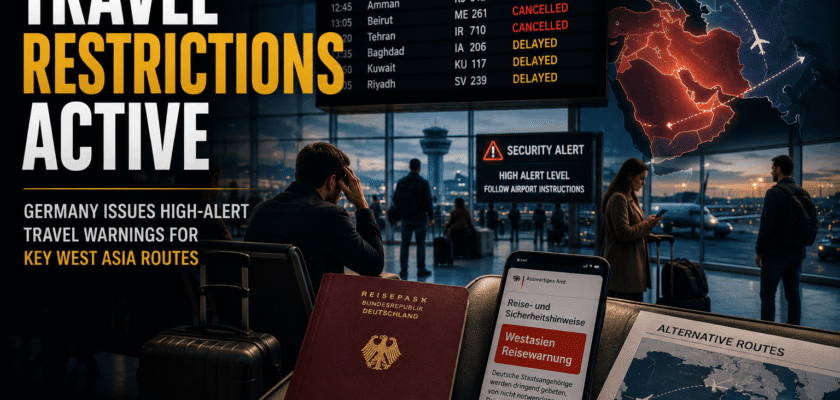
Germany West Asia Travel Warnings: What Changed
Germany West Asia travel warnings have become a major concern for tourists, business travelers and transit passengers because the regional security situation remains highly volatile.
The German Federal Foreign Office currently warns against travel to a broad list of countries and territories, including Israel and the Palestinian territories, Lebanon, Jordan, Syria, Iraq, Iran, Bahrain, Kuwait, Oman, the United Arab Emirates, Saudi Arabia, Qatar and Yemen.
The warning reflects missile and drone attacks, damaged civilian infrastructure, uncertain ceasefire conditions and the risk of sudden airspace restrictions.
Travel Warning Is Not the Same as a Legal Travel Ban
A German travel warning is strong official advice, but it is not automatically a law preventing a person from boarding a flight.
It can still have serious effects:
- Package tours may be cancelled
- Insurers may exclude claims
- Airlines may suspend routes
- Employers may stop business travel
- Consular help may be limited
- Travelers may face evacuation difficulties
- Rebooking costs may rise
The practical result can feel like a restriction even when the border remains technically open.
Which Destinations Are Covered
The German Foreign Office’s regional FAQ lists warnings for:
- Israel and the Palestinian territories
- Lebanon
- Jordan
- Syria
- Iraq
- Iran
- Bahrain
- Kuwait
- Oman
- United Arab Emirates
- Saudi Arabia
- Qatar
- Yemen
The exact warning can differ within each country. Some advice may cover the entire destination, while other pages contain special regional conditions.
Why the Warnings Returned or Tightened
The current warning environment followed renewed military escalation involving the United States, Israel, Iran and Iran-aligned groups.
German official guidance notes attacks on:
- Airports
- Hotels
- Office buildings
- Residential buildings
- Military facilities
- Energy infrastructure
- Maritime traffic
Even after a ceasefire was announced on April 8, Germany continued to describe the regional situation as highly volatile.
Airspace Risk Is the Biggest Practical Problem
Travelers may be affected even when their destination is not directly attacked.
Airlines can face:
- Sudden airspace closures
- Longer diversion routes
- Fuel stops
- Crew-duty limits
- Cancelled connections
- Delayed baggage
- Missed onward flights
- Higher ticket prices
A route through Dubai, Doha, Abu Dhabi, Muscat, Riyadh, Kuwait or Bahrain can be disrupted by regional airspace decisions.
Lufthansa and Route Reallocation
Lufthansa responded to the conflict by reallocating capacity away from cancelled Middle Eastern destinations toward parts of Asia and Africa.
This shows how geopolitical risk changes global travel networks. When Gulf routes become unstable, European airlines may:
- Add alternative Asian services
- Increase direct long-haul flying
- Avoid Iranian airspace
- Recalculate fuel costs
- Reduce reliance on Gulf connections
- Change seasonal schedules
Travelers should not assume an itinerary booked months earlier will operate unchanged.
Iran: The Highest-Risk Route
Germany has maintained a long-standing travel warning for Iran and has urged German citizens to leave when safe departure options are available.
Risks include:
- Military strikes
- Arbitrary detention
- Limited consular support
- Airspace disruption
- Internal security controls
- Internet restrictions
- Border delays
- Terrorism risk
Non-essential travel should not be planned against an active official warning.
Iraq, Syria and Yemen
Iraq, Syria and Yemen already carried major security risks before the latest escalation.
Potential dangers include:
- Armed conflict
- Terrorism
- Kidnapping
- Weak medical access
- Sudden road closures
- Limited evacuation options
- Unexploded weapons
- Local militia activity
These are not suitable destinations for ordinary tourism during active warnings.
Lebanon and Israel Routes
Lebanon and Israel remain affected by cross-border fighting and fragile ceasefire arrangements.
Travelers may face:
- Rocket or drone alerts
- Local evacuation orders
- Airport disruption
- Road closures
- Military checkpoints
- Falling debris
- Rapid changes in safe areas
- Limited insurance coverage
A destination that appears calm in the morning can change by evening.
Kuwait and Bahrain After Missile Attacks
Recent missile attacks placed Kuwait and Bahrain directly inside the regional risk map.
Kuwait International Airport suffered damage in a June 3 attack, while CENTCOM said six of seven Iranian ballistic missiles aimed toward Kuwait and Bahrain were intercepted on June 6.
This means travelers should treat airport status, air-raid alerts and local authority instructions as real operational risks, not distant news.
UAE, Qatar, Oman and Saudi Arabia
These Gulf destinations are major tourism and transit hubs, but they can still be affected by regional missile risk, airspace changes and flight cancellations.
Travelers should check:
- Airport operating status
- Airline notifications
- Local alert systems
- Hotel cancellation rules
- Transit visa requirements
- Alternative routes
- Travel-insurance wording
A luxury tourism hub can remain commercially active while still carrying elevated security risk.
Jordan as a Transit Route
Jordan is often used for tourism, business travel and regional connections. German guidance includes it in the regional warning list because conflict can affect airspace and border security even when civilian facilities inside Jordan have not been directly hit.
Travelers should avoid assuming that a country is unaffected simply because there has been no recent major strike within its borders.
How Travel Insurance May Be Affected
Travel insurance is one of the most important reasons to follow official warnings.
Policies may exclude:
- War
- Terrorism
- Travel against government advice
- Known events
- Evacuation from conflict zones
- Airline insolvency
- Missed connections caused by airspace closure
Before travel, ask the insurer for written confirmation rather than relying only on a sales summary.
Package Tour Rights
German and European package-travel rules can give travelers stronger cancellation rights when extraordinary circumstances seriously affect the destination.
Possible factors include:
- Official travel warning
- Airport closure
- Major security incident
- Inability to provide contracted services
- Unavoidable route changes
Independent flight and hotel bookings may offer less protection than a package tour.
Business Travel Duty of Care
Companies sending staff into the region should conduct a formal risk review.
Employers should provide:
- Approved itinerary
- Emergency contact system
- Secure transport
- Insurance confirmation
- Evacuation plan
- Hotel security review
- Flexible return ticket
- Daily check-in process
- Remote-work alternative
- Clear stop-travel criteria
Business urgency does not remove employer responsibility.
Transit Passengers Are Also Exposed
A passenger may never leave the airport and still face disruption.
Transit risks include:
- Airport closure
- Missed connection
- Unplanned overnight stay
- Visa problems
- Baggage separation
- Hotel shortages
- Rebooking queues
- Medical-access limits
Avoid very short connection times during a volatile period.
What to Check Before Booking
Before paying, verify:
1. German Foreign Office advice
2. Airline operating status
3. Destination airport status
4. Transit-country warning
5. Insurance exclusions
6. Cancellation flexibility
7. Visa rules
8. Backup routing
9. Emergency funds
10. Embassy registration options
Flexible tickets can be more valuable than the cheapest fare.
What to Do If You Are Already There
Travelers already in an affected country should:
- Follow local authority alerts
- Keep passports accessible
- Charge phones and power banks
- Maintain food, water and medicines
- Avoid military and government sites
- Confirm airport status before departure
- Keep cash available
- Register with the German crisis-preparedness list where relevant
- Stay in contact with family
- Leave when authorities advise and a safe route exists
Do not travel toward an airport during an active alert without checking conditions.
Germany’s Safe-Travel Tools
The German Federal Foreign Office provides destination pages and the “Sicher Reisen” travel app.
These tools can help travelers:
- Read current warnings
- Receive updates
- Find embassy contacts
- Review entry rules
- Access emergency guidance
- Prepare documents
Screenshots or offline copies are useful if mobile networks fail.
Why Social Media Is Not Enough
During a security crisis, social media may contain:
- Old videos
- Fake airport-closure claims
- Unverified missile reports
- Rumours of border openings
- False evacuation messages
- Manipulated images
Use official authorities, airlines, airports and established news organizations before changing travel plans.
Flight Refunds and Rebooking
A cancelled flight normally triggers airline rebooking or refund rights, but extra losses may not be covered.
Travelers should keep:
- Booking confirmation
- Cancellation message
- Receipts
- Hotel invoices
- Insurance correspondence
- Screenshots of airport status
- Written airline instructions
Documentation improves the chance of reimbursement.
Alternative Routes to Asia and Africa
Travelers may avoid high-risk Gulf connections by considering:
- Direct European flights
- Istanbul connections, subject to current advice
- Central Asian hubs
- North African routes
- Longer direct services
- Rail-air combinations within Europe
Every alternative has its own visa, weather, connection and security risks.
The Cost of Avoiding West Asia Airspace
Diversions can increase:
- Flight time
- Fuel consumption
- Ticket prices
- Crew costs
- Cargo delays
- Carbon emissions
- Connection risk
Travelers may need to accept longer journeys in exchange for lower exposure to volatile corridors.
Tourism Businesses Face Cancellation Pressure
Hotels, tour operators and destination businesses can suffer even when attractions remain open.
The warning can reduce:
- New bookings
- Group tours
- Corporate travel
- Conference attendance
- Cruise calls
- Airline capacity
- Travel-insurance availability
Regional instability therefore affects tourism far beyond the immediate strike area.
A Traveler Decision Matrix
Consider four factors:
Low destination risk + stable flights:
Travel may remain practical with monitoring.
Elevated warning + flexible itinerary:
Postponement may be wise.
Active attacks + official warning:
Avoid or leave when safely possible.
Essential travel only:
Use professional security, insurance and evacuation planning.
The correct decision depends on personal risk, not only whether tickets are available.
Common Mistakes to Avoid
Do not:
- Treat a travel warning as old news
- Assume a Gulf hub is automatically safe
- Buy non-refundable tickets without insurance review
- Ignore transit-country advice
- Travel near military sites
- Depend on one airline route
- Wait until the airport closes to make a plan
- Share unverified security messages
- Carry medicines without extra supply
- Assume embassy evacuation is guaranteed
Preparation is more reliable than last-minute rescue.
What Could Change the Warnings
Germany may relax or tighten advice depending on:
- Ceasefire implementation
- Missile and drone activity
- Airspace reopening
- Airport safety
- Diplomatic progress
- Terrorism assessments
- Evacuation capacity
- Local medical access
- New attacks on civilians
Warnings can change with little notice.
Final Verdict
Germany West Asia travel warnings reflect a region where tourism, aviation and military risk are now closely connected.
The current official list covers major conflict zones and important Gulf transit hubs. The warning is not automatically a legal travel ban, but it can affect insurance, package-tour rights, airline operations and access to consular support.
In simple words, a flight that is still bookable is not automatically a safe or sensible journey.
Travelers should check the German Federal Foreign Office, airline and destination authorities immediately before booking, before departure and again before travelling to the airport.

