
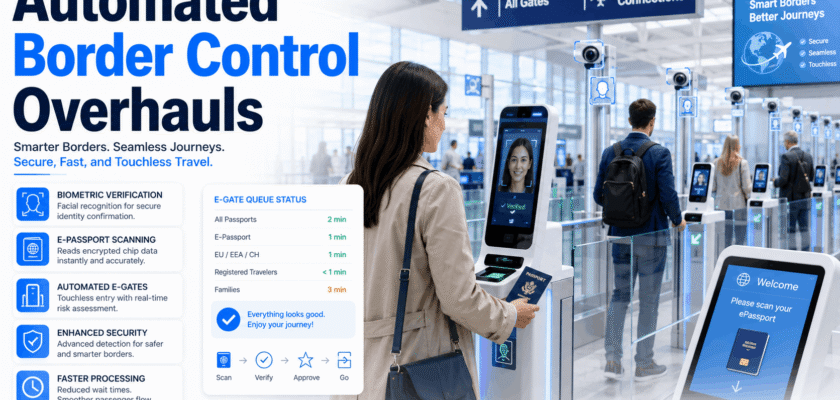
Automated Border Control Overhauls: What Travelers Need to Know
Automated border control overhauls are changing how international passengers move through airports. Instead of only showing a passport to an officer, many travelers now face e-gates, face scans, fingerprint checks and digital entry records.
The shift is meant to make border control faster and more secure over time. However, first-time enrollment can take longer. This is why some passengers are seeing longer queues at busy airports and transit terminals.
The European Union’s Entry/Exit System is a major example. The system registers travel document data, entry and exit details, fingerprints and facial images for many non-EU travelers. It also replaces manual passport stamping.
Therefore, the best travel strategy is simple. Arrive early, keep your passport ready, understand the scan process and avoid tight international connections during rollout periods.
| KEY TAKEAWAYBiometric gates can speed up repeat travel, but the first scan may take longer. Travelers should allow extra time when a country or airport is newly deploying the system. |
Automated Border Control Overhauls and E-Gate Queues
An automated border system usually checks three things. First, it scans the passport chip. Next, it compares the traveler’s face or fingerprints with official records. Finally, it records entry or exit data.
This process can reduce manual stamping. Moreover, it can help authorities detect overstays and identity mismatch faster.
Still, queues can grow during early rollout. Reuters and major travel reports have noted delays linked with Europe’s biometric border checks. IATA also said additional checks had a negative impact on queues in certain tourist locations after full effect in April 2026.
How Biometric Passport Scanners Work
Biometric passport scanners read the chip inside an ePassport. The gate then asks the traveler to look at a camera. In some systems, fingerprints are also collected.
If the scan matches, the gate opens or the officer completes the check faster. If the scan fails, the traveler is sent to manual control.
Failures are not always serious. A glare on glasses, a damaged passport chip, a low-quality camera angle or a changed appearance can cause a manual check.
Who May Face Extra Biometric Checks
✓ Non-EU travelers entering Schengen countries under the Entry/Exit System.
✓ Passengers using a biometric system for the first time.
✓ Travelers with damaged passports or unreadable chips.
✓ Children or older adults when face capture is difficult.
✓ Passengers with name, visa or document mismatches.
✓ Travelers using small airports with limited e-gate capacity.
✓ Passengers transiting through border-control points rather than sterile transfer zones.
| TRAVEL SAFETY BOXDo not book very tight connections during a new biometric rollout. A first-time scan, manual referral or queue surge can easily reduce your transfer buffer. |
Step-by-Step: How to Use a Biometric E-Gate
✓ Step 1: Remove sunglasses, mask and anything that blocks your face.
✓ Step 2: Place the passport photo page on the scanner as shown on the screen.
✓ Step 3: Stand on the marked spot and look directly at the camera.
✓ Step 4: Keep your face still until the system finishes the scan.
✓ Step 5: Place fingers on the scanner if fingerprints are requested.
✓ Step 6: Wait for the gate to open or for an officer to guide you.
✓ Step 7: After crossing, check whether you still need a stamp, receipt or onward check.
How to Avoid Delays at International Transit Terminals
Transit terminals can be confusing because not every connection uses the same border process. Some passengers remain airside. Others must pass immigration, collect bags and re-check in.
Because of this, travelers should study the transit airport before departure. A low-cost airline transfer, separate ticket or terminal change can force border control even when the final destination is elsewhere.
Additionally, biometric systems can slow down when many passengers arrive from long-haul flights at the same time. Early preparation reduces stress.
Transit Checklist
✓ Keep at least three hours for international self-transfer when possible.
✓ Check whether your bags are through-checked or must be collected.
✓ Confirm visa or transit permission before flying.
✓ Keep boarding passes and hotel proof ready.
✓ Carry a pen and offline copies of key documents.
✓ Use the airport’s official connection guide, not random social posts.
What the EU Entry/Exit System Changes
The EU Entry/Exit System records short-stay entries and exits for non-EU nationals visiting the Schengen area. Official EU pages say the system records passport details, biometric data and the date and place of entry and exit.
The Council of the EU says EES automates border registration and helps replace manual passport stamps. For many travelers, this means fingerprints and facial images may be taken at first registration.
Once enrolled, repeat checks should become faster in theory. However, early months can still bring confusion, queue pressure and temporary local adjustments.
Privacy Questions Travelers Should Ask
Biometric travel systems collect sensitive identity data. Therefore, travelers should understand where the data is used and how long it may be stored.
Official systems are not the same as random airport apps. Travelers should avoid sharing passport photos or biometric information through unofficial links.
Moreover, if an airport offers optional biometric boarding or bag drop, read the consent language before agreeing.
Common Traveler Mistakes
⚠ Arriving at the airport with a tight buffer during rollout periods.
⚠ Assuming e-gates are always faster for first-time users.
⚠ Keeping sunglasses or hats on during face capture.
⚠ Using a damaged passport chip without extra time.
⚠ Booking separate-ticket transfers without checking immigration rules.
⚠ Following viral airport advice instead of official instructions.
⚠ Leaving phone battery low when digital confirmations are needed.
How Families Should Prepare
Families should expect slower processing because children may need extra help at gates. Some countries may also require manual control for younger travelers.
Parents should keep passports, boarding passes and consent documents in one folder. If a child travels with one parent, carry any required authorization documents based on destination rules.
Most importantly, keep the group together until an officer or gate system instructs otherwise.
How Business Travelers Should Prepare
Business travelers often book tight schedules. However, biometric border rollouts can disrupt that habit.
To reduce risk, business travelers should choose longer connections, store passport and visa copies offline and avoid same-day meetings immediately after arrival when possible.
Furthermore, frequent travelers should track whether their first biometric enrollment has already been completed. Repeat entry may be smoother after the first registration.
Organic Search Summary for Travelers
Automated border control overhauls are reshaping airport travel. Biometric passport scanners, e-gates and digital entry records can improve speed, but they also create new first-time delays.
Travelers should arrive early, keep documents ready and avoid tight connections at airports where new systems are being deployed.
Above all, passengers should use official airport, airline and government sources because border rules vary by nationality and route.
Conclusion
Automated border control overhauls are becoming a normal part of international travel. The move from passport stamps to biometric gates is meant to improve security and long-term efficiency.
However, the transition period can be messy. First-time scans, airport capacity limits and traveler confusion can create queues.
The safest plan is practical. Arrive early, understand the e-gate process, protect your biometric data and leave more connection time when traveling through newly upgraded terminals.
Frequently Asked Questions
Q. What are automated border control overhauls?
They are upgrades that use e-gates, passport-chip scans, face checks, fingerprints and digital entry records at borders.
Q. Do biometric passport scanners replace officers?
Not fully. Officers still supervise systems and handle manual checks when scans fail.
Q. Will e-gates always save time?
Not always. First-time enrollment can take longer, especially during a new rollout.
Q. What is the EU Entry/Exit System?
It is a Schengen border system that records passport data, biometrics and entry/exit details for many non-EU travelers.
Q. How can I avoid delays?
Arrive early, keep documents ready, avoid tight connections and follow official airport or government instructions.

