
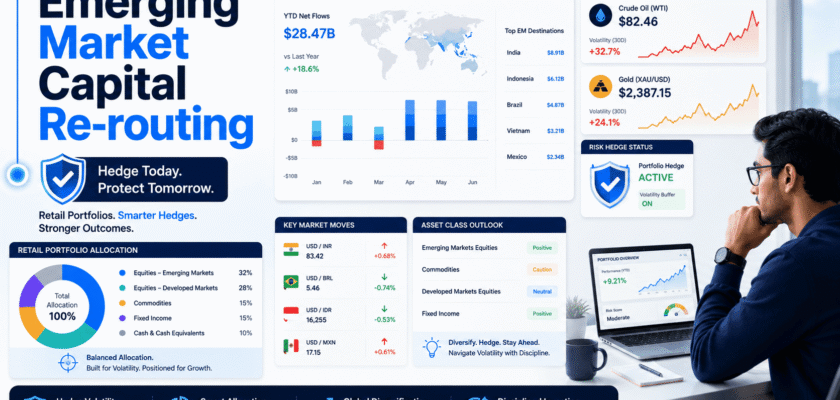
Emerging Market Capital Re-routing: Why Retail Investors Are Rechecking Risk
Emerging market capital re-routing is becoming a key mid-year finance theme. Capital is not leaving every market in the same way. Instead, it is moving between equity, debt, gold, cash and currency hedges as commodity volatility changes risk appetite.
Reuters reported that foreign investors pulled a net $26.6 billion from emerging market portfolios in May 2026. The pressure came mainly from equities, while EM debt still recorded inflows. That split matters for retail investors.
At the same time, oil, gold and currency markets have been unstable. Oil-price swings can hurt import-heavy economies, while gold often attracts demand when investors worry about crisis risk.
Therefore, retail portfolios need a calmer plan. The goal is not to predict every commodity move. The goal is to avoid being overexposed to one shock.
| KEY TAKEAWAYCommodity volatility can affect equities, currencies, inflation and bond yields at the same time. A good retail hedge spreads risk instead of trying to guess the next headline. |
Emerging Market Capital Re-routing and Commodity Volatility
Commodity volatility can change emerging market flows quickly. When oil rises, oil-importing economies may face currency pressure, inflation worries and weaker consumer sentiment. However, oil-exporting markets may benefit.
Gold behaves differently. Reuters reported that a World Gold Council survey showed a record 45% of surveyed central bank reserve managers planned to increase gold holdings within the next year. Many cited crisis reliability and diversification.
This difference explains why capital re-routing is complex. Investors may sell EM equities, buy EM debt, add gold or hold more cash at the same time.
What May Trigger Mid-Year Portfolio Stress
✓ Sharp oil-price moves driven by geopolitical headlines.
✓ Currency pressure in import-heavy emerging economies.
✓ Foreign investor outflows from EM equities.
✓ Higher inflation expectations from energy or food costs.
✓ Rising demand for gold during crisis periods.
✓ Lower market liquidity when traders reduce commodity exposure.
✓ Stronger U.S. rate expectations affecting EM risk appetite.
Why Oil Volatility Matters More Than One Oil Price
Retail investors often ask whether oil is high or low. However, the bigger issue in 2026 is volatility. Reuters reported that investors retreated from the oil market at a record pace as chaos and policy uncertainty made crude difficult to hold.
When liquidity falls, price moves can become sharper. That can affect airline stocks, paint companies, logistics firms, oil marketing companies, currency expectations and inflation-sensitive sectors.
Because of this, a portfolio hedge should not depend on one oil-price forecast. It should work even when the market reverses quickly.
| RISK CONTROL BOXA retail hedge is not a bet. It is a cushion. It should reduce portfolio damage during a shock without destroying long-term growth potential. |
Hedge Layer 1: Gold as a Crisis Buffer
Gold can act as a crisis buffer because it is not directly tied to one company’s earnings. It may also help when currency trust or geopolitical risk becomes a concern.
However, gold is not risk-free. Prices can fall after a sharp rally. In addition, gold does not create business cash flow like a company does.
Therefore, gold works best as a measured allocation, not as an all-in trade. Retail investors can use a small allocation through regulated products based on their country and tax rules.
Hedge Layer 2: High-Quality Debt and Cash
Debt and cash buffers can help investors avoid panic selling. When equity markets fall, a liquid buffer gives investors time.
In emerging market stress, high-quality debt may be more useful than low-quality yield chasing. Reuters noted that EM debt still attracted inflows even when EM equities saw heavy outflows in May 2026.
That does not mean every debt fund is safe. Investors should review duration, credit quality, expense ratio and liquidity.
Hedge Layer 3: Currency and Global Diversification
Commodity shocks often pass through currencies. India, for example, is sensitive to crude oil, gold and other commodity imports. Reuters reported that the rupee’s oil-relief rally was expected to stay limited because of RBI forward-book and hedging factors.
Retail investors can reduce local currency concentration through measured global exposure. However, this should be done carefully because foreign funds also carry currency, tax and valuation risk.
A better approach is gradual diversification. Sudden moves after a crisis headline often create poor entry points.
Hedge Layer 4: Staggered Buying Instead of One Big Switch
Staggering investment can reduce timing risk. During volatile periods, prices can move sharply in both directions.
Instead of shifting the entire portfolio at once, retail investors can rebalance in steps. This keeps emotion lower and avoids one-date decision risk.
Moreover, staggered investing works well when the investor is unsure whether the shock will fade quickly or become a longer cycle.
Retail Portfolio Re-routing Framework
✓ Keep emergency money separate from market investments.
✓ Limit exposure to one commodity-sensitive sector.
✓ Use gold as a small diversifier, not a full portfolio replacement.
✓ Prefer high-quality debt over risky yield chasing.
✓ Add global exposure slowly if it matches the goal.
✓ Rebalance in phases instead of reacting to every headline.
✓ Review currency risk before buying foreign assets.
✓ Keep long-term equity exposure aligned with time horizon.
Sectors That Can React to Commodity Spikes
Commodity swings do not affect every sector equally. Oil-importing sectors may face margin pressure, while energy producers may benefit.
Paint, chemicals, aviation, logistics, FMCG, metals, oil marketing and power businesses can all react differently. Because of this, sector concentration matters.
Retail investors should check whether their mutual funds or stocks already have hidden commodity sensitivity. A diversified fund can still hold many companies exposed to the same input cost.
Common Mistakes During EM Volatility
⚠ Selling all equities after one headline.
⚠ Buying gold only after a sharp rally.
⚠ Chasing low-quality debt for higher yield.
⚠ Ignoring currency risk in foreign funds.
⚠ Overweighting one sector because it performed well last month.
⚠ Confusing hedging with short-term trading.
⚠ Using borrowed money for commodity-linked trades.
⚠ Forgetting taxes and exit loads while rebalancing.
How Indian Retail Investors Can Think About It
Indian retail investors face a special mix of risks. India is a large oil importer, and commodity import costs can affect the rupee, inflation and corporate margins.
However, India also has strong domestic demand and a large savings base. This means the answer is not to avoid equities completely.
Instead, investors can use a balanced approach: quality equity, high-quality debt, a modest gold buffer, emergency cash and limited global diversification.
Organic Search Summary for Retail Investors
Emerging market capital re-routing is a sign that global investors are becoming more selective. Equity outflows, debt inflows, gold demand and oil swings can happen together.
Retail investors should not copy hedge funds or traders. Instead, they should build a cushion that protects long-term goals.
The simplest strategy is disciplined rebalancing. Use cash, quality debt, gold and diversified equity exposure in a controlled way.
Conclusion
Emerging market capital re-routing shows how quickly market leadership can change when commodities become volatile. Oil, gold, currencies and capital flows are now linked through investor confidence.
For retail portfolios, the best answer is not panic. It is structure. Investors should understand what each asset does and avoid overloading one risk.
A measured hedge can reduce stress during mid-year volatility. More importantly, it can keep long-term plans intact when markets react to the next commodity shock.
Frequently Asked Questions
Q. What is emerging market capital re-routing?
It means money moving between EM equities, debt, currencies, gold and cash as investors adjust to risk.
Q. Why does commodity volatility affect retail portfolios?
Commodity swings can affect inflation, currency values, company margins, bond yields and equity sentiment.
Q. Is gold a good hedge for every investor?
Gold can help diversify risk, but the right allocation depends on goals, risk profile and time horizon.
Q. Should retail investors sell EM equities during volatility?
Not automatically. A better approach is to review allocation, risk level and goal timeline before acting.
Q. What is a simple hedge framework?
Use emergency cash, quality debt, measured gold exposure, diversified equity and phased rebalancing.

