
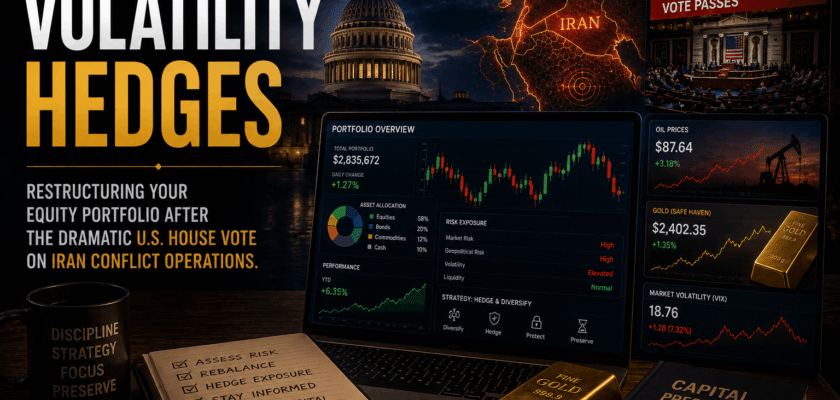
Volatility Hedges: Why Investors Are Rechecking Risk After the Iran Vote
Volatility hedges are back in focus after the U.S. House passed a war powers resolution aimed at limiting President Donald Trump’s military action against Iran. The vote was narrow, but politically important. It showed that even some Republicans are now uncomfortable with the direction of the conflict.
Reuters reported that the House backed the resolution on June 3, 2026, in a 215–208 vote. The measure would direct Trump to stop U.S. military action against Iran unless Congress authorises it, though the resolution still faces the Senate process.
For investors, this matters because geopolitical shocks can move oil, defence stocks, airlines, shipping, gold, currencies, and broad equity sentiment. Therefore, portfolio hedging is no longer only for professional traders. Retail investors also need a simple risk-management plan.
Why Volatility Hedges Matter in 2026
Volatility hedges matter because markets are reacting to political uncertainty, oil risk, and military escalation. The House vote was a clear rebuke to the White House, but it does not automatically end the conflict. AP reported that the House approved the war powers resolution for the first time since the conflict began, with a handful of Republicans joining Democrats.
This creates a mixed signal for markets.
On one side, the vote may reduce fear of unlimited escalation.
On the other side, it may increase political uncertainty between Congress and the White House.
Investors hate uncertainty because uncertainty makes earnings, fuel costs, interest-rate expectations, and risk appetite harder to predict.
That is why volatility hedges are useful.
What Are Volatility Hedges?
Volatility hedges are assets or strategies that help reduce portfolio damage when markets become unstable. They do not guarantee profit. They are designed to reduce downside risk, balance losses, or provide cash during stress.
Common volatility hedges include:
- Cash allocation
- Gold
- Short-duration debt funds
- Defensive sectors
- Low-beta stocks
- Dividend stocks
- Oil and energy exposure
- Currency diversification
- Put options
- Inverse ETFs, where suitable
In simple words, volatility hedges act like a seat belt. They do not stop the accident, but they can reduce injury.
Volatility Hedges and the Iran Conflict
Volatility hedges become important during the Iran conflict because West Asia is linked with oil supply, shipping routes, and global risk sentiment. Even if the U.S. House vote suggests political pushback against military operations, markets will still watch what happens next.
Reuters reported that the broader Gulf flare-up has already affected oil sentiment, with oil prices moving as investors watched the conflict and diplomacy.
Iran-related risk can affect:
- Crude oil prices
- Petrol and diesel expectations
- Airline stocks
- Shipping stocks
- Defence stocks
- Gold prices
- Currency movement
- Emerging markets
- Inflation expectations
- Bond yields
So, the portfolio impact can spread beyond one sector.
The U.S. House Vote: What Investors Should Understand
The U.S. House vote does not mean the war is over. It means Congress is trying to reassert authority over military action. The Guardian reported that the House passed the resolution 215–208 and that four Republicans joined Democrats.
Investors should understand three points:
- The vote is politically important.
- The Senate still matters.
- The White House response can still move markets.
So, this is not a clean “risk off” or “risk on” signal.
It is a volatility signal.
Why Equity Portfolios Need Restructuring
Equity portfolios need restructuring when risk concentration becomes too high. Many retail investors own mostly high-growth stocks, small caps, tech names, or momentum stocks. These can fall sharply when global risk rises.
A portfolio may need restructuring if:
- Too much money is in one sector
- Too much exposure is in small caps
- No cash buffer exists
- No defensive stocks are present
- International risk is ignored
- Oil-sensitive stocks dominate
- Portfolio has high debt companies
- Valuations are stretched
- Stop-loss discipline is missing
- Investor panic risk is high
Restructuring does not mean selling everything. It means balancing risk.
First Step: Check Your Risk Exposure
Before adding volatility hedges, check what you already own. Many investors do not know their true exposure.
Ask:
- How much is in equities?
- How much is in debt or cash?
- How much is in small caps?
- How much is in high-beta stocks?
- How much is in oil-sensitive sectors?
- How much is in defensive sectors?
- How much is international exposure?
- How much is gold?
- What is my emergency fund?
- Can I hold during a 20% fall?
This simple review can prevent emotional decisions.
Cash Is Also a Hedge
Cash is one of the simplest volatility hedges. Many investors ignore cash because it does not look exciting. But during market stress, cash gives flexibility.
Cash helps you:
- Avoid forced selling
- Buy quality stocks at lower prices
- Handle emergencies
- Reduce portfolio anxiety
- Wait for clarity
- Rebalance calmly
- Pay SIPs during volatility
- Avoid bad loans
- Sleep better
A cash buffer is boring, but useful.
For retail investors, 5% to 15% cash or liquid funds can be reasonable depending on risk profile.
Gold as a Geopolitical Hedge
Gold is a classic geopolitical hedge. It often attracts demand when investors worry about war, currency pressure, inflation, or financial stress.
Gold can help during:
- War risk
- Oil shocks
- Currency weakness
- Inflation fear
- Equity sell-offs
- Central bank uncertainty
- Dollar volatility
- Safe-haven demand
However, gold can also be volatile. It should not become your full portfolio.
For many investors, 5% to 10% gold exposure through gold ETFs, sovereign gold bonds, or digital gold alternatives can act as a risk buffer.
Short-Duration Debt Funds for Stability
Short-duration debt funds or liquid funds can provide stability during equity volatility. They are not completely risk-free, but they are usually less volatile than equities.
They can help investors:
- Park emergency money
- Hold tactical cash
- Reduce portfolio swings
- Prepare for buying opportunities
- Avoid panic selling
- Maintain liquidity
- Build a defensive layer
Avoid chasing very high yield in debt funds during uncertain times.
Credit risk can hurt when markets become stressed.
Defensive Sectors Can Reduce Portfolio Shock
Defensive sectors are businesses that people use even during weak markets. These sectors may fall less than high-growth cyclical stocks during panic.
Defensive areas can include:
- FMCG
- Healthcare
- Utilities
- Select telecom
- Insurance
- Essential consumer goods
- High-quality pharma
- Stable dividend companies
These stocks may not always give the highest return in bull markets. But they can reduce drawdowns during stress.
A balanced equity portfolio should include some defensives.
Oil-Sensitive Stocks Need Special Review
Oil-sensitive stocks need special review during Iran-related volatility. If crude oil rises sharply, some companies face higher costs.
Sectors that can be affected include:
- Airlines
- Paints
- Chemicals
- Tyres
- Logistics
- Oil marketing companies
- Transport
- Cement
- Some consumer goods
- Aviation-related services
A short-term oil spike can hurt margins.
Investors should check whether their portfolio is too exposed to companies that suffer when crude rises.
Energy Stocks Can Act as Partial Hedge
Energy stocks can sometimes act as a partial hedge when oil prices rise. Upstream oil and gas producers may benefit from higher crude prices.
However, not all energy stocks behave the same.
Check:
- Is the company upstream or downstream?
- Does it benefit from higher crude?
- Does government pricing affect margins?
- Is debt high?
- Are refining margins stable?
- Is the company exposed to subsidies?
- Does currency movement matter?
Energy exposure can hedge oil risk, but it must be chosen carefully.
Defence Stocks: Hedge or Hype?
Defence stocks often rise during geopolitical tension, but investors must be careful. A news-based rally can become overvalued quickly.
Before buying defence stocks, check:
- Order book
- Execution capability
- Margins
- Valuation
- Government contracts
- Export potential
- Debt level
- Cash flow
- Delivery timelines
- Past performance
Do not buy defence stocks only because war headlines are trending.
A good company at a bad price can still become a bad investment.
Low-Beta Stocks for Lower Volatility
Low-beta stocks usually move less than the broader market. They can help reduce portfolio swings.
Low-beta does not mean no risk. It only means the stock has historically been less sensitive to market movement.
Low-beta portfolios may include:
- Stable large caps
- Mature companies
- Dividend payers
- Defensive sectors
- Regulated utilities
- Strong balance-sheet companies
These stocks can support investors who do not want extreme ups and downs.
Dividend Stocks Can Help During Uncertainty
Dividend stocks can provide regular income and emotional comfort during uncertain markets. Companies that pay consistent dividends often have stable cash flows.
Look for:
- Consistent dividend history
- Strong balance sheet
- Moderate payout ratio
- Stable earnings
- Low debt
- Good governance
- Reasonable valuation
- Sector stability
Do not chase only high dividend yield.
Sometimes high yield is a warning sign if the stock price has fallen due to business problems.
International Diversification
International diversification can reduce country-specific risk. If your entire portfolio is in one market, local shocks can hurt more.
Investors can diversify through:
- U.S. index funds
- Global equity funds
- International ETFs
- Developed market funds
- Global tech exposure
- Gold funds
- Dollar assets
- International debt options
However, international markets can also fall during global panic.
Diversification reduces concentration. It does not remove risk.
Currency Risk and Dollar Exposure
During geopolitical stress, the U.S. dollar can strengthen because investors seek safety. For Indian investors, some dollar exposure may help during rupee weakness.
Dollar exposure can come from:
- International funds
- U.S. ETFs
- Export-oriented companies
- Gold
- Global assets
But currency movement is unpredictable.
Do not overdo dollar exposure only because of one event.
Use it as part of long-term diversification.
Put Options as Advanced Hedges
Put options can protect against downside, but they are not suitable for every investor. Options require knowledge, timing, and risk control.
A put option can help if the market falls sharply. But it also costs premium, and that premium can expire worthless.
Use options only if you understand:
- Strike price
- Expiry date
- Premium cost
- Implied volatility
- Liquidity
- Position size
- Risk-reward
- Tax impact
- Exit plan
- Total portfolio exposure
Retail beginners should avoid complex options without proper learning.
Inverse ETFs and Tactical Hedges
Inverse ETFs rise when the underlying index falls. They can be used for tactical hedging, but they are risky and not suitable for long-term holding.
Problems include:
- Daily reset effect
- Tracking error
- High volatility
- Timing difficulty
- Wrong position sizing
- Emotional misuse
Most retail investors are better served by asset allocation, cash, gold, and defensive exposure instead of aggressive inverse products.
Simple hedges often work better than complex ones.
Rebalancing Is the Most Practical Hedge
Rebalancing is one of the most practical volatility hedges. It means bringing your portfolio back to target allocation.
For example, if your target is:
- 70% equity
- 20% debt
- 10% gold
And after a rally, equity becomes 82%, you reduce some equity and add to debt or gold.
This prevents overexposure.
During panic, rebalancing may also help you buy quality equity when prices fall.
Discipline matters more than prediction.
SIP Investors Should Not Panic
SIP investors should not panic during geopolitical volatility. If your goal is long term, volatility can help you accumulate more units at lower prices.
However, review your funds.
Check:
- Fund quality
- Expense ratio
- Portfolio overlap
- Small-cap exposure
- Risk level
- Time horizon
- Goal alignment
- Emergency fund
- Debt allocation
- Gold exposure
Do not stop SIPs only because headlines look scary.
Stop only if your financial situation changes or the fund no longer fits your plan.
How Much Equity Should You Hold?
The right equity allocation depends on age, income stability, goals, and risk tolerance.
A simple guide:
- High risk, long term: higher equity
- Medium risk: balanced equity and debt
- Low risk: lower equity and higher debt
- Near-term goals: avoid heavy equity
- No emergency fund: reduce risk first
If you need money within 1–3 years, do not keep it mostly in equities.
Market timing is hard. Goal timing is more important.
Emergency Fund Comes Before Hedging
Emergency fund comes before sophisticated hedging. If you do not have 6 months of expenses saved, focus there first.
An emergency fund protects you from:
- Job loss
- Medical costs
- Family emergency
- Business slowdown
- Market crash selling
- Unexpected travel
- Debt pressure
A person without emergency cash may be forced to sell investments during a bad market.
That is the worst time to sell.
Portfolio Example for Moderate Investors
A moderate investor may consider a balanced structure like this:
- 55% to 65% equity
- 20% to 30% debt or liquid funds
- 5% to 10% gold
- 5% cash buffer
- Small international exposure if suitable
This is only a general example, not personal financial advice.
Your exact allocation should depend on your goals, age, income, risk profile, and time horizon.
Portfolio Example for Aggressive Investors
An aggressive investor may still hold higher equity, but should avoid blind concentration.
Possible structure:
- 70% to 80% equity
- 10% to 15% debt
- 5% to 10% gold
- 5% cash
- International exposure inside equity allocation
Even aggressive investors need risk control.
High conviction is not the same as overconfidence.
Portfolio Example for Conservative Investors
A conservative investor should focus on capital protection.
Possible structure:
- 25% to 40% equity
- 40% to 55% debt
- 10% gold
- 5% to 10% cash
- Limited high-risk exposure
This can reduce stress during volatile events.
Conservative investors should avoid chasing defence, oil, or options trades based on headlines.
What Not to Do After the Iran Vote
After the Iran vote, avoid emotional trading.
Do not:
- Sell everything in panic
- Buy defence stocks blindly
- Chase oil stocks after a spike
- Use leverage
- Trade options without knowledge
- Stop SIPs suddenly
- Ignore emergency funds
- Believe every social media prediction
- Overload gold
- Copy influencer portfolios
A good investor reacts with a plan, not panic.
What to Watch Next
Investors should watch the next updates carefully.
Important signals include:
- Senate action on war powers resolution
- Trump administration response
- Oil price movement
- Strait of Hormuz risk
- U.S. dollar movement
- Gold price trend
- Defence stock valuations
- Airline and shipping pressure
- Inflation expectations
- Central bank commentary
The House vote is one event. The market will respond to the full chain of events.
How Indian Investors May Be Affected
Indian investors may be affected through oil prices, rupee movement, foreign institutional flows, inflation expectations, and sector rotation.
India imports a large share of its crude oil needs. So, oil volatility can affect:
- Fuel prices
- Current account pressure
- Rupee sentiment
- Inflation
- Airline margins
- Paint and chemical companies
- Logistics costs
- Market mood
- Bond yields
- Monetary policy expectations
This is why Indian portfolios should not ignore U.S.-Iran conflict risk.
Best Sectors to Review in India
Indian investors should review exposure to sectors sensitive to crude and global risk.
Review:
- Airlines
- Paints
- Tyres
- Chemicals
- Logistics
- Oil marketing companies
- Defence
- Pharma
- FMCG
- IT exporters
This does not mean buy or sell all of them.
It means understand how each sector may react.
Gold vs Equity During Geopolitical Stress
Gold and equity behave differently during stress. Gold may rise when fear increases, while equities may fall if investors reduce risk.
But this relationship is not guaranteed every day.
Gold helps as a hedge because it often responds to:
- War fear
- Currency uncertainty
- Inflation worries
- Safe-haven demand
- Central bank buying
Equity helps long-term wealth creation.
A portfolio needs both growth and protection.
Do Not Over-Hedge
Over-hedging is also a mistake. If you become too defensive, you may miss long-term growth. The goal is not to remove all risk. The goal is to hold the right amount of risk.
Over-hedging can cause:
- Low returns
- High opportunity cost
- Too much cash drag
- Complex portfolio
- Confusing decisions
- Frequent trading
- Tax impact
- Emotional frustration
A hedge should protect your plan, not replace your plan.
Final Verdict
Volatility hedges are important after the U.S. House vote on Iran conflict operations because political uncertainty, oil risk, and market sentiment may remain unstable. The House vote showed bipartisan resistance to continued military action, but it does not instantly end geopolitical risk.
For investors, the best response is not panic. The best response is portfolio discipline.
Hold enough cash, add defensive exposure, consider gold, review oil-sensitive sectors, avoid overconcentration, and rebalance according to your risk profile. Advanced tools like put options or inverse ETFs should be used only by investors who understand them properly.
In simple words, volatility hedges help investors stay calm when headlines become loud.
A strong portfolio is not the one that predicts every crisis. It is the one that survives uncertainty and keeps moving toward long-term goals.


