
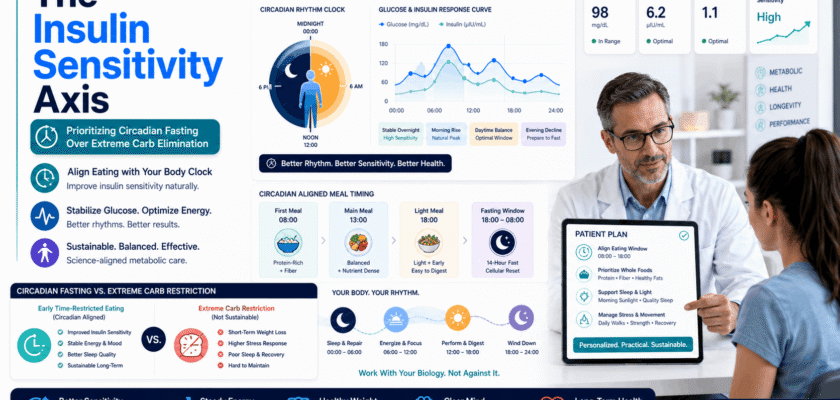
Insulin Sensitivity Axis: Why Meal Timing Is Becoming Central
The insulin sensitivity axis is a simple way to understand how the body handles glucose across the day. It includes insulin response, meal timing, sleep rhythm, liver glucose output, muscle glucose uptake and daily activity.
Modern metabolic clinicians are paying closer attention to this axis because food timing can change glucose patterns. A strict low-carb diet may help some people, but intense carbohydrate elimination is not the only path to better metabolic control.
Circadian fasting, also called time-restricted eating when done in a fixed window, focuses on when food is eaten. It usually works best when the eating window is earlier in the day and aligned with the body clock.
Therefore, the question is shifting. Instead of asking only how many carbs to remove, clinicians are asking when the body is most prepared to process those carbs.
| KEY TAKEAWAYCircadian fasting is not about starving the body. It is about placing meals in a window that may better match natural insulin sensitivity, sleep hormones and daily energy rhythm. |
Insulin Sensitivity Axis and Circadian Fasting
Insulin sensitivity is not flat across the day. Many people handle glucose better earlier than later. This is one reason late-night meals can create larger glucose spikes for some individuals.
A 2026 systematic review found that time-restricted eating improved metabolic outcomes compared with usual diets, and early time-restricted eating was superior to late time-restricted eating. The same review reported reductions in fasting glucose and fasting insulin with early time-restricted eating.
This does not prove that every person should fast. However, it supports the idea that meal timing can be a meaningful lever in metabolic health.
Why Extreme Carb Elimination Is Not Always the First Move
Carbohydrate elimination can lower glucose exposure in some cases. However, it may also be hard to sustain, socially difficult and nutritionally uneven when done without guidance.
Harvard Nutrition Source explains that carbohydrates come in many forms, including sugars, fibers and starches. This matters because beans, fruits, whole grains and vegetables are not the same as sugary drinks or refined snacks.
Because of this, many clinicians prefer improving carbohydrate quality, timing and portion structure before asking a patient to remove an entire food group.
The Four Parts of the Insulin Sensitivity Axis
✓ Circadian timing: eating earlier may match stronger daytime glucose handling.
✓ Meal composition: protein, fiber and healthy fats can slow glucose rise.
✓ Sleep rhythm: poor sleep can worsen hunger and glucose control.
✓ Muscle activity: walking and resistance training improve glucose uptake.
How Circadian Fasting Can Be Practiced More Safely
A safer fasting plan should be realistic. Many people do better with a 10 to 12 hour eating window than an extreme fast.
For example, a person may eat between 8 AM and 6 PM, then avoid late-night snacking. This is not a crash diet. It is a routine that reduces late meals and gives the body a longer overnight rest.
Additionally, the eating window should still include enough protein, fiber, minerals and calories. Fasting is not helpful if it leads to binge eating, fatigue or nutrient gaps.
| PRACTICAL ROUTINE BOXA simple start is a 12-hour overnight fast, such as finishing dinner by 7 PM and eating breakfast at 7 AM. After that, a person may shorten the window only if it feels safe, sustainable and approved by a clinician when needed. |
What Research Says About Timing
Research on circadian nutrition suggests that food timing is connected with glucose control. Reviews on aligning food intake with the circadian clock describe benefits when eating windows match daytime metabolic rhythms.
A 2026 preprint in people with prediabetes found that later eating start was linked with lower insulin sensitivity and hyperinsulinemia, independent of energy intake and other factors. Because it is a preprint, it should be treated as early evidence, not final medical proof.
Other studies are mixed. A German research release in 2025 reported that time-restricted eating without calorie reduction did not improve metabolic health in one study, though it did shift internal clocks. This shows why fasting should be personalized.
Foods That Support the Axis Without Carb Fear
✓ High-fiber carbohydrates such as beans, oats, vegetables and whole grains.
✓ Protein at each meal to support satiety and muscle maintenance.
✓ Healthy fats from nuts, seeds, olive oil or similar foods based on culture and access.
✓ Low-sugar beverages instead of sweet drinks.
✓ Earlier dinners and fewer late-night snacks.
✓ Post-meal walking when possible.
When Circadian Fasting May Not Be Appropriate
⚠ Pregnancy or breastfeeding unless supervised by a clinician.
⚠ History of eating disorders or binge-restrict cycles.
⚠ Use of insulin or glucose-lowering medicines without medical monitoring.
⚠ Underweight status, frailty or active illness.
⚠ Teenagers and children unless advised by a pediatric professional.
⚠ People with shift work who cannot maintain a stable eating rhythm.
Why Sleep and Light Exposure Matter
Circadian fasting works best when sleep is not ignored. Late screens, short sleep and irregular wake times can push hunger and glucose control in the wrong direction.
Morning light, regular sleep timing and earlier meals can support the same rhythm. This does not replace medical care, but it can make a healthy plan easier to follow.
In practical terms, a person should not fast all morning after sleeping at 3 AM and then expect perfect metabolic results. The whole rhythm matters.
A 7-Day Beginner Reset
✓ Day 1: Track normal eating times without changing anything.
✓ Day 2: Move dinner 30 minutes earlier.
✓ Day 3: Stop sweet drinks after sunset.
✓ Day 4: Add protein and fiber to breakfast or first meal.
✓ Day 5: Walk for 10 minutes after the largest meal.
✓ Day 6: Try a 12-hour overnight fast if safe.
✓ Day 7: Review energy, hunger, sleep and cravings before changing more.
What Clinicians May Track
✓ Fasting glucose and post-meal glucose patterns.
✓ HbA1c when medically appropriate.
✓ Fasting insulin or HOMA-IR when ordered by a clinician.
✓ Waist circumference and body composition trends.
✓ Sleep duration and meal timing consistency.
✓ Medication safety if the patient uses diabetes drugs.
Organic Search Summary for Readers
The insulin sensitivity axis connects meal timing, sleep rhythm, muscle activity and carbohydrate quality. This is why circadian fasting is gaining attention.
Extreme carb elimination is not always the first or best step. A more balanced approach can focus on earlier eating, better carbs, protein, fiber and movement.
The safest plan is personalized. People with medical conditions should get professional guidance before using fasting as a health tool.
Conclusion
The insulin sensitivity axis shows that metabolic health is not controlled by carbohydrates alone. Timing, sleep, movement and meal quality all play important roles.
Circadian fasting may help some people because it aligns eating with the body clock. However, it should be done gently, safely and without extreme restriction.
For many readers, the strongest first step is simple: eat earlier, reduce late snacking, improve carbohydrate quality and move after meals. That approach is easier to sustain than panic-driven carb elimination.
Frequently Asked Questions
Q. What is the insulin sensitivity axis?
It is the interaction between insulin response, glucose control, meal timing, sleep rhythm, muscle activity and food quality.
Q. Is circadian fasting the same as intermittent fasting?
It is a form of time-based eating that focuses on aligning the eating window with the body clock, often earlier in the day.
Q. Is cutting carbs bad?
Not always. Some people benefit from reducing refined carbs, but extreme carbohydrate elimination is not necessary or safe for everyone.
Q. Can people with diabetes try fasting?
Only with medical guidance, especially if they use insulin or glucose-lowering medicines.
Q. What is a simple first step?
Finish dinner earlier, avoid late-night snacks and add protein plus fiber to meals.


