
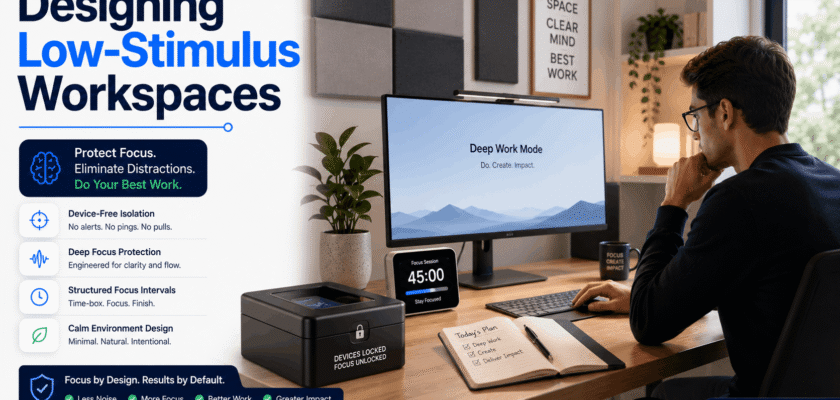
Low-Stimulus Workspaces: Why Solo Operators Need a Focus Zone
Low-stimulus workspaces are becoming a serious productivity tool for solo operators. A freelancer, founder, writer, coder or creator may work alone, but the workspace is rarely quiet. Phones, tabs, messages and quick notifications keep pulling attention away from deep work.
High-performance solo operators often need long blocks of clear thinking. However, modern devices create constant micro-interruptions. Each alert may feel small, yet the total cost becomes heavy.
The American Psychological Association explains that switching between complex tasks takes a toll on productivity. That finding matches what many solo workers feel every day: the mind needs time to return after interruption.
Therefore, low-stimulus workspaces are not about aesthetic minimalism only. They are a practical system for protecting attention, reducing decision fatigue and creating stronger work output.
| KEY TAKEAWAYA low-stimulus workspace removes unnecessary signals before willpower is needed. The strongest focus system is designed into the room, not forced through motivation alone. |
Low-Stimulus Workspaces and Device-Free Isolation Intervals
Device-free isolation intervals are planned blocks where the phone, extra screen and non-essential notifications are physically removed. This is stronger than silent mode because the device is not within easy reach.
For solo operators, this matters because nobody else protects the schedule. Without boundaries, every app can become a boss. A device-free interval turns the workspace into a single-task zone.
The interval does not need to last all day. Even 45 to 90 minutes can create a deep-work window if the task is clear and the environment is stable.
Why Notification Silence Is Not Enough
Silent mode still leaves temptation visible. A phone on the desk can trigger checking behavior even without a sound.
Workspace design should reduce the need to resist. Put the phone in another room, inside a drawer or in a visible phone box away from the desk.
Asana describes deep work as distraction-free concentration that helps people learn difficult things and create higher-quality work. Device-free intervals support that state by removing the fastest source of context switching.
The Four Zones of a Low-Stimulus Workspace
✓ Focus zone: one desk, one screen and one active task.
✓ Capture zone: a notebook or card for ideas that appear during work.
✓ Recovery zone: a chair, floor mat or small corner for five-minute breaks.
✓ Device parking zone: a fixed place where the phone stays during focus intervals.
How to Design a Device-Free Isolation Interval
✓ Step 1: Choose one task before the interval begins.
✓ Step 2: Move the phone away from the desk.
✓ Step 3: Close extra browser tabs and unused apps.
✓ Step 4: Set a visible timer for 45, 60 or 90 minutes.
✓ Step 5: Keep one capture notebook for distracting thoughts.
✓ Step 6: Take a short reset break before checking messages.
| FOCUS DESIGN BOXThe best interval is not the longest one. It is the one you can repeat daily without breaking your schedule. Start with one protected block and expand slowly. |
Visual Rules for a Cleaner Desk
✓ Keep only the tools needed for the current task.
✓ Use one notebook instead of loose sticky notes everywhere.
✓ Hide cables where possible to reduce visual noise.
✓ Use soft lighting that does not create glare on the screen.
✓ Keep food, random bills and unrelated objects away from the focus zone.
✓ Use a simple desk tray for items that must stay nearby.
Digital Rules for Solo Operators
A low-stimulus room can fail if the computer is chaotic. The digital workspace needs the same discipline as the physical desk.
Close messaging apps during focus intervals unless the task requires them. Use full-screen mode for writing, design or coding. Keep a separate browser profile for deep work if needed.
Most importantly, use a clear start ritual. When the workspace becomes predictable, the brain enters work mode faster.
Why Solo Operators Struggle More With Context Switching
Team employees may have managers, calendars and meeting structures. Solo operators must create their own structure. This freedom is powerful, but it can also become scattered.
Every context switch steals planning energy. A creator may move from script writing to WhatsApp, then to analytics, then to email, then back to writing. The task is never fully finished, and the mind feels tired.
Low-stimulus workspaces reduce that pattern by making the next correct action obvious.
Common Mistakes to Avoid
⚠ Buying expensive desk products without changing habits.
⚠ Keeping the phone face down but still on the desk.
⚠ Using two or three monitors for every task, even when one screen is enough.
⚠ Starting focus time without a clear output target.
⚠ Checking messages during the first small moment of discomfort.
⚠ Turning the workspace into a storage corner.
⚠ Trying to create a perfect setup instead of a repeatable setup.
A 7-Day Low-Stimulus Workspace Reset
✓ Day 1: Remove ten items from the desk.
✓ Day 2: Create a phone parking zone.
✓ Day 3: Choose one daily 45-minute device-free interval.
✓ Day 4: Switch off non-essential desktop notifications.
✓ Day 5: Use one notebook for capture thoughts.
✓ Day 6: Create a simple shutdown checklist.
✓ Day 7: Review which rule produced the best focus improvement.
How to Keep the System Realistic
The workspace should support real life. A parent, founder or freelancer may not have perfect silence all day. That is fine.
The goal is to create predictable islands of focus. Even one protected interval can improve the quality of the day.
If the system feels too strict, reduce the interval length. A practical workspace beats a perfect workspace that nobody uses.
Organic Search Summary for Readers
Low-stimulus workspaces help solo operators reduce distraction by designing the room, desk and digital tools around attention.
Device-free isolation intervals are useful because they remove the fastest trigger for checking behavior. They make deep work easier to start and easier to repeat.
The best setup is simple: one task, one screen, low visual noise, phone away, and a clear end time.
Conclusion
Low-stimulus workspaces are no longer a luxury. For solo operators, they are a practical productivity system.
By removing unnecessary signals and enforcing device-free isolation intervals, workers can protect deep focus without depending on motivation alone.
The result is a cleaner mind, a cleaner desk and stronger output from the same working hours.
Frequently Asked Questions
Q. What are low-stimulus workspaces?
They are work environments designed to reduce visual, digital and sound distractions so focus becomes easier.
Q. What is a device-free isolation interval?
It is a planned work block where the phone and non-essential devices are kept away from the desk.
Q. How long should a focus interval be?
Start with 45 minutes. Increase to 60 or 90 minutes only if it feels repeatable.
Q. Do I need a separate room?
No. A clean desk corner can work if the phone is parked elsewhere and interruptions are reduced.
Q. Is this only for creators?
No. Writers, founders, students, coders, consultants and remote workers can all use it.


