
Green Shipping Matrix: Why Commercial Fleet Logistics Is Changing
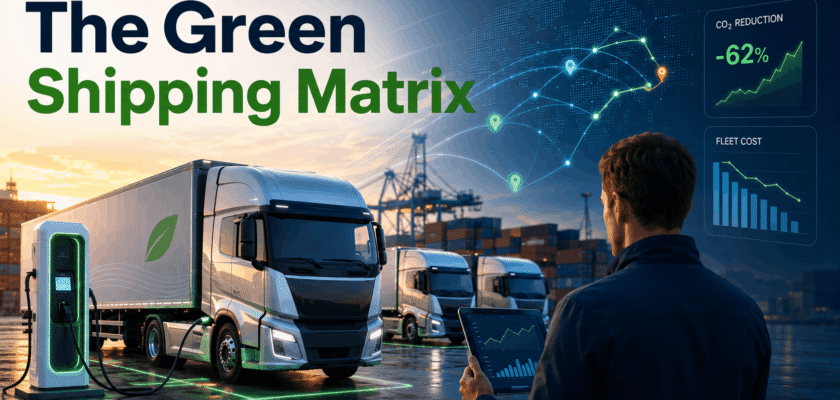
Green shipping matrix is becoming a useful way to understand the next phase of EV commercial fleet logistics. Large companies are no longer looking only at electric trucks. They are also looking at charging hubs, route planning, AI decision tools and carbon accounting.
Saint-Gobain gives one clear real-world signal. In 2026, Saint-Gobain and XPO Logistics added six fully electric HGVs to UK operations, with charging infrastructure at a Nottinghamshire logistics hub. XPO said the investment could reduce CO2e emissions by almost 800,000 kg per year.
Mistral AI gives another signal from the software side. CMA CGM announced a five-year, €100 million partnership with Mistral AI to develop AI solutions for shipping, logistics and media operations. That shows how logistics groups are moving AI into routing, documents and customer workflows.
Together, these two trends explain the green shipping matrix. Hardware reduces tailpipe emissions. Software reduces wasted miles, idle time, paperwork delays and poor route choices.
| KEY TAKEAWAYThe green shipping matrix is not only about buying electric trucks. It is about combining EV fleets, fast charging, AI route planning, emissions data and depot scheduling into one operating system. |
Green Shipping Matrix and EV Commercial Fleet Logistics
EV commercial fleet logistics works differently from diesel logistics. A diesel truck can refuel quickly almost anywhere. An electric HGV needs route planning around range, charging speed, load weight and depot availability.
This is why the matrix matters. Fleet managers must match vehicle range with delivery distance, charging capacity with daily cycles, and emissions goals with customer service promises.
Saint-Gobain and XPO Logistics described a back-to-base charging model in which six charging points can charge eHGVs to 80% in about 90 minutes and fully charge them in under two hours. That type of depot model can make EV logistics more predictable.
What Saint-Gobain’s eHGV Trial Shows
✓ Electric HGVs are moving from pilot talk to real delivery operations.
✓ Back-to-base charging can reduce range anxiety for fixed regional routes.
✓ Depot infrastructure is as important as the truck purchase.
✓ Customer feedback and driver feedback matter during scale-up.
✓ Multi-year trials can produce useful data on cost, uptime and emissions.
✓ Green logistics can support both sustainability reporting and commercial reputation.
How Mistral AI-Style Logistics Intelligence Fits the Matrix
AI can improve fleet logistics when it is connected to real operating data. A route tool can compare delivery windows, battery range, loading schedules, port delays, weather risk and customer priority.
CMA CGM said its Mistral AI partnership would support shipping and logistics operations with custom AI solutions. Its stated areas included customer experience, automated claims, intelligent e-commerce tools and document management.
For commercial EV fleets, this type of AI logic can later support route planning, exception handling and cost prediction. The important point is not the brand name alone. It is the operating shift from manual decisions to data-led decisions.
| OPERATIONAL LENSAn EV truck saves emissions only when the route, load, charging window and delivery plan fit together. AI can help connect those variables before the truck leaves the depot. |
How the Matrix Can Reduce Transit Costs
Reducing corporate supply chain transit costs does not come from one single move. It comes from removing many small forms of waste.
A poorly planned EV route can create waiting time at chargers. A late document can delay port movement. A missed maintenance signal can remove a vehicle from service. Each problem adds cost.
The green shipping matrix connects these problems. It allows the fleet team to compare cost per route, energy per delivery, emissions per shipment and service reliability together.
Cost Levers Fleet Managers Should Track
✓ Energy cost per kilometer versus diesel cost per kilometer.
✓ Depot charging time and charger utilization.
✓ Driver waiting time during loading and charging.
✓ Vehicle uptime and maintenance downtime.
✓ CO2e reduction per customer delivery.
✓ Route density and return-load efficiency.
✓ Document delays and claims processing time.
✓ Battery range under heavy load and bad weather.
Why High-Yield Partnerships Matter
High-yield partnerships matter because no single company controls the full green logistics chain. A building-materials company needs logistics partners. A shipping group needs AI partners. A fleet needs charging partners. A depot needs grid and infrastructure support.
Saint-Gobain’s project includes XPO Logistics, Volvo electric trucks and Gridserve charging support. This shows the partnership model clearly.
Mistral AI’s enterprise partnerships show the other side. Logistics companies want AI systems that understand industrial workflows, not only generic chat tools. This is why the next winner may be the company that integrates trucks, chargers and data into one repeatable workflow.
Risks in EV Fleet Logistics
⚠ Electric HGV range can fall under heavy loads or difficult weather.
⚠ Charging queues can reduce delivery reliability.
⚠ Upfront truck and infrastructure costs can be high.
⚠ Grid capacity can limit depot expansion.
⚠ AI tools may give weak recommendations if data quality is poor.
⚠ Maintenance teams need training for electric drivetrains.
⚠ Customers may not accept slower delivery windows during early trials.
The Ideal Green Shipping Matrix Workflow
A strong green shipping matrix starts before dispatch. The system checks order priority, delivery distance, vehicle range, driver hours, charger availability and customer time windows.
Next, it assigns the best vehicle and route. If the route is too long for one battery cycle, the plan changes before the truck leaves the depot.
Finally, the system records emissions and cost data after delivery. That feedback improves future planning and helps the company prove the value of green logistics.
Simple Operating Flow
✓ Map the delivery lane.
✓ Match the vehicle to the lane.
✓ Reserve the charging window.
✓ Check load and range risk.
✓ Run the AI route-cost model.
✓ Dispatch with live exception alerts.
✓ Record cost, delay and CO2e data after delivery.
What This Means for Indian Commercial Fleets
Indian commercial fleets can learn from these European trials, but the model must be localized. India has different road conditions, depot locations, electricity tariffs and delivery patterns.
For India, the first practical use cases may be fixed-route urban delivery, factory-to-depot movement, airport cargo support and regional hub distribution.
The strongest adoption will likely come where routes are predictable and charging can happen at a home depot. That is where EV fleet economics are easier to measure.
Organic Search Summary for Readers
The green shipping matrix connects electric commercial vehicles, charging hubs, AI logistics tools and emissions tracking. It helps companies understand how to reduce transport cost and carbon together.
Saint-Gobain’s electric HGV deployment shows the hardware side of the shift. Mistral AI-linked logistics partnerships show the software side.
For fleet operators, the lesson is clear. EV logistics works best when trucks, chargers, routes, documents and emissions data are planned as one system.
Conclusion
The Green Shipping Matrix is becoming a new framework for commercial fleet logistics. It is not enough to electrify vehicles and hope for lower costs.
Companies need charging infrastructure, route intelligence, AI-supported workflows and reliable emissions measurement. Saint-Gobain’s eHGV trial and Mistral AI’s logistics partnerships show both halves of that transition.
The future of EV commercial fleet logistics will belong to operators that combine clean vehicles with smarter decisions. That is where green shipping can become both sustainable and commercially useful.
Frequently Asked Questions
Q. What is the green shipping matrix?
It is a framework that connects EV fleets, charging infrastructure, AI route planning, emissions data and logistics cost control.
Q. Did Saint-Gobain and Mistral AI announce a direct joint deal?
No verified direct joint partnership was found. This article analyzes their parallel logistics signals: Saint-Gobain on EV fleet deployment and Mistral AI on AI logistics partnerships.
Q. How can EV fleets reduce transit costs?
They can reduce energy cost, emissions cost and downtime when routes, charging and depot schedules are planned correctly.
Q. Why does AI matter in green shipping?
AI can help optimize routes, documents, exceptions, customer service and capacity planning.
Q. Can Indian fleets use this model?
Yes, especially on predictable hub-to-depot, urban delivery and factory logistics routes where charging can be planned.


