
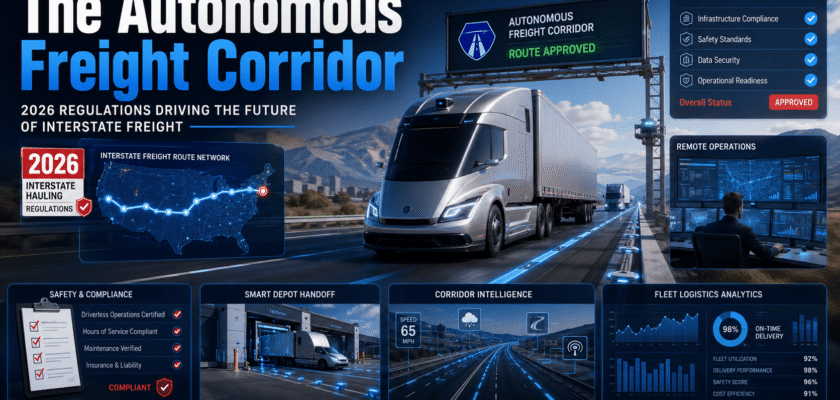
Autonomous Freight Corridor: Why 2026 Is Different
The autonomous freight corridor is now moving from test lane to operating model. The change is slow, but it is real.
In 2026, fleets are not only asking if driverless trucks can work. They are asking where they can run, who approves them, and how safety duties are shared.
This is why interstate hauling rules matter. A truck may cross state lines, but every lane still needs clear permits, safe routes, remote support, and emergency plans.
So, long-distance logistics is becoming a corridor business. The best fleets will plan lanes, hubs, data checks, and compliance together.
| KEY TAKEAWAYAutonomous trucking is not only a vehicle story. It is a route, rule, depot, data, and safety story. |
Autonomous Freight Corridor Rules Are Reshaping Fleet Plans
Self-driving freight regulations are becoming more detailed. Texas is a strong example.
TxDMV says all companies operating automated vehicles commercially on or after May 28, 2026, must maintain active authorization.
Texas law-enforcement guidance also says commercial AV operators must file a First Responder Interaction Plan. They must also receive state authorization before operating.
Therefore, fleet managers cannot treat autonomous routes like normal routes. They need legal checks before the dispatch plan is built.
What Fleet Logistics Automation 2026 Really Means
Fleet logistics automation 2026 is not just about removing a driver from the cab. It is about redesigning the whole freight chain.
A common model is hub-to-hub freight. Human drivers handle the first and last miles. Then an autonomous truck covers the controlled middle mile.
This can reduce fatigue exposure on long highway runs. It can also make trailer handoffs more predictable.
However, the model needs strong depots. It also needs trained staff, clean data, and fast incident response.
The Regulatory Checklist for Driverless Freight Lanes
✓ State authorization before commercial operation.
✓ First responder interaction plans for police and fire teams.
✓ Clear operational design domain limits.
✓ Crash reporting under NHTSA rules where applicable.
✓ Remote support rules for stuck or stopped vehicles.
✓ Insurance coverage for driverless operation.
✓ Depot handoff rules for trailers and loads.
✓ Cybersecurity controls for vehicle and route data.
Why Interstate Hauling Rules Are Harder Than Local Testing
Local tests are easier to control. Interstate hauling is harder.
A long-haul lane may cross weather zones, road-work areas, weigh stations, and different state rules. It also needs clear response plans if the truck stops on the shoulder.
FMCSA gave Aurora a short waiver in January 2026 for warning-device rules. It covered Level 4 ADS commercial vehicles and allowed cab-mounted warning beacons for a defined period.
That example shows the larger point. Driverless trucks may need small rule changes before they can scale safely.
| FLEET SAFETY BOXA driverless truck lane should not go live only because the truck can drive. It should go live when the route, depot, law-enforcement plan, insurance, and data rules are ready. |
How Autonomous Commercial Trucking Routes Are Being Built
The first strong lanes are not random. They are usually repeatable routes with stable freight demand.
Aurora said in February 2026 that it had validated driverless operations on the Fort Worth to Phoenix lane. The company described the lane as about 1,000 miles long.
That route matters because it goes beyond normal human hours-of-service limits. It also shows why autonomous lanes may focus on long, repeatable highway corridors first.
Still, route expansion depends on software, mapping, safety cases, state rules, and customer demand.
How This Changes Long-Distance Fleet Logistics
✓ Dispatch teams must plan by approved lane, not only by destination.
✓ Depots become control points for trailer handoffs.
✓ Maintenance teams must track sensors and autonomy hardware.
✓ Safety teams need incident playbooks for each route.
✓ Insurance teams need clearer risk records.
✓ Shippers may ask for route-level uptime proof.
✓ Human drivers may shift to regional and final-mile roles.
The Role of NHTSA Crash Reporting
Crash reporting is a major part of public trust.
NHTSA says its Standing General Order helps it receive timely crash notifications for ADS and Level 2 ADAS vehicles. The agency can then investigate safety concerns.
For fleets, this means autonomous operations should be data-ready. If an incident happens, the company must know what happened, where it happened, and what system was active.
In simple terms, compliance is now part of fleet uptime.
What Shippers Should Ask Before Using a Driverless Lane
✓ Is the lane approved for commercial operation?
✓ Which state rules apply to the route?
✓ Who handles first-responder contact?
✓ What happens if the truck stops mid-route?
✓ How are delays reported to the shipper?
✓ How is cargo security managed?
✓ What backup capacity exists if autonomy is paused?
✓ Which data is shared after each trip?
Main Risks Fleet Leaders Must Manage
⚠ Patchwork state rules can slow route expansion.
⚠ Bad weather can affect route reliability.
⚠ Remote support must be fast and clear.
⚠ Public trust can fall after one visible incident.
⚠ Cybersecurity risks can hit vehicle data and dispatch systems.
⚠ Maintenance teams need new skills.
⚠ Labor planning may become sensitive.
⚠ Insurance pricing may change as data grows.
A Practical Pilot Plan for Fleet Operators
A fleet should not start with every route. It should start with one simple lane.
First, choose a steady highway route. Next, check state rules and depot support. Then run supervised trials before deeper automation.
After that, measure safety events, on-time rate, fuel or energy use, maintenance alerts, and customer service issues.
If the route performs well, the fleet can add more lanes slowly.
Pilot Scorecard
✓ Approved route and permit status.
✓ First responder plan on file.
✓ Clear weather and ODD limits.
✓ Depot staff trained for handoff.
✓ Remote support time measured.
✓ Incident reports reviewed weekly.
✓ Customer delivery score tracked.
✓ Backup truck plan ready.
What This Means for Indian Fleet Operators
India can learn from the U.S. lane model. Long routes need rules before scale.
For India, the first value may come from assisted driving, digital fleet control, driver monitoring, and route automation. Fully driverless interstate freight will need deeper legal and road-safety planning.
However, the direction is useful. Fleets that prepare clean data, strong depots, and digital compliance will adapt faster when autonomous rules mature.
Organic Search Summary for Readers
The autonomous freight corridor is changing fleet logistics in 2026. The core shift is from vehicle testing to route approval.
Self driving freight regulations now shape where trucks can operate. They also shape how fleets report incidents and support first responders.
The winning model is likely hub-to-hub freight. It keeps autonomous trucks on planned highway lanes and keeps humans close to complex local delivery.
Conclusion
The autonomous freight corridor is not a future slogan anymore. It is becoming a regulated freight system.
In 2026, the big question is no longer only technical. It is also legal, operational, and social.
Fleet leaders that combine compliance, route design, depot planning, and safety data will move first. Others will wait for the rules to become clearer.
Frequently Asked Questions
Q. What is an autonomous freight corridor?
It is a planned freight lane where driverless or highly automated trucks run under defined route, safety, and regulatory rules.
Q. Are driverless trucks legal on all U.S. interstates?
No. Rules vary by state. Operators still need to follow federal safety rules and state authorization where required.
Q. Why is Texas important for autonomous trucking?
Texas has major freight lanes. It also requires commercial AV operators to hold active TxDMV authorization from May 28, 2026.
Q. What is hub-to-hub autonomous freight?
It is a model where autonomous trucks handle highway miles between depots. Human drivers cover first and last miles.
Q. Will autonomous trucks remove all drivers?
Not quickly. Many models still need human drivers for local delivery, depot work, support, and complex routes.


