
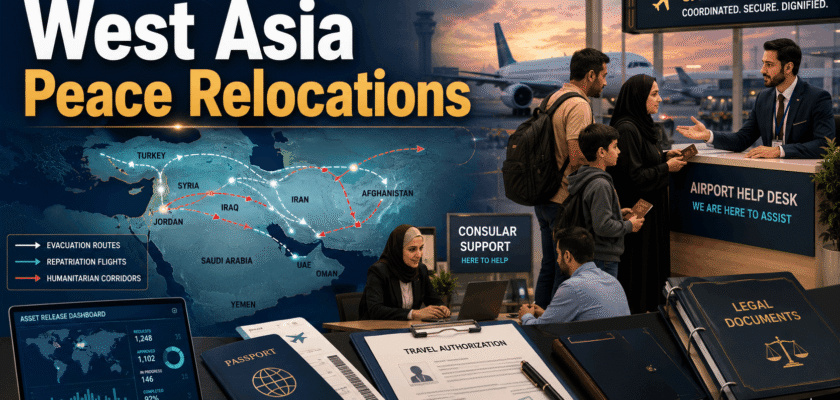
West Asia Peace Relocations: Why the Policy Question Matters
West Asia peace relocations are now a policy issue, not only a travel issue. When regional tension rises, workers, students, seafarers and families need safe routes home. They also need legal help, wage support and reintegration planning.
In 2026, India used consular outreach, aviation routes and maritime support to assist citizens affected by the West Asia crisis. Official updates and public reports show large-scale returns from the Gulf and specific repatriation support for Indian seafarers.
At the same time, emergency asset releases inside India became part of the stability plan. PIB reported that about Rs 17,744 crore was being released as the first wage-component instalment under MGNREGA during the West Asia crisis briefing.
Therefore, this story is bigger than one evacuation flight. It is about how states connect emergency money, legal channels and worker protection when a regional shock spreads across borders.
| KEY TAKEAWAYA safe return plan has three layers: rescue, legal processing and reintegration. If any layer is weak, families can return home but still face debt, lost wages or weak job options. |
West Asia Peace Relocations and Emergency Asset Release
Emergency asset release can mean different things in a crisis. It may include wage liquidity, travel assistance, consular support, insurance processing or rapid domestic scheme disbursal.
In India’s 2026 West Asia briefing, the most clearly verified large public figure is the Rs 17,744 crore MGNREGA wage-component release. That fund was not described as a direct repatriation fund. However, it shows how governments protect domestic liquidity when global tension may affect jobs and prices.
For returned workers, this matters because many families depend on overseas income. If a worker comes back suddenly, local income support and fast administrative help can reduce financial stress.
What a Repatriation Legal Framework Should Cover
✓ Emergency contact and consular registration.
✓ Safe exit routes by air, sea or land.
✓ Temporary travel document support.
✓ Wage claims and contract dispute channels.
✓ Insurance, death benefit and medical claim support.
✓ Legal aid for stranded workers and seafarers.
✓ Returnee skill mapping and domestic job matching.
✓ State-level reintegration support for families.
What Current Official Updates Show
MEA said in March 2026 that more than 52,000 Indians had availed flights from the Gulf region by March 7. Later public reporting and parliamentary updates continued to track citizen safety, advisories and repatriation support.
PIB also reported on April 20, 2026 that more than 2,563 Indian seafarers had been safely repatriated from locations across the Gulf region. This shows that maritime workers need a separate support channel from air passengers.
These facts do not prove one single multi-billion repatriation fund. However, they do prove that evacuation, seafarer safety and domestic liquidity were all part of the crisis response.
| FACT-CHECK BOXConfirmed: large-scale returns, seafarer repatriation, control-room style consular outreach, and domestic wage liquidity measures. Not confirmed: one official standalone fund with the exact name “West Asia Peace Relocations”. |
Why Overseas Worker Deployment Rules Need Updating
Overseas worker deployment is not only about sending workers abroad. It must also include a return plan. A crisis can close airspace, stop work sites, disrupt wages and trap workers between employers and borders.
NITI Aayog’s 2026 States Framework on International Mobility says bilateral agreements should create legal frameworks for worker mobility with destination countries. It also highlights fair wages, safe conditions and dispute resolution in MoUs.
This is important because a worker should not depend only on a private recruiter during a crisis. The legal framework should identify who pays, who records the case and who helps the worker return.
The Three-Part Peace Relocation Model
1. Emergency Exit
The first goal is safe exit. Governments need embassy hotlines, verified travel advisories, transit permissions and evacuation coordination with airlines, ports and neighboring states.
Seafarers also need vessel-level tracking. Their risks can be very different from airport passengers.
2. Legal Clearance
The second goal is legal clearance. Workers may need exit permits, passport help, contract proof, wage claim documents and insurance forms.
Without legal support, a worker can reach home but lose unpaid salary, injury claims or return rights.
3. Reintegration
The third goal is reintegration. Returnees may need local jobs, credit support, skill recognition, mental-health support and family income planning.
IOM says safe, dignified and rights-based return and sustainable reintegration are key to protecting migrant rights. That principle fits the West Asia worker context.
What States Can Do Faster
✓ Create district-level returnee registration desks.
✓ Map skills of returning workers within 15 days.
✓ Link returnees to local contractors, industries and skill centres.
✓ Create wage-claim help desks with embassy records.
✓ Offer temporary income support when verified overseas income is disrupted.
✓ Use digital lockers for passport, contract and insurance proof.
✓ Track recruiters involved in unsafe deployment.
✓ Build state-to-destination-country MoUs for future deployment.
Why Reintegration Cannot Wait
A sudden return can create a debt shock. Many migrant workers borrow money for recruitment, travel and family needs. If income stops, the household can face pressure within weeks.
That is why reintegration should begin before the worker reaches home. Embassy lists, flight manifests, state portals and district data can help identify who needs support.
Moreover, reintegration should not end with a one-time payment. The stronger model connects skills, local demand and safe future migration routes.
Risks in a Weak Repatriation System
⚠ Workers may return without unpaid wages.
⚠ Families may fall into emergency debt.
⚠ Seafarers may face delayed claim settlement.
⚠ Recruiters may avoid accountability.
⚠ States may not know how many skilled returnees arrived.
⚠ Women and low-wage workers may lack legal support.
⚠ Informal workers may disappear from official tracking.
How Bilateral Migration Policies Can Improve
Bilateral migration policies should do more than open job routes. They should also define crisis return rules.
A strong agreement can mention employer duties, emergency wages, medical care, dispute resolution, safe housing and exit procedures. It can also set data-sharing rules for workers who are stranded.
This reduces confusion when a crisis starts. It also protects both sides from panic, misinformation and illegal intermediaries.
What Families Should Track During a Crisis
✓ Passport copy and visa page.
✓ Employer name and worksite address.
✓ Recruiter details in India and abroad.
✓ Insurance documents and nominee details.
✓ Emergency embassy contacts.
✓ Salary proof and pending wage records.
✓ Flight, ship or transit details.
✓ Medical records if injury or illness is involved.
Organic Search Summary for Readers
West Asia peace relocations show how repatriation policy, emergency liquidity and migrant worker protection connect during a regional crisis.
The verified 2026 record shows Indian return operations, seafarer repatriation and domestic fund-flow preparedness. It does not confirm one single fund under the exact headline name.
The best policy response is layered. It should combine consular rescue, legal claim support and long-term reintegration.
Conclusion
West Asia peace relocations are not just emergency flights. They are a test of migration governance, legal readiness and social protection.
A strong system must help people leave danger, protect their claims and restart their lives at home. It must also prepare safer future deployment routes.
The 2026 crisis shows one clear lesson. Repatriation becomes stronger when emergency money, legal frameworks and state-level reintegration work together.
Frequently Asked Questions
Q. What are West Asia peace relocations?
They are crisis relocation and return processes for workers, families, students and seafarers affected by conflict or instability in West Asia.
Q. Is there a confirmed single multi-billion repatriation fund?
No verified official source confirms one single fund under that exact title. The article treats it as a policy lens and explains verified related measures.
Q. Why does emergency asset release matter?
It can protect incomes, fund support systems and reduce financial pressure on families affected by sudden return or job disruption.
Q. What should a migrant worker legal framework include?
It should include consular support, wage claims, exit routes, insurance help, recruiter accountability and reintegration support.
Q. Why are seafarers mentioned separately?
Seafarers face maritime risks, vessel security issues and port-based repatriation challenges that differ from air passengers.


