AI Compliance Crunch: Why Mid-Market Firms Feel the Pressure
AI compliance crunch is now a board-level issue for mid-market firms. AI tools moved fast. Controls did not move as fast.
Teams first used chatbots for speed. Then they added AI search, coding helpers, sales tools and support agents. Soon, data risk became hard to track.
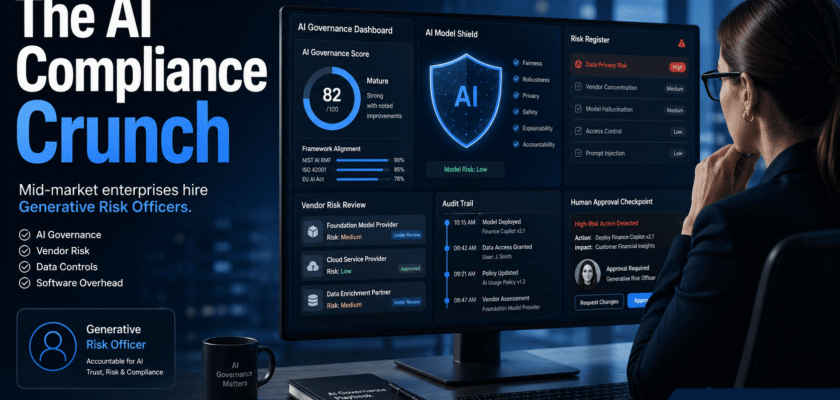
Now leaders need a new role. Many call it a generative risk officer. The title may vary. Yet the job is clear.
This person keeps AI useful, safe and auditable. Also, this role helps cut software overhead by removing risky or duplicate tools.
| KEY TAKEAWAYMid-market firms do not need a huge AI bureaucracy. They need one clear owner, a risk register, simple guardrails and proof that tools are safe to use. |
AI Compliance Crunch and the Rise of Generative Risk Officers
A generative risk officer is not only a legal person. The role sits between IT, legal, security, finance and business teams.
First, the officer maps every AI tool. Next, they check data flows. Then they set rules for prompts, vendors, users and audit trails.
This helps the company move faster. It also reduces hidden risk. Therefore, the role is becoming useful for lean firms.
Why Mid-2026 Is Different
The pressure is stronger in 2026 because AI adoption is no longer a small pilot. Many teams now use AI in daily work.
Deloitte says agentic AI is scaling fast. It also says many firms still lack mature guardrails for agent behavior and audit trails.
In India, RBI has proposed AI and ML risk rules for banks. The draft calls for board-approved frameworks, model inventories and human oversight.
Meanwhile, the EU AI Act is moving through its timeline. GPAI obligations already apply. More rules will follow for high-risk systems.
What a Generative Risk Officer Actually Does
✓ Builds one AI tool inventory.
✓ Ranks tools by risk level.
✓ Checks vendor contracts and data use.
✓ Sets safe prompt rules for staff.
✓ Creates human review points.
✓ Tracks AI mistakes and user complaints.
✓ Keeps audit proof for future reviews.
✓ Cuts duplicate and unsafe AI tools.
The Core Framework: Policy, Proof, and People
A good AI compliance plan needs three simple parts. The first part is policy. It explains what staff can and cannot do.
The second part is proof. Teams need logs, approvals and vendor evidence. These records matter during audits.
The third part is people. Staff need short training. Managers need clear escalation paths. Without people, policy stays on paper.
| READABILITY GREEN NOTEKeep the company rule simple. No sensitive data in public AI tools. No high-risk AI decision without human review. No vendor tool without approval. |
How Compliance Can Cut Digital Software Overheads
AI compliance is often seen as a cost. However, it can also reduce waste.
A risk officer can find duplicate tools. They can remove unused seats. They can block tools that copy the same function with weaker controls.
As a result, the firm may spend less on software. Also, finance gets a clearer view of AI value.
The 30-Day AI Compliance Sprint
✓ Day 1 to 5: List every AI tool in use.
✓ Day 6 to 10: Mark data type and business owner.
✓ Day 11 to 15: Rate each tool as low, medium or high risk.
✓ Day 16 to 20: Check vendor terms and security proof.
✓ Day 21 to 25: Remove duplicate or unsafe tools.
✓ Day 26 to 30: Publish rules and train each team.
Standards That Mid-Market Teams Can Use
Mid-market firms should not start from zero. They can use public frameworks.
NIST offers an AI Risk Management Framework. It also has a Generative AI Profile that helps teams identify unique gen AI risks.
ISO/IEC 42001 gives a management-system model for responsible AI use. It covers risk, policy, monitoring and improvement.
The EU AI Act adds a risk-based rule structure. So, global firms need to know where their AI tools are used.
Where Mid-Market Firms Are Most Exposed
⚠ Customer support bots that answer wrongly.
⚠ Sales tools that use private lead data.
⚠ HR tools that rank candidates.
⚠ Finance tools that create reports without review.
⚠ Marketing tools that create copied claims.
⚠ Coding tools that add insecure code.
⚠ AI agents that take actions across apps.
⚠ Vendors that train models on company data.
Simple Hiring Profile for a Generative Risk Officer
The best hire may not be a pure AI engineer. A strong profile can come from risk, audit, legal, privacy, cyber security or compliance.
Still, the person must understand AI workflows. They should know how prompts, model outputs, logs and data controls work.
They also need business sense. If controls are too slow, staff will bypass them. Therefore, rules must be useful and easy.
Useful Skills
✓ AI risk mapping.
✓ Vendor review.
✓ Data privacy basics.
✓ Prompt policy writing.
✓ Incident response.
✓ Staff training.
✓ Audit evidence tracking.
✓ Budget review.
What CEOs Should Ask Every Month
✓ How many AI tools do we use?
✓ Which tools touch customer data?
✓ Which tools make or support decisions?
✓ Which vendors can use our data?
✓ Which tools have no owner?
✓ What incidents happened this month?
✓ What did we shut down?
✓ What did we save?
Common Mistakes to Avoid
⚠ Buying AI tools before mapping risk.
⚠ Letting each team create its own rules.
⚠ Ignoring vendor data rights.
⚠ Using AI outputs without human review.
⚠ Keeping no audit trail.
⚠ Training staff only once.
⚠ Treating AI compliance as only a legal task.
Organic Search Summary for Readers
AI compliance crunch is forcing mid-market firms to build real controls. The main driver is simple. AI use has scaled faster than governance.
Generative risk officers can help close that gap. They map tools, rate risk, check vendors, train teams and cut waste.
The best system is simple. Keep one inventory. Assign one owner. Add human review. Save audit proof. Then scale AI safely.
Conclusion
The AI compliance crunch is not a temporary trend. It is the next step in enterprise AI adoption.
Mid-market firms cannot copy large-company bureaucracy. Yet they cannot ignore AI risk either.
So, the practical answer is a lean governance role. A generative risk officer can make AI safer, cheaper and easier to trust.
Frequently Asked Questions
Q. What is the AI compliance crunch?
It is the pressure firms face when AI use grows faster than rules, controls and audit proof.
Q. What is a generative risk officer?
It is an emerging role that manages gen AI risks, vendor proof, policy, training and AI incident records.
Q. Do mid-market firms need this role?
Many do. They may not need a large team, but they need a clear AI risk owner.
Q. Can AI compliance reduce software cost?
Yes. It can find duplicate tools, unused seats and risky vendors.
Q. Which frameworks can help?
NIST AI RMF, ISO/IEC 42001 and the EU AI Act are useful starting points.


