
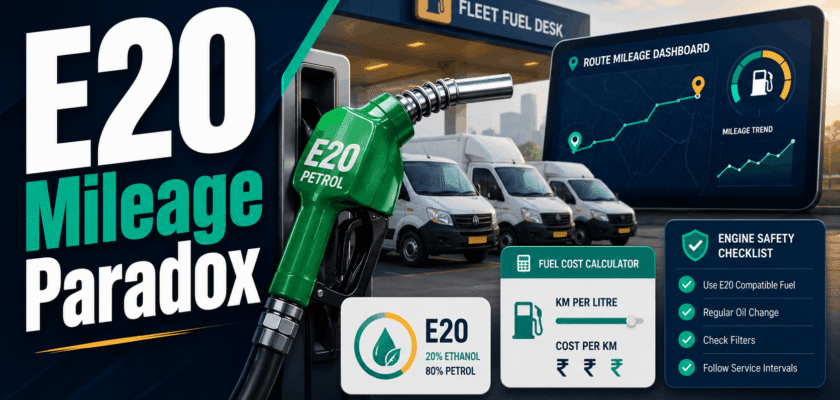
The E20 Mileage Paradox: Why Nitin Gadkari’s Defense of the 20% Ethanol Blend Matters for Commercial Fleets
Nitin Gadkari E20 Fuel Defense 2026: Why Fleet Owners Should Care
Nitin Gadkari E20 fuel defense 2026 has turned a fuel debate into a fleet-cost debate.
The minister has accepted one point. E20 can marginally affect mileage because ethanol has lower energy content than petrol.
However, he has also rejected the larger fear that E20 is causing broad vehicle damage.
This matters for commercial fleets. A personal car owner may notice a small monthly change. A fleet owner sees that change across dozens, hundreds, or thousands of daily trips.
So, the real issue is not only whether E20 petrol is safe. The bigger issue is how fleets measure fuel economy, maintenance, and driver behaviour under the new blend.
| ✅ Core Takeaway E20 may not be an engine-damage crisis. But for fleets, even a small mileage change can become a real operating-cost issue. |
What Gadkari Said About E20 Mileage and Damage
Recent reporting says Gadkari agreed that the average mileage may dip as ethanol content rises.
At the same time, he said the impact is marginal in most use cases.
He also argued that vehicle damage claims are overblown and that E20 was introduced after testing by ARAI and vehicle makers.
Government fact sheets also say India reached the 20% ethanol blending target ahead of the old 2030 timeline.
The same official material says no widespread pattern of engine failure linked to E20 has been reported since rollout.
Still, fleet owners should not treat the debate as closed. They should treat it as a signal to improve fuel tracking.
Why the Mileage Paradox Hits Commercial Fleets Harder
The ethanol blend vehicle mileage loss debate sounds small when people talk about one car.
But fleets work on repetition.
A cab fleet, logistics fleet, sales fleet, or delivery fleet may run many vehicles every day. Therefore, a small drop in km/l can change the monthly budget.
For example, industry officials have placed the fuel-efficiency drop around 3% to 3.5% in some cases due to E20’s lower energy content.
That number may look small. Yet it matters when diesel, CNG, petrol, tyres, insurance, tolls, salaries, and maintenance already pressure margins.
This is why commercial operators should not argue only on social media. They should build clean data from their own vehicles.
E20 Petrol Engine Damage Risks: What Is Clear and What Is Not
The public fear is simple. Many owners worry that E20 petrol engine damage risks may be higher for older vehicles.
Officials and major automakers have said there is no evidence of widespread E20-related damage.
Reuters reported that auto industry officials defended the E20 rollout and said years of testing and service data do not show broad vehicle damage.
However, older vehicles still need closer care. Rubber parts, filters, hoses, seals, and fuel-system health should be checked on schedule.
Fleet owners should avoid panic. But they should also avoid neglect.
The safest approach is practical. Use trusted fuel pumps. Keep service records. Track complaints vehicle-wise. Then compare data before and after E20 use.
Fleet Impact Table
| Fleet Concern | What E20 Changes | Practical Action |
| Mileage | A small mileage dip can become a big monthly fuel line item. | Track route-wise km/l for 30 days. |
| Engine Risk | Officials and automakers say no widespread E20-linked engine failure has been found. | Keep service records and use trusted pumps. |
| Older Vehicles | Pre-2023 vehicles may need closer observation and better preventive maintenance. | Check hoses, seals, filters, and fuel lines. |
| Driver Habits | AC load, tyre pressure, idling, speed and payload may hurt mileage more than blend change. | Train drivers and audit idling time. |
| Budgeting | A 3% to 3.5% drop matters when a fleet runs thousands of kilometres. | Rework fuel-cost assumptions every month. |
What Commercial Fleet Owners Should Do Now
The first step is baseline tracking.
A fleet owner should compare mileage by vehicle, route, driver, load, tyre pressure, and AC use.
This prevents a common mistake. Many people blame fuel first. But idling, traffic, overloading, poor tyre pressure, and harsh driving can also reduce mileage.
Next, fleet owners should make preventive maintenance stricter.
A small inspection plan can reduce bigger repair risk later.
✓ Record daily fuel filled and kilometres covered.
✓ Compare city, highway, and mixed-route mileage separately.
✓ Check fuel filters, hoses, seals, and spark plugs on time.
✓ Train drivers to reduce idling and sudden acceleration.
✓ Use one or two trusted fuel stations when possible.
✓ Review vehicle manuals and service advisories carefully.
Why E20 Still Matters for India’s Fuel Strategy
The government’s argument is larger than one vehicle’s mileage.
India imports a large share of its crude oil. So, ethanol blending is being pushed as an energy-security tool.
Official data says the ethanol programme has helped substitute crude oil, save foreign exchange, reduce emissions, and support farmer income.
That is why the E20 debate will not disappear quickly.
For the auto sector, the next phase is calibration. Engines, service systems, fleet software, and consumer communication all need clearer alignment.
What Drivers Should Understand
Drivers should understand that fuel economy is not controlled by fuel alone.
Smooth acceleration, correct tyre pressure, clean filters, regular servicing, and low idling can all improve km/l.
Also, fleets should avoid mixing fuel from unknown sources during a complaint investigation.
If a vehicle shows jerking, poor pickup, stalling, or sudden mileage drop, the owner should check fuel quality, service history, and vehicle condition together.
This balanced method protects both the vehicle and the business.
Why This Story Can Trend on Google Discover
This story has a strong news hook because E20 petrol is already a national debate.
It also has a business angle because fuel cost directly affects commercial fleets.
Finally, it has a practical search angle. Many readers want to know whether E20 causes mileage loss or engine damage.
That makes this topic useful for car owners, cab operators, logistics firms, and small businesses.
Conclusion: Nitin Gadkari E20 Fuel Defense 2026 Needs Fleet-Level Data
Nitin Gadkari E20 fuel defense 2026 is not only a political statement.
It is also a reminder for fleet owners to become more data-driven.
The current evidence does not show widespread engine damage from E20.
However, mileage loss can still affect operating costs, especially in commercial fleets.
Therefore, the smartest fleet strategy is simple. Track fuel, maintain vehicles, train drivers, and separate real data from online noise.


