
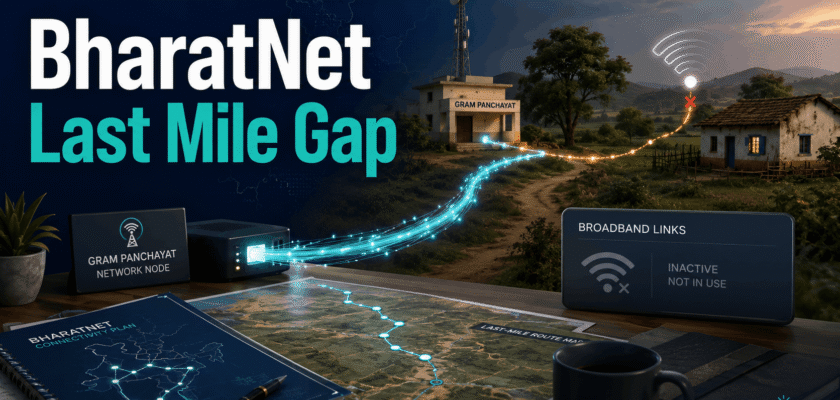
Gaps in the Last Mile: Why 55% of BharatNet’s Broadband Connections Remain Inactive Despite Massive Infrastructure Expansion
BharatNet rural broadband implementation challenges 2026 have exposed a simple but serious gap.
India has built a massive rural fibre backbone. Yet many commissioned connections are still not being used actively.
That is the real last-mile problem. Fibre can reach a Gram Panchayat, but a family, shop, school, clinic, or small business may still fail to get steady internet where it is needed most.
So, the BharatNet debate is no longer only about how many kilometres of fibre were laid. It is about how many people can actually use that network every day.
BharatNet Rural Broadband Implementation Challenges 2026: The Number Behind the Concern
Recent RTI-based reporting showed a sharp usage gap in the flagship rural broadband project.
The Department of Telecommunications had a target of 18 lakh fixed broadband connections under BharatNet until March 2026.
Against that target, 13.23 lakh fixed connections were commissioned. However, only about 8.01 lakh were actively being used.
That means more than 55% of the target number remained inactive. This is why the headline is not only about expansion. It is about conversion.
| ✅ Core TakeawayBharatNet has a strong infrastructure story, but the usage story is weaker.For rural digital growth, a service-ready connection must become an active, affordable, and reliable connection. |
Why Fibre to a Gram Panchayat Is Not Enough
BharatNet was designed as a broadband backbone for rural India.
The network can support e-health, e-education, online governance, digital payments, and local enterprise. However, a backbone alone does not create daily usage.
The last mile decides whether the network reaches homes, shops, schools, health centres, panchayat offices, and public hotspots.
This is where the challenge becomes practical. Villages need stable power, local maintenance, simple tariffs, working routers, service support, and demand creation.
Without these layers, fibre may exist on paper while users still depend on patchy mobile data.
Last Mile Internet Connectivity India: What Is Breaking the Chain?
The last mile internet connectivity India problem has several parts.
First, the household may not understand the monthly plan or installation process.
Second, local entrepreneurs may not find the model profitable enough to maintain service.
Third, public Wi-Fi points may be installed but not active, visible, or trusted by users.
Fourth, power backup and fibre repairs can decide whether the service works during the most important hours.
This is why utilisation can stay weak even after public spending and physical rollout.
Flagship Rural Digital Infrastructure Metrics That Matter Now
| Metric | What It Shows | What Should Improve |
| Commissioned connections | The number of available fixed broadband connections. | Faster household and institution onboarding. |
| Active users | How many connections are actually used. | Better service quality and local awareness. |
| Operational Wi-Fi hotspots | Whether public access points are working on the ground. | Uptime audits and local maintenance contracts. |
| Service-ready Gram Panchayats | How far the backbone has reached. | Actual reach to homes, schools, clinics, and shops. |
| Complaint resolution | Whether users trust the service after breakdowns. | Local repair teams and clear escalation systems. |
The Wi-Fi Hotspot Signal Is a Warning
Public Wi-Fi was supposed to make BharatNet visible to everyday users.
However, RTI-based reporting said 1.04 lakh Wi-Fi hotspots had been installed under BharatNet, while only 766 were operational as of September 2025.
That number matters because public access can introduce rural users to fixed broadband services.
If a hotspot is installed but not useful, the village does not see the value of the network. As a result, demand does not build.
This is also a business problem. Low usage can reduce the confidence of local internet partners and slow new investment.
Why the Amended BharatNet Program Still Matters
The Amended BharatNet Program is still important because it tries to fix old design weaknesses.
Official material says the program aims for optical fibre connectivity to 2.64 lakh Gram Panchayats in ring topology. It also includes network upgrades, IP-MPLS, power backup, remote fibre monitoring, and long-term operation and maintenance.
These features can make the network more reliable.
However, the next test is adoption. The project must prove that rural users can get affordable, stable, and easy broadband service near their real place of work and life.
What Business Leaders Should Watch
BharatNet is not only a telecom story. It is also a rural business story.
Better broadband can support rural fintech, telemedicine, online education, agritech, local e-commerce, and village-level service centres.
But inactive connections delay those opportunities.
Investors, start-ups, device makers, cloud platforms, and digital service providers should watch active-user growth, not only fibre-rollout announcements.
A village becomes a digital market only when people can connect easily, pay affordably, and trust the service.
Practical Fixes for the Next Phase
✓ Publish monthly active-connection dashboards by district.
✓ Separate commissioned, live, active, and paying connections clearly.
✓ Make public Wi-Fi uptime visible and auditable.
✓ Train village-level operators for repairs and customer onboarding.
✓ Simplify tariffs for homes, shops, schools, and clinics.
✓ Use local demand campaigns for education, health, and small business use cases.
✓ Link payments, service complaints, and maintenance reports into one simple system.
Why This Story Can Trend on Google Discover
This story has a strong public-interest hook because BharatNet is tied to Digital India and rural growth.
It also has a sharp number: more than 55% inactive against the March 2026 target base.
Finally, it affects many readers. Students, small businesses, panchayat offices, healthcare workers, and rural families all need reliable broadband.
That makes the article useful for policy readers and practical for common users.
Conclusion: BharatNet Rural Broadband Implementation Challenges 2026 Need a Usage-First Reset
BharatNet rural broadband implementation challenges 2026 show that infrastructure alone is not enough.
India has made major progress in building rural broadband capacity. But active usage must now become the main measure of success.
The real win will come when rural homes, schools, clinics, shops, and local offices can rely on stable broadband every day.
Therefore, BharatNet’s next phase must focus on last-mile adoption, not only network expansion.


