


Life Beyond Earth: What the Latest Space Missions Actually Found (2026 Update)
The question, “Are we alone?” has captivated humanity for millennia. In 2026, our scientific instruments and ambitious space missions are bringing us closer than ever to answering it. While we haven’t yet found definitive proof of intelligent alien civilizations, the latest discoveries from probes across our solar system and telescopes peering into distant galaxies have revealed a universe teeming with environments surprisingly hospitable to life as we know it—and perhaps even life we don’t.
Here’s a rundown of what the most recent space missions have actually found, bringing us tantalizingly closer to confirming life beyond Earth.
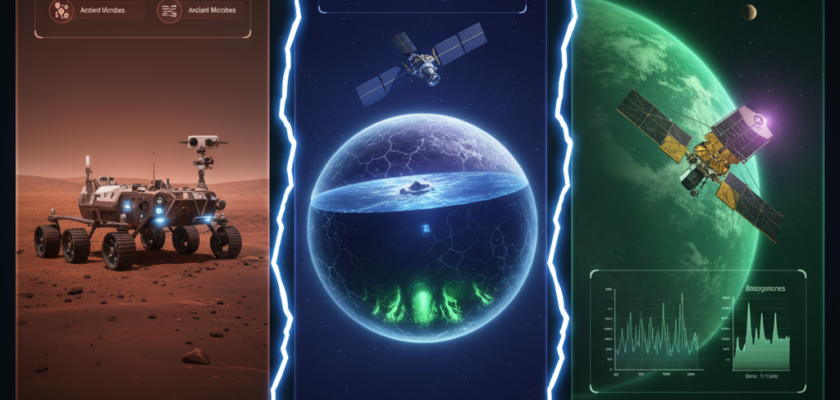
1. Mars Sample Return Mission: Unearthing Ancient Microbes?
The joint NASA-ESA Mars Sample Return mission, which landed its final rover component in late 2025, is diligently collecting rock and soil samples from Jezero Crater. This site is believed to have once harbored a large lake, making it a prime candidate for preserving signs of ancient Martian life.
- Latest Findings (Preliminary): While the samples are still being collected and will only return to Earth for analysis in the early 2030s, initial on-site spectroscopy has detected complex organic molecules and intriguing mineral formations consistent with past aqueous environments. These are not direct proof of life, but they significantly strengthen the case for Mars having been habitable.
- Significance: If the returned samples reveal fossilized microbial life, it would be the first definitive evidence of extraterrestrial life.
2. Europa Clipper Mission: The Hunt for Ocean Life
NASA’s Europa Clipper, after its long journey, has begun its detailed study of Jupiter’s moon Europa in early 2026. Europa is believed to harbor a vast subsurface ocean beneath its icy shell, a prime location for life.
- Latest Findings: The mission’s ice-penetrating radar is mapping the ocean’s depth and composition, while spectrometers are analyzing plumes of water vapor thought to erupt from the surface. Initial data indicates the ocean is indeed vast, salty, and contains essential chemical building blocks (like carbon and nitrogen compounds) for life. Heat signatures from hydrothermal vents are also being closely monitored.
- Significance: Confirmation of active hydrothermal vents, coupled with the right chemistry, would make Europa arguably the most promising place for extant life in our solar system.
3. James Webb Space Telescope (JWST): Biosignatures on Exoplanets
The JWST continues to revolutionize exoplanet atmospheric characterization, searching for “biosignatures”—chemical fingerprints that might indicate the presence of life.
- Latest Findings (2025-2026): Building on earlier detections, JWST has refined observations of several Earth-sized exoplanets in the habitable zones of their stars. Notably, the atmosphere of TRAPPIST-1e has shown an unexpected abundance of both water vapor and potential methane, without a corresponding level of carbon dioxide. On Earth, this combination is often indicative of biological processes.
- Significance: While not definitive, these complex atmospheric compositions are difficult to explain through purely geological processes, making TRAPPIST-1e a leading candidate for further investigation and the possibility of life.
4. Dragonfly Mission to Titan (Saturn’s Moon): Prebiotic Chemistry Unveiled
Although the Dragonfly mission’s drone will land on Saturn’s moon Titan in 2034, preliminary findings from earlier missions and ongoing orbital observations are crucial. Titan has a dense atmosphere and liquid methane lakes, making it uniquely Earth-like in some ways.
- Latest Insights: Detailed atmospheric models, refined by data from the Cassini mission (prior to 2017) and Earth-based telescopes, suggest Titan is a ‘prebiotic chemistry laboratory.’ It has all the necessary elements (carbon, hydrogen, nitrogen, oxygen) and complex organic molecules in liquid form, under conditions that might foster the building blocks of life.
- Significance: Titan helps us understand the conditions under which life could arise, even if it’s life fundamentally different from our own, based on methane instead of water.
5. Breakthrough Listen & SETI Initiatives: Listening for Signals
Beyond finding habitable environments, the search for intelligent life continues through radio and optical SETI (Search for Extraterrestrial Intelligence) programs.
- Latest Status (2026): While no confirmed signals have been detected, advancements in AI-driven signal processing are allowing researchers to sift through vast amounts of data more efficiently than ever. New targeted observations of exoplanets identified by JWST as potentially habitable are now underway.
- Significance: The ongoing search emphasizes that while environments for life are common, finding evidence of intelligent life requires patience and advanced technology.
Life Beyond Earth: A 2026 Snapshot of Discoveries
| Mission/Telescope | Target | Key Discovery/Insight | Significance |
| Mars Sample Return | Jezero Crater, Mars | Organic molecules, aqueous minerals | Strong evidence for past habitability |
| Europa Clipper | Europa (Jupiter’s Moon) | Vast subsurface ocean, chemical building blocks | Prime candidate for extant life |
| James Webb Telescope | TRAPPIST-1e (Exoplanet) | Complex atmospheric biosignatures (H2O, CH4) | Leading candidate for exoplanet life |
| Dragonfly Mission (prep) | Titan (Saturn’s Moon) | Prebiotic chemistry, organic liquid | Unique environment for alternative life |
| Breakthrough Listen | Exoplanets, Galactic Center | No confirmed signals, AI-driven search | Continuous search for intelligent life |
Conclusion
As of 2026, the quest for life beyond Earth is more vibrant and promising than ever. From the potential microbial fossils on Mars to the deep oceans of Europa and the mysterious atmospheres of distant exoplanets, scientific missions are painting a picture of a universe far more biologically interesting than previously imagined. While definitive proof remains elusive, each new finding pushes the boundaries of our understanding, reminding us that the question of whether we are alone might soon transition from philosophy to fact.
Which of these space discoveries excites you the most? Do you believe we will find life beyond Earth in your lifetime? Share your cosmic thoughts in the comments below!


