
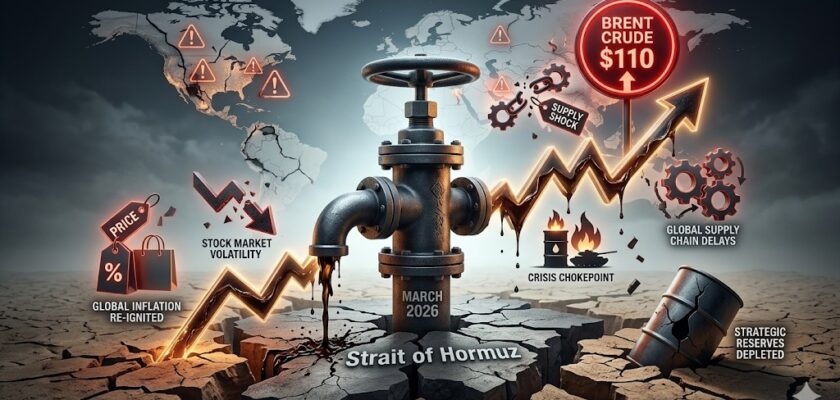
Brent Crude Hits $110: How the Strait of Hormuz Crisis is Impacting Global Markets
In a dramatic escalation of global energy tension, Brent Crude oil has surged past the $110 per barrel mark in March 2026. This is the highest price level seen in nearly two years, and the primary catalyst is a deepening security crisis in the Strait of Hormuz.
This narrow waterway, separating Iran from Oman and the UAE, is the world’s most critical oil transit chokepoint. With approximately 20-30% of global total oil consumption passing through daily, any disruption here sends shockwaves through the entire global economy.
Here is a comprehensive analysis of how the Strait of Hormuz crisis is impacting global markets and why $110 Brent might just be the beginning.
1. The Chokepoint Paralysis: Supply Disruption
The current crisis involves increased military posturing, attacks on commercial vessels, and threats of a full blockade of the Strait. For global energy markets, this translates to immediate fear:
- Physical Shortages: Even a partial closure delays millions of barrels of oil and Liquefied Natural Gas (LNG) from reaching markets in Asia, Europe, and the Americas.
- Risk Premium Jumps: The immediate spike to $110 is driven less by an actual shortage today and more by the probability of a major disruption tomorrow. This “geopolitical risk premium” is now priced into every barrel.
2. Global Inflation Re-Ignited
Just as central banks globally were beginning to signal a victory over the inflation wave of the mid-2020s, the oil surge threatens to undo all progress:
- Transportation Costs: Higher fuel prices directly increase the cost of moving goods (shipping, trucking, air freight), which is then passed on to consumers.
- Energy Bills: The price of natural gas (often linked to oil) and electricity will rise, straining household budgets and industrial output.
- A “Stagflation” Shadow: The combination of rising costs (inflation) and potentially slowing economic growth due to energy uncertainty raises the dreaded specter of stagflation.
3. Stock Market Volatility & Sector Shift
Global equity markets are reacting with intense volatility as investors recalibrate expectations for 2026:
- Winners (Energy & Defense): Oil major stocks, renewable energy firms, and defense contractors are seeing significant gains.
- Losers (Transportation & Consumer Discretionary): Airlines, cruise lines, automotive, and retail sectors are under pressure due to fears of reduced consumer spending and higher operational costs.
- Flight to Safety: Investors are moving capital into “safe-haven” assets like Gold, the US Dollar, and Swiss Franc, withdrawing from emerging markets.
4. A Rush for Strategic Reserves
Major economies are moving into crisis management mode:
- SPR Releases: The US and IEA partners (International Energy Agency) are considering coordinated releases from their Strategic Petroleum Reserves (SPR) to cool the market. However, with SPR levels already lower than historic averages, the long-term effectiveness is questioned.
- Alternative Supplies: Europe and Asia are aggressively seeking alternative oil and gas supplies from Africa, Latin America, and North America (US Shale), further tightening those markets.
5. The Great Energy Transition Paradox
The crisis is creating a contradictory effect on the global energy transition:
- Acceleration: High fossil fuel prices make renewable energy projects (Solar, Wind, Green Hydrogen) more economically attractive, potentially accelerating investment.
- Delay: At the same time, governments may temporarily relax emissions standards, increase coal usage, and approve new fossil fuel projects to ensure short-term energy security.
Impact Analysis: If the Strait Remains Disrupted (2026)
| Economic Metric | Immediate Impact (Brent @ $110) | Prolonged Crisis (Brent @ $130+) |
| Global GDP Growth | Slower, but Stable | Significant Recession Risk |
| Global Inflation | 1-2% Increase Expected | Persistent, High Inflation (>5%) |
| Central Bank Policy | Paused Rate Cuts, Possible Hikes | Aggressive Rate Hikes (Fighting Inflation) |
| Supply Chain | Delays & Increased Costs | Major Shortages & Rerouting |
| Geopolitics | Increased Tension & Diplomacy | Potential for Wider Conflict |
Conclusion
Brent Crude hitting $110 is a stark reminder of the fragile nature of the global energy architecture. The crisis in the Strait of Hormuz has transformed from a regional security issue into a decisive factor for the 2026 economic outlook.
While the world seeks diplomatic solutions, the immediate reality is a return to energy insecurity, inflationary pressure, and profound market volatility. The coming weeks will be critical in determining whether this is a temporary price spike or the beginning of a sustained energy crisis that could reshape the global economy.
How is the surge in oil prices impacting your local economy or business? Share your insights and observations in the comments below.


