
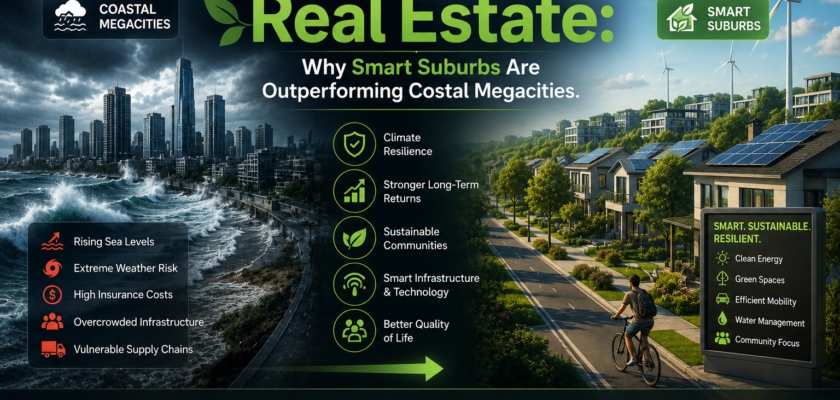
Climate-Resilient Real Estate: Why Smart Suburbs Are Outperforming Coastal Megacities.
The global real estate playbook is facing a fundamental structural rewrite. As of May 19, 2026, the premium traditional asset class—coastal luxury real estate—is witnessing an unprecedented valuation shift. For decades, proximity to the ocean and central metropolitan density were the undisputed drivers of property premiums. Scale and location were the only metrics that mattered.
However, as we cross into mid-2026, the global real estate sector is reckoning with a massive asset correction often termed the “Climate Bubble”. With global studies estimating that property prices are overvalued by up to $237 billion to $520 billion relative to actual flood risks, a monumental capital current is migrating inward.
The clear beneficiary of this flight to safety is Climate Resilient Real Estate 2026. High-tech, inland “Smart Suburbs” and secondary tier-II regional hubs are systematically outperforming coastal megacities. By replacing geographic vulnerability with autonomous, low-friction infrastructure, these modern suburban layouts are delivering what sinking dense metropolises no longer can: absolute capital preservation.
1. The Coastal Megacity: Vulnerability, Attrition, and the Insurance Desert
The operational decline of the traditional coastal city is driven by an compounding crisis of physical risk and financial attrition. Densely packed coastal economic engines—from Miami and New York to Mumbai and low-lying global manufacturing ports—are grappling with systemic climate exposures:
- The Exposure Shock: Over the past two decades, sea-level rise has drastically altered the flood-risk map, pulling millions more urban residents into high-severity annual flood brackets.
- The Rise of “Insurance Deserts”: The most immediate catalyst popping the urban coastal real estate bubble is the collapse of the property coverage market. Driven by repetitive, billion-dollar weather disasters, major institutional insurance carriers are aggressively hiking quarterly premiums by double digits—or abandoning high-risk coastal states entirely.
- The Valuation Deficit: When home insurance becomes an impossible luxury or structurally unavailable, lenders tighten mortgage criteria. This immediately cuts off standard retail buying power, turning prized oceanfront developments into severe Operational Liabilities.
2. The Smart Suburban Shift: Low-Friction and Autonomous Resiliency
While coastal megacities struggle with legacy drainage systems and rigid, high-density layouts, master-planned smart suburbs are capturing institutional capital by designing for Autonomous Precision from the ground up.
In India, this manifests in the government’s aggressive policy focus on City Economic Regions (CERs), a strategic framework designed to intentionally disperse economic activity and housing supply away from overcrowded tier-I metros into resilient secondary hubs.
A. Blue-Green Infrastructure Integration
Smart suburbs bypass the standard “concrete jungle” model by embedding nature-based solutions. They deploy integrated mangrove buffers along accessible coastlines, permeable pavements, dedicated bio-swales, and advanced stormwater retention networks. These engineering choices absorb flash floods seamlessly, removing the panic-selling risks of old, slow municipal setups.
B. Decentralized Microgrids and Passive Cooling
Mirroring guidelines from the UN Environment Programme (UNEP) 2026 Buildings Report, next-gen suburbs are moving toward strict zero-emission building codes. By utilizing passive cooling technologies—such as solar shading, natural cross-ventilation layouts, and highly reflective roofs—these properties natively slash internal room temperatures. This directly minimizes reliance on overloaded energy grids during intense heatwaves.
3. Strategic Matrix: Coastal Megacity vs. Climate-Resilient Smart Suburb
| Investment Variable | Legacy Coastal Megacities | Climate-Resilient Smart Suburbs (2026) |
| Risk Characterization | High-severity flooding, storm surge, sea-level rise | Geographically optimized, inland topography |
| Insurance Environment | Premium spikes; escalating non-renewal trends | Highly insurable; predictable risk profiles |
| Energy & Cooling Infrastructure | Centralized dependency, high thermal load risks | Decentralized solar microgrids; passive cooling |
| Valuation Trend | Attrition, pricing discounts for high flood metrics | Premium appreciation driven by green compliance |
| Development Premise | Expensive reactive defense walls & retrofitting | Frictionless, proactive climate adaptation |
4. Monetizing the Resilient Premium
Investing in Climate Resilient Real Estate 2026 assets has evolved from a niche environmental sentiment into a hard-nosed fiduciary requirement. Global financial markets are actively pricing structural climate efficiency directly into underlying asset values.
- The Efficiency Valuation Boost: Institutional data from the UN Environment Programme Finance Initiative indicates that implementing verifiable green and energy-efficient practices boosts residential asset valuations by up to 3% to 8%, and commercial assets by a massive 10% to 20%.
- Lower Mortgage Default Predictors: Central banking models show an indisputable mathematical correlation: energy-efficient, climate-hardened properties have a significantly lower statistical probability of entering payment arrears or mortgage defaults.
- The Yield Retention: Because smart suburbs utilize decentralized resources, their net operating incomes (NOI) remain highly insulated from volatile municipal energy hikes or structural repair assessments.
Conclusion
The geographic landscape of wealth is migrating. The un-bottlenecked digital currents of 2026 mean that corporate talent, executive nomads, and multi-channel builders no longer require physical proximity to legacy coastal downtown cores to scale operations. As a result, the old abacus maze of prioritizing prestige over safety is completely collapsing.
By redirecting capital into master-planned, inland smart suburbs, forward-looking real estate investors are securing an undeniable Minimized Risk portfolio profile. The ultimate premium luxury of this decade is no longer an ocean view—it is absolute, uncompromised structural permanence in a shifting world.


