
Beyond the Snippet: How to Format Tables and FAQs for Generative AI Search Engine Feeds.
The traditional SEO playbook for winning “Position Zero” is officially obsolete. As we navigate May 2026, the classic Featured Snippet—where Google lifted a clean paragraph of text into a neat box—has been largely replaced by dynamic, multi-source answers. Whether it is Google’s AI Overviews, Perplexity, or ChatGPT’s browse features, search has fundamentally transitioned from retrieval to synthesis.
Instead of fighting for a single blue link, websites are now competing for inclusion inside Generative AI Search Engine Feeds. This means your content is no longer just being read by humans; it is being digested by a framework called Retrieval-Augmented Generation (RAG).
To get your data “lifted” and cited by an LLM, your pages must be highly extractable. Two content formats reign supreme in this new architecture: Tables and FAQs. Here is the exact technical blueprint to format them so AI engines treat your site as their absolute source of truth.
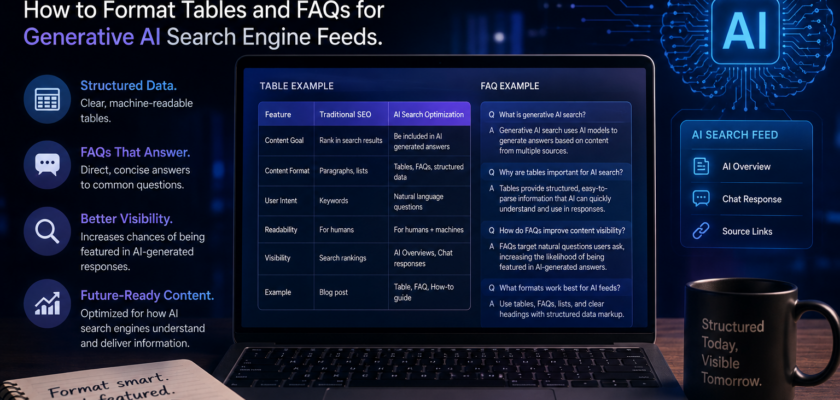
1. Tables: Moving Beyond Visual Presentation to Machine-Readability
Large Language Models do not “look” at a table the way a human browser does; they parse its underlying code to build relational data points. Complex tables with merged cells (colspan or rowspan), nested graphics, or infinite scroll elements create structural noise that causes RAG ingestion pipelines to fail.
The AI-First Table Rules:
- Frame with Headings: Never let a table sit naked on a page. Always place it directly beneath a clear H2 or H3 heading that frames the exact intent (e.g.,
## Compare Tata Nexon vs. Tata Tigor EV Running Costs). - Add a Text Summary: Provide a short paragraph or caption immediately above or below the table summarizing the core takeaway. This gives the LLM a text shortcut to verify what the data proves.
- Keep Data Columns Flattened: Keep tables strictly horizontal and two-dimensional. Use standard
<th>tags for headers and predictable<td>cells. If you need to compare multiple complex variables, break them down into separate, smaller tables rather than one giant master grid.
2. FAQs: Engineering Content for Conversational Prompts
Search prompts in 2026 are two to three times longer than traditional keyword queries because users talk to AI engines in full sentences. Frequently Asked Questions (FAQs) are prime real estate for Generative AI Search Engine Feeds because they match this conversational intent perfectly.
The “Inverted Pyramid” QA Structure:
To ensure an AI agent can cleanly lift your answer, structure every FAQ response using the “Direct-to-Detail” method:
                    ┌──────────────────────────────────────┐
                    │      H3 Tag: The Conversational      │
                    │         User Question (Prompt)       │
                    └──────────────────┬───────────────────┘
                                       │
                                       ▼
                    ┌──────────────────────────────────────┐
                    │  Sentence 1-2: Plain, Declarative    │
                    │    Direct Answer (The AI "Lift")     │
                    └──────────────────┬───────────────────┘
                                       │
                                       ▼
                    ┌──────────────────────────────────────┐
                    │  Paragraph 2: Context, Hard Stats,   │
                    │   & Deeper Explanatory Nuance        │
                    └──────────────────────────────────────┘
- The Prompt Match: Use an H3 tag written exactly like a user query (e.g.,
### What is the real-world cost per km of a CNG car?). Avoid vague headings like### Cost Info. - The Direct Sentence: The very first sentence under the heading must directly answer the prompt without fluff. Use short, declarative sentences (15–20 words maximum).
- Inject Specific Micro-Data: LLMs look for high “Information Gain” and exact numbers. Including small, verified numbers (like benchmarks, ranges, or exact percentage deltas) signals factual accuracy to the AI’s ranking system.
3. Strategic Matrix: Schema Architecture for AI Feeds
Structuring the text on the front-end is only half the battle; you must apply the correct backend “nutrition labels” using Schema markup to tell the AI exactly what your data represents.
| Content Type | Primary Schema Object | Purpose in Generative Search |
| FAQ Sections | FAQPage (JSON-LD) | Feeds conversational answers directly into AI Overviews and answer cards. |
| User Submissions | QAPage | Used when a single question features multiple crowd-sourced or expert community answers. |
| Data Tables | Dataset or Table | Helps LLMs map entities and chronological metrics without mistaking rows for prose. |
| Individual Authors | Person | Verifies E-E-A-T signals, proving a real expert with established credentials authored the data. |
4. System Integration: Binding Formats Together
The ultimate method to gain visibility in Generative AI Search Engine Feeds is to create an interconnected content hub. AI engines look for deep topical authority rather than isolated keywords.
When designing a resource page, integrate your formats seamlessly. Introduce the core topic with strong, authoritative text, drop a clean HTML table breaking down the hard data or product specifications, and conclude the page with an FAQ section that addresses edge cases, constraints, and contextual definitions.
Cross-link this setup with descriptive anchor text to related sub-topics on your domain. This creates a clean, machine-readable semantic map that AI crawlers can digest, index, and surface with absolute confidence.
Conclusion
As the value of the traditional organic search click drops, your digital strategy must shift from winning position rankings to earning a dominant Share of Influence inside AI summaries. AI search engines do not create facts; they harvest them from well-structured sources.
By formatting your tables into clean, flattened structures and turning your FAQ blocks into direct, data-rich answers backed by JSON-LD markup, you transform your website from a simple text destination into an essential data feed for the LLM era. Stop writing walls of unformatted text. Clean up your code, structure your insights, and let the machines carry your brand to the top of the feed.


