
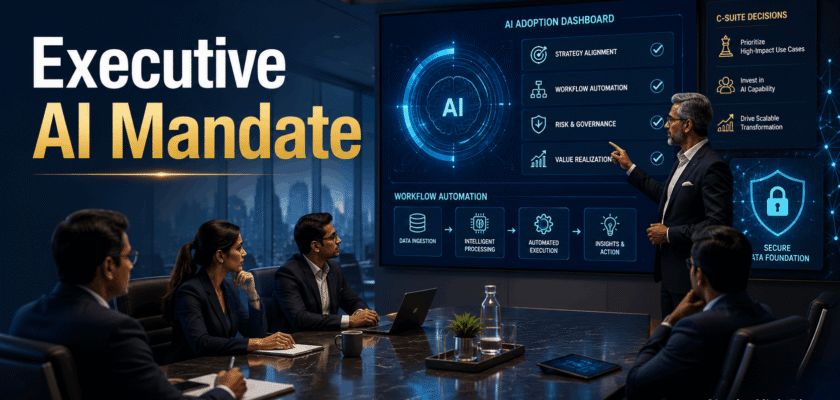
LinkedIn India AI Adoption Survey 2026: Why This Matters Now
The LinkedIn India AI adoption survey 2026 shows one clear shift. AI is no longer a side tool for tech teams.
It is becoming a leadership mandate inside Indian companies.
According to recent LinkedIn-linked reporting, 79% of Indian business leaders feel pressure to speed up AI implementation. That is close to four out of five leaders.
Also, the pressure is stronger among Chief Marketing Officers and Chief Technology Officers. That makes sense.
Marketing teams want faster content, smarter targeting, and better customer journeys. Technology teams want automation, analytics, and faster product cycles.
However, fast AI adoption also brings risk. A company can save time. But it can also create errors, data leaks, bias, and weak governance.
What the 2026 AI Pressure Really Means
The big story is not only about tools like chatbots or copilots.
The bigger story is about enterprise artificial intelligence trends becoming part of daily decisions.
Recent reports say 84% of Indian C-suite leaders believe AI is creating new roles in their organisations.
The same reporting also says AI inputs are becoming a key part of leadership decisions.
So, AI is moving from experimentation to execution.
This is why the LinkedIn India AI adoption survey 2026 is important for business readers. It shows a real change in mindset.
| ✅ Core TakeawayAI adoption is not just a software upgrade.It is a workflow, hiring, training, governance, and leadership upgrade. |
Key Data Points in Simple Words
| Data Point | What It Says | Why It Matters |
| 79% | Indian business leaders feel pressure to accelerate AI. | AI is now urgent at board level. |
| 82% CMOs | Marketing leaders feel high pressure. | Customer growth and content speed matter. |
| 81% CTOs | Tech leaders feel high pressure. | Automation and product speed matter. |
| 84% | C-suite leaders say AI is creating new roles. | Hiring and skills will change. |
| 16% YoY | AI-related hiring in Indian IT rose in June. | Special AI skills are in demand. |
Why Indian Tech Leaders Are Moving So Fast
First, business cycles are getting shorter.
Customers expect quicker replies. Employees expect better tools. Investors expect better margins.
As a result, leaders are using AI to remove slow steps from daily work.
For example, AI can help with support tickets, lead scoring, coding support, compliance checks, and meeting summaries.
Second, Indian companies are watching global competitors.
If rivals use AI to cut turnaround time, other firms cannot wait for long pilot projects.
Third, AI hiring is changing the job market. Reuters reported that AI-related hiring in India’s IT sector rose 16% year on year in June, while overall IT hiring fell.
That means companies are not only buying AI tools. They are also searching for people who can run them safely.
Enterprise AI Is Creating New Roles
The LinkedIn India AI adoption survey 2026 also points to a new job reality.
AI is not only replacing simple tasks. It is also creating new work.
Companies now need people who can test prompts, review AI output, manage data quality, and explain AI decisions.
New role ideas may include AI workflow manager, AI governance lead, prompt operations specialist, AI quality reviewer, and human-AI training coordinator.
These roles sound technical. Still, many of them need business judgment more than coding skills.
That is why Indian professionals should learn both tool use and domain use.
The Hidden Risk: AI Adoption Without AI Governance
Fast adoption can help a company grow. However, careless adoption can create serious problems.
For example, an AI tool may produce a wrong answer with high confidence.
It may also expose private data if employees paste sensitive files into unsafe tools.
Therefore, enterprise AI needs strong rules.
India’s AI governance debate is also growing. The India AI Governance Guidelines released under MeitY in November 2025 focus on innovation with safeguards, fairness, accountability, and responsible use.
This matters because enterprise AI adoption must be trusted by customers, employees, and regulators.
| ��️ Smart AI Adoption Checklist✓ Keep a clear list of approved AI tools.✓ Train teams before full rollout.✓ Block sensitive data from open tools.✓ Review AI output before customer use.✓ Track time saved, errors reduced, and quality impact. |
What Employees Should Do in 2026
Employees should not panic about AI. But they should not ignore it either.
A safe strategy is simple. Learn one AI tool deeply. Then apply it to real work.
For example, a marketer can learn AI for campaign ideas and content briefs.
A finance employee can use AI for data summaries, but must verify every number.
A developer can use AI for code suggestions, tests, and documentation.
The best employees will not be the ones who blindly copy AI output.
Instead, the best employees will check, improve, and apply AI output with context.
What Companies Should Do Next
Companies should avoid one mistake. They should not make AI adoption a one-time software launch.
They need a simple rollout plan.
✓ Start with three high-value use cases.
✓ Choose clear owners for each AI workflow.
✓ Set data safety rules before access is expanded.
✓ Train managers to judge AI output quality.
✓ Measure productivity gains every month.
This approach keeps AI adoption practical. It also reduces hype.
Why This Story Can Trend on Google Discover
The topic has three strong angles.
First, AI is a high-interest technology topic.
Second, the LinkedIn India AI adoption survey 2026 gives it a timely news hook.
Third, Indian professionals want simple guidance on job roles, AI skills, and workplace changes.
That makes this story useful for tech readers, business readers, and career-focused readers.
Conclusion: The AI Mandate Is Real, but It Needs Control
The LinkedIn India AI adoption survey 2026 shows that Indian leaders are under real pressure to move faster.
But speed alone is not enough.
Companies need training, data safety, governance, and clear ownership.
In 2026, the winners will not be the companies that adopt every AI tool first.
The winners will be the companies that use enterprise AI with discipline, trust, and measurable results.


