
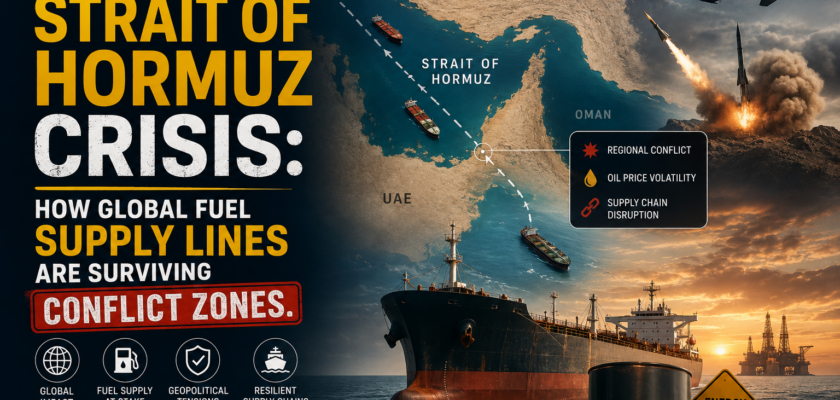
The Strait of Hormuz Crisis: How Global Fuel Supply Lines Are Surviving Conflict Zones.
The global energy architecture is facing its most severe stress test since the 1970s. As of May 19, 2026, the Strait of Hormuz Crisis 2026 has fundamentally rewritten the rules of maritime logistics. What began on February 28 as a targeted military intervention has spiraled into an effective naval blockade. Daily commercial traffic through the world’s most critical chokepoint has collapsed by a staggering 90%—plummeting from over 130 daily transits to single digits.
With 18.4 million barrels of oil per day, 20% of global liquefied natural gas (LNG), and 30% of globally traded fertilizer inputs completely bottlenecked, the global economy is in survival mode. Here is the inside look at how alternative supply lines, emergency rationing, and subsea engineering are keeping the world moving through the crossfire.
1. The Breakdown of the Core Current
The Strait of Hormuz Crisis 2026 is not a minor supply delay; it is a systemic blockade. Because the Gulf basin is geographically enclosed, the effective closure has landlocked thousands of vessels and left more than 400 tankers stranded in the Persian Gulf or staging in the Gulf of Oman.
The structural impacts have triggered domino-effect disruptions across major global sectors:
- The LNG Freeze: Following drone and missile strikes on key energy nodes like Qatar’s Ras Laffan complex, QatarEnergy was forced to declare Force Majeure. This instantly wiped out roughly 20% of the world’s LNG supply, sending Asian spot prices soaring above $25 per MMBtu.
- The Industrial Surcharge: In Europe, historically low gas storage levels (hitting 30% after a brutal winter) collided with the blockade. Heavy industrial players like chemical and steel manufacturers have been slapped with 30% surcharges to absorb surging feedstock costs.
- The Passage Toll: For the few non-Western ships attempting passage, safety cannot be guaranteed. The transit is subject to strict political leverage, including a reported “unauthorized condition fee” of nearly $2 million per vessel.
2. Survival Mechanisms: How Nations Are Adjusting
To maintain a semblance of financial and resource stability, governments have abandoned standard operational protocols in favor of Autonomous Precision and crisis management.
A. The Indian Blueprint: Rationing & Safe Passages
As an economy where nearly two-thirds of LNG imports traditionally transit through Hormuz, India faced an immediate domestic threat. The government responded through a coordinated multi-ministerial roadmap:
- The Natural Gas Control Order: Directing a strict physical rationing of natural gas, capping supplies to non-essential industries and domestic fertilizer plants at 70% to preserve reserves.
- Strategic Excise Cuts: Slicing central excise and customs duties on motor fuels and petrochemical inputs to absorb the cost-push pass-through.
- Bilateral Naval Escorts: The Indian Navy, coordinating with international task forces, is actively negotiating safe-passage pathways for Indian-flagged vessels to secure alternative crude loads.
B. The Megaproject Accelerant: The Oman-to-India Subsea Pipeline
The Strait of Hormuz Crisis 2026 has served as a massive wake-up call regarding maritime vulnerabilities. In response, the Ministry of Petroleum has fast-tracked a feasibility assessment for the ₹40,000 Crore ($4.7 Billion) Middle East-India Deep-water Pipeline (MEIDP).
Planned as a 2,000-kilometer underwater network running beneath the Arabian Sea, this network will connect Oman directly with the Gujarat coastline. Plumbing depths of 3,450 meters, it aims to bypass the chokepoint entirely, supplying 31 million standard cubic meters of gas per day directly to the Indian mainland.
3. Strategic Matrix: Supply Line Survival Strategies
| Mitigation Layer | Pre-Crisis Logistics (Traditional) | 2026 Crisis Logistics (Survival Mode) |
| Shipping Route | Direct through the Strait of Hormuz | Complete Redirection / Long-haul Cape Route |
| Contract Status | Regular Spot & Long-term Delivery | Widespread Force Majeure / Spot Market Halts |
| Risk Mitigation | Standard Hull & Cargo Insurance | War-Risk Premium Spikes / Route Refusal Clauses |
| Gas Security | Just-In-Time Shipping Imports | Subsea Pipeline Planning / Strict Internal Rationing |
| Economic Impact | Stable, predictable supply costs | Systemic cost-push shocks across all sectors |
4. The Long Tail: Why a Ceasefire Won’t Instantly Fix the Mess
Even if the temporary diplomatic ceasefires hold, logistics experts warn that the energy supply chain faces a “long tail” recovery risk. Supply lines will not return to baseline capacity for at least 12 months due to deep structural damage.
The physical destruction of Qatari gas liquefaction infrastructure alone is estimated to require three to five years to fully repair. Furthermore, carrier fleets cannot simply reset; shipping lines are absorbing permanent capital changes due to escalated bunker fuel surcharges, ballooning freight rate indexes, and contract renegotiation liabilities.
Conclusion
The Strait of Hormuz Crisis 2026 marks the definitive end of supply chain complacency. Moving forward, energy security is no longer an exercise in finding the lowest global price; it is about establishing physical and structural autonomy.
As the World Bank tracks multi-billion dollar daily GDP losses, the global move toward localized renewable storage, electric vehicle infrastructure, and deep-sea bypass pipelines is transforming from a green transition timeline into an immediate national security requirement. The old, fragile abacus of maritime trade has cracked; only those who build absolute un-bottlenecked resilience will survive the next economic era.


