
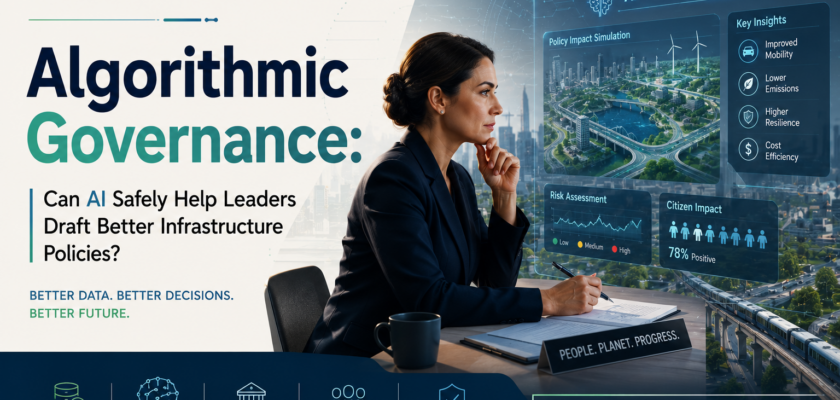
Algorithmic Governance: Can AI Safely Help Leaders Draft Better Infrastructure Policies?
The execution of state capacity is undergoing a profound structural evolution. As of May 20, 2026, governments worldwide are transitioning from experimenting with simple digital public utilities to deploying highly sophisticated predictive modeling systems. When drafting large-scale public initiatives—such as smart city electrical grids, transcontinental transport networks, or complex deep-water water systems—the volume of data that must be synthesized is far too vast for human committees to process in isolation.
This bottleneck has given rise to a highly debated methodology: Algorithmic Governance AI Policy 2026.
Instead of treating Artificial Intelligence purely as an administrative automation assistant, policymakers are leveraging advanced predictive engines to actively model, write, and stress-test public framework blueprints. However, as AI transitions from software sandboxes into physical world operations, it introduces a severe realization: physical industries are governed by real-world consequences, not mere computer calculations.
Can algorithms safely guide the hand that drafts a nation’s foundational infrastructure policy, or does automated governance scale unprecedented systemic fragility? Let’s look past the political buzzwords and analyze the strict technical boundaries, frameworks, and human-centric guardrails required to govern the systems that govern us.
1. The Promise of Predictive Infrastructure Engineering
When a state entity leverages an Algorithmic Governance AI Policy 2026 template, it gains access to an incredibly powerful computational synthesis matrix. Traditional policy cycles are reactive, slow, and heavily prone to subjective political blind spots.
A. Dynamic Simulation & Digital Twins
Rather than guessing the economic and environmental downstream impacts of an infrastructure project, AI engines utilize industrial digital twins and comprehensive synthetic environments. By ingesting decades of regional weather volatility metrics, population migration trends, supply chain logistics, and soil data, the algorithm compresses decades of operational iteration into hours before a single shovel touches the ground.
B. Maximizing Resource Efficiency
In agricultural and rural sectors, this model is already demonstrating immense value. Predictive frameworks actively map out crop distribution, regional irrigation capacities, and microgrid requirements. This shifts the state’s fundamental operational philosophy away from costly, reactive relief provision to proactive, strategic resource allocation, eliminating multi-million dollar waste vectors before a project is officially greenlit.
                  [ Raw National Data Ingestion ]
      (Demographics, Climate Risks, Supply Chain, Power Grids)
                                │
                                ▼
             [ Algorithmic Governance Policy Engine ]
     (Processes millions of multi-modal data points in real time)
                                │
         ┌──────────────────────┴──────────────────────┐
         ▼                                             ▼
┌───────────────────────────────┐             ┌───────────────────────────────┐
│     The Software Sandbox      │             │    The Physical Deployment    │
│  Graceful rollbacks possible; │             │  Irreversible consequences;   │
│  errors cost zero real world │             │  structural disruption and    │
│  infrastructure assets.       │             │  safety risks if unmanaged.   │
└───────────────────────────────┘             └───────────────────────────────┘
2. The Core Liability: Physical Consequences vs. Digital Computation
Despite the clear benefits of algorithmic synthesis, tech policy experts warn that deploying AI directly into high-impact infrastructure drafting introduces deep vulnerabilities if left unchecked.
- The Reality Gap: In software environments, errors fail gracefully. A flawed recommendation algorithm can be rolled back, patched, or quietly updated. Physical infrastructure allows zero flexibility. If an AI model hallucinating data miscalculates the structural shear stress of a bridge layout or misallocates peak voltage levels to a regional power sub-station, the failure materializes as severe physical destruction, operational shutdown, and direct risk to human lives.
- Algorithmic Colonization & Bias: A major risk embedded within global governance models is the heavy reliance on foundational AI stacks trained overwhelmingly on Western cultural, urban, and geographical datasets. Applying a foreign algorithmic template to a localized, diverse tier-II region risks misrepresenting regional realities, creating skewed policies that ignore the unique requirements of the local populace.
3. Strategic Matrix: Conventional Policy Drafting vs. Algorithmic Governance
| Operational Vector | Conventional Human Policy Committees | Algorithmic Governance AI Policy 2026 |
| Data Ingestion Capacity | Limited; subject to bureaucratic delays & selective analysis | Massive; processes millions of multi-modal files instantly |
| Modeling Mechanics | Retrospective case studies and historical baseline reviews | Real-time synthetic simulations & continuous digital twins |
| Error Vulnerability | Human cognitive bias, political compromise, slow pacing | Hallucinations, systemic training data bias, blind automation |
| Risk Characterization | High bureaucratic delay; slow response to modern crises | Amplified fragility; unmanaged errors scale rapidly if unvetted |
| Oversight Philosophy | After-the-fact judicial, legislative, or public review | Mandatory, upfront human-centric approval & runtime controls |
4. The Human-Centric Safeguard: Constructing the Sandbox
To completely bypass the structural vulnerabilities of automated decision-making, leading sovereign frameworks—evidenced by the comprehensive India AI Governance Guidelines launched at the AI Impact Summit—insist that human agency must remain the absolute anchor of state craft.
Responsible Algorithmic Governance AI Policy 2026 frameworks execute this via three rigid techno-legal pillars:
A. The Graded Liability System
Infrastructure AI applications cannot operate under a blanket regulatory banner. Regulatory frameworks deploy a graded system based strictly on high-impact risk profiles. Critical public networks—such as transport grid safety mechanisms—are treated with the highest tier of scrutiny, requiring extensive logging, technical traceability, and cybersecurity sandboxing before deployment.
B. Frontline Intervention Rights
The ultimate check against automated policy fragility is establishing hard, clear stop rules. Frontline technical operators, regulators, and civic engineers must possess the explicit, protected authority to completely override AI-generated dictates the moment a system deviates from safe operating boundaries.
C. Understandable by Design
An infrastructure policy cannot be accepted if it emerges from an un-auditable “black box” algorithm. AI policy generators must use explainable models, ensuring that every data source used, every algorithmic weigh-scale applied, and every safety margin calculated is fully transparent and understandable to human reviewers.
Conclusion
AI shouldn’t replace the human architect of public policy; it should act as an advanced engineering shield. Utilizing Algorithmic Governance AI Policy 2026 models to synthesize mass environmental and structural metrics allows nations to design resilient, future-proof public infrastructure with an accuracy level that manual committees could never calculate.
But the true indicator of a state’s advancement isn’t how much authority it delegates to the machine—it is how robustly it structures human control over that machine. By prioritizing responsible, human-centric techno-legal frameworks over blind technological optimism, we ensure that as our infrastructure systems grow more complex, our collective safety, regional sovereignty, and public trust remain completely unshakeable. The future of governance isn’t a world ruled by numbers; it’s a world where human intent uses data to build a stronger foundation for everyone.


