
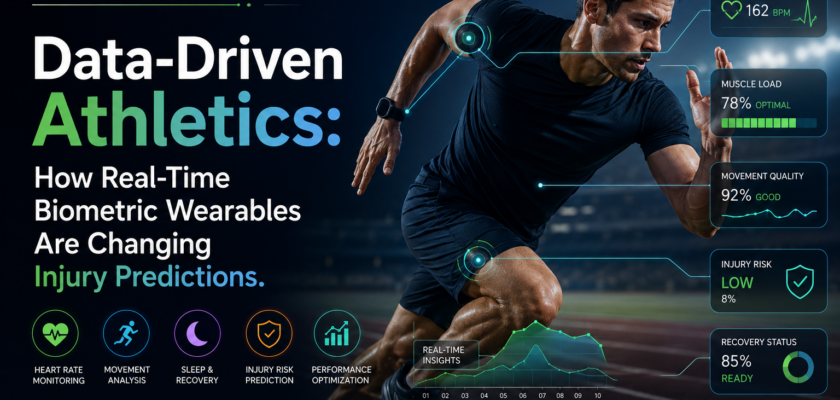
Data-Driven Athletics: How Real-Time Biometric Wearables Are Changing Injury Predictions.
In elite sports, the line between an athletic milestone and a season-ending disaster is measured in millimeters and milliseconds. For decades, sports medicine relied heavily on reactive, subjective metrics. A trainer would ask an athlete how they felt, check their basic range of motion during a standard screening, and cross their fingers that an overused tendon wouldn’t snap on the next play.
As we progress through May 2026, that guessing game has officially ended. The global sports injury prediction market has surged to a staggering $2.25 billion, signaling a massive migration away from traditional, slow diagnostic timelines.
We are living in the era of Biometric Wearables Injury Prediction 2026.
Today’s elite training grounds no longer treat physical breakdowns as unavoidable accidents. By capturing thousands of baseline parameters per second and running them through sophisticated machine learning models, sports scientists are achieving Autonomous Precision in catching soft-tissue damage, physiological imbalances, and dynamic joint structural risks before symptoms even register physically to the athlete.
1. The Multimodal Sensor Stack: The Body as a Live Feed
To achieve the precise data required for modern Biometric Wearables Injury Prediction 2026 models, teams have abandoned single-signal approaches. Relying on just a standalone GPS pod or a basic heart rate wristband is recognized as an operational liability that leaves massive blind spots.
Modern athletic systems deploy a unified, low-friction sensor stack that captures both internal physiological strain and external biomechanical force simultaneously:
- Inertial Measurement Units (IMUs): Lightweight, multi-axis accelerometers and gyroscopes embedded directly into smart compression garments or protective gear analyze exact skeletal kinematics. They measure joint angles, angular velocity, and shock distribution at 3D coordinate layers.
- Surface Electromyography (sEMG): Microscopic, skin-facing textile sensors continuously map muscle activation patterns, measuring the direct electrical output of key muscle groups during high-velocity movements.
- Advanced Autonomic Trackers: High-frequency optical sensors continually log subtle Heart Rate Variability (HRV) fluctuations, tracking real-time nervous system adaptations to signal hidden systemic fatigue.
2. Deconstructing the Prediction Matrix: How AI Catches the Breakdowns
Raw sensor streams generate a chaotic wave of information. The breakthrough relies on specialized edge-computing architectures that clean, synthesize, and run this multi-modal payload through local machine-learning classifiers with near-zero latency.
A. The ACL Instability Flag
Anterior Cruciate Ligament (ACL) tears typically occur during explosive jump landings or sudden cutting maneuvers. In the 2026 framework, as an athlete moves, a hybrid neural network processes the live IMU data stream.
If the model identifies an early joint-angle asymmetry crossing a 10-degree threshold—or captures a distinct, microscopic inward knee rotation (valgus dynamics) shortly after ground contact—it instantly flags a dynamic coordination deficit. This neural analysis provides a massive upgrade over baseline video tracking, catching dangerous landing mechanics with an accuracy rate of 92.3%.
B. Modeling Soft-Tissue “Physiological Drift”
Unlike structural joint injuries, conditions like hamstring strains or tendinopathies develop gradually over training cycles. AI engines manage this by continuously calculating the Acute-to-Chronic Workload Ratio (ACWR).
When a sudden spike in external practice load is paired with a dropping HRV decline rate and an irregular sEMG muscle imbalance crossing 15%, the platform identifies a “Physiological Drift”. The algorithm realizes the athlete’s body is failing to recover from the stress current, generating a predictive injury warning days before a physical tear manifests.
  [ High-Hz IMU Movement Data ]  ───┐
                                      ├──► [ Low-Latency AI Fusion Engine ] ──► [ Individualized Fatigue Twin ]
  [ sEMG Muscle Activation Feed ] ───┤               │                                    │
                                      │               ▼                                    ▼
  [ Continuous HRV Stress Logs ]  ───┘       [ Real-Time Alert ]               [ Prescriptive Workload Adjust ]
                                         "Asymmetry > 10° Detected"             "Reduce Intensity by 18%"
3. Strategic Matrix: Subjective Screening vs. Predictive Wearables
| Operational Parameter | Conventional Sports Medicine (Reactive) | Biometric Wearables Injury Prediction 2026 |
| Data Capture Philosophy | Subjective player logs; periodic manual tests | Continuous, real-time multimodal sensor streams |
| Data Ingestion Pacing | Asynchronous, retrospective review | Instantaneous (Under 190ms computational feedback) |
| Biomechanical Accuracy | Visible human error; limited to camera paths | Automated tracking of micro-joint strain & asymmetry |
| Workload Strategy | Pre-set, generic calendar timelines | Dynamic, tailored load balancing per session |
| Risk Landscape | High incidence of unpredicted soft-tissue tears | Minimized Risk (Highly preemptive intervention loops) |
4. Individualization via Digital Twins: The Next Competitive Frontier
The industry is rapidly shifting away from broad, standardized group metrics. Because every human body possesses highly unique structural tolerances, standard threshold models frequently introduce an element of uncertain returns.
To bridge this gap, elite athletic programs are deploying Digital Twins. The cloud platform aggregates months of personal historical performance metrics, past injury data, and micro-movement baselines to construct a personalized virtual model of the player’s unique anatomy.
When the live wearable stream deviates from that specific athlete’s clean baseline, a tailored alert is dispatched directly to the coaching staff’s tablet. The data is highly prescriptive; it doesn’t just say “rest,” it outlines an exact training reduction—such as reducing cutting intensity by 18% for the next session—to allow the micro-trauma to heal while maintaining peak cardiovascular conditioning.
Conclusion
The integration of Biometric Wearables Injury Prediction 2026 models marks a permanent evolution in the nature of athletic preparation. By converting the human body’s complex physiological and mechanical variables into clean, actionable, and real-time data feeds, sports science has successfully moved from reactive recovery to predictive prevention.
Shedding the slow, manual diagnostics of the past allows sports organizations to protect their most valuable assets with uncompromised accuracy. In the modern competitive arena, the teams that dominate the standings are no longer just those that train the hardest, but those that run the most sophisticated data pipelines to keep their elite talent safely on the field.


