
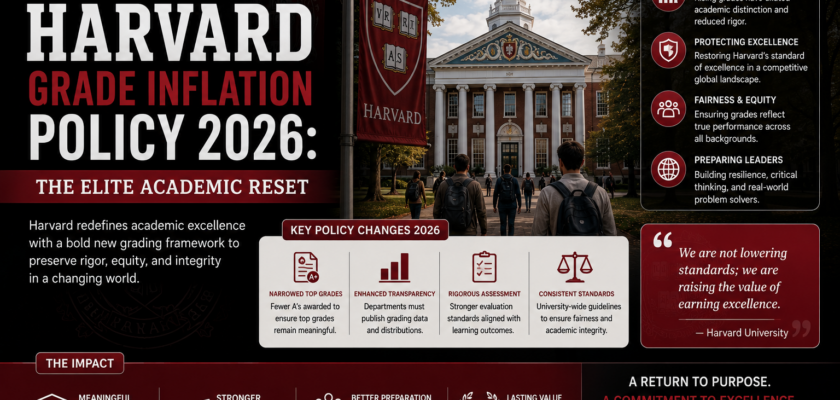
The Harvard Grade Crackdown: Why Elite Universities Are Purging Grade Inflation in 2026.
The rubber-stamped Ivy League transcript is officially facing an administrative execution. For decades, the definition of academic excellence at elite universities has suffered from systemic dilution. What once served as a mark of extraordinary intellectual distinction has steadily transformed into a baseline expectation, rendering the traditional grade point average increasingly meaningless to employers and graduate admissions boards alike.
This week, the epicenter of American academia initiated a historic correction. On Wednesday, May 20, 2026, the Harvard Faculty of Arts and Sciences voted overwhelmingly to pass a sweeping grading reform.
The landmark decision establishes the Harvard Grade Inflation Policy 2026 framework. Designed to shock the undergraduate culture back into structural rigor, the mandate introduces hard, mathematical quotas on top-tier evaluations.
As elite institutions scramble to protect their institutional credibility from absolute credential bankruptcy, the message from Cambridge is clear: the era of the “easy Ivy A” is dead. Here is a breakdown of the structural mechanics behind the crackdown, the internal faculty data that triggered it, and the cascading impact it will have on the global talent pipeline.
1. The “20 Plus Four” Rule: Re-Engineering the Ivy Transcript
The core mechanism of the newly approved policy—scheduled to formally take effect in the fall semester of 2027—replaces faculty discretion with absolute structural limits.
                    [ The Harvard Grading Architecture ]
                                     │
         ┌───────────────────────────┴───────────────────────────┐
         ▼                                                       ▼
┌─────────────────────────────────┐                     ┌─────────────────────────────────┐
│     Legacy Blurry System        │                     │   The 2027 Capping Formula      │
│ • Over 60% of all grades are As │                     │ • Strict 20% cap on pure As     │
│ • No boundary lines on merit    │                     │ • Plus 4 additional slots buffer│
│ • "Tyranny of the Perfect GPA"  │                     │ • Evaluated by Percentile Rank  │
└─────────────────────────────────┘                     └─────────────────────────────────┘
Rather than allowing professors to distribute top marks freely, Harvard is introducing a rigid capping formula. Under the “20 plus four” baseline rule:
- The Mathematical Quota: Instructors in standard letter-graded undergraduate courses are legally permitted to award an absolute “A” grade to no more than 20% of the enrolled class, plus a fixed buffer of four additional students.
- The Classroom Breakdown: In a standard lecture of 80 undergraduates, a maximum of 20 students can walk away with an A. In a hyper-competitive seminar of 20 students, only eight pure A marks can legally be recorded.
- The Honor Reset: In a parallel 458-to-201 vote, the faculty approved a total restructuring of internal awards and prizes. Instead of sorting students by razor-thin, inflated cumulative GPAs, the university will transition to a system built purely on average percentile rankings.
2. Deconstructing the Data: Inside the 60% Crisis
The administrative momentum driving this aggressive policy change was catalyzed by an uncompromised internal review led by Amanda Claybaugh, Dean of Undergraduate Education. The findings exposed an educational ecosystem suffering from deep structural hollowing.
University tracking data revealed a massive trajectory shift over the past two decades. In 2005, straight “A” grades represented a modest 24% of all marks distributed across the college. By 2015, that ratio climbed to 40%. Following the disruptions of remote pandemial learning, the metric exploded, revealing that more than 60% of all undergraduate grades awarded at Harvard sat squarely in the A range.
As professors like Latin American studies expert Steven Levitsky noted, the hyper-inflation completely erased the boundary line between a true performance of extraordinary distinction and a student who simply mastered the basic formatting of a standard essay.
The rampant inflation triggered a profound race to the bottom. Professors who maintained traditional, rigorous grading standards saw their course enrollments drop sharply as students strategically migrated toward lighter, high-grade options to protect their perfect records.
3. Strategic Matrix: Inflated Ivy Era vs. 2026 Grade Reform
| Academic Dynamic | The Post-Pandemic Inflated Ivy Era | Harvard Grade Inflation Policy 2026 |
| Top-Tier Density | Massive (60%+ of all undergraduate marks are As) | Strictly throttled via the “20 + four” rule |
| Academic Risk Appetite | Low (Students dodge hard courses to guard GPAs) | High (Reduces the tyranny of a perfect transcript) |
| Prizes & Distinctions | Judged on blurred, nearly identical GPA scales | Determined entirely by average percentile rank |
| A-Minus Buffer Lane | Merged seamlessly with straight As on paper | Uncapped; provides a soft landing zone for GPAs |
| Student Risk Profile | Severe anxiety over minor decimal changes | Minimized Risk; restores real signaling trust |
4. Systemic Backlash and the AI X-Factor
Unsurprisingly, the administrative decision has triggered massive institutional friction across the student body. In a comprehensive campus survey, a massive 85% of undergraduate respondents expressed intense disapproval of the proposals, warning that a mandatory curve will fuel toxic classroom competition, isolate peers, and heighten mental health stresses.
Furthermore, some faculty members highlight a deep operational blind spot: the policy focuses entirely on fighting historical patterns while ignoring the modern catalyst accelerating grade inflation today—Generative AI.
As advanced LLMs become completely embedded within student workflows, separating authentic student synthesis from a perfectly prompted, bot-assisted paper has become nearly impossible for an isolated professor to track.
By clamping down exclusively on the final grade count without providing structural tools to detect artificial optimization, the policy risks turning classrooms into a high-stakes abacus maze. Students may become hyper-strategic, utilizing private AI nodes to polish assignments to a mechanical perfection simply to secure one of the scarce, legally permitted A-grade slots within the new 20% limit.
Conclusion
The implementation of the Harvard Grade Inflation Policy 2026 represents a necessary, albeit painful, cultural reset for higher education. For years, the fear of campus friction and the consumer-driven demands of high-tuition education forced universities to hand out empty accolades, hollowing out the value of an elite degree from the inside out.
By installing a hard, mechanical floor beneath academic evaluation metrics, Harvard is stepping up to govern itself.
The shift forces a major realignment across corporate recruiting networks and elite graduate schools. A transcript from an elite college will finally mean exactly what it says on the paper, returning the A grade to its original definition: a rare mark of uncompromised, extraordinary human distinction.


