


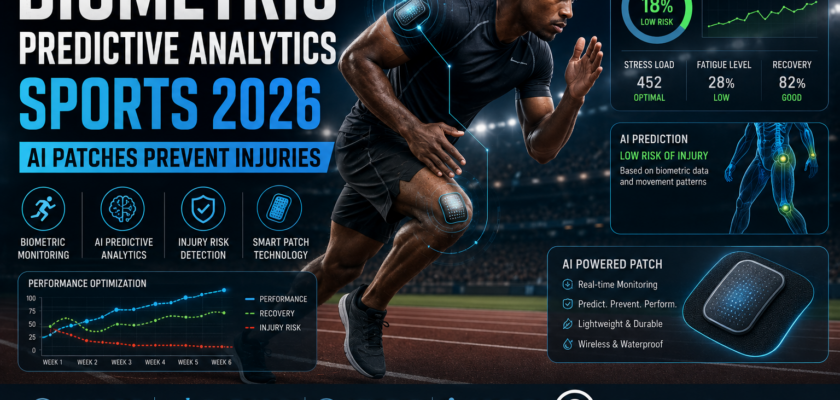
Biometric Predictive Analytics: How AI-Fitted Jersey Patches Prevent In-Game Muscle Injuries.
In professional sports, the cost of a non-contact soft tissue injury is an absolute disaster for both team strategy and financial planning. For decades, training staffs handled muscle strains, hamstring tears, and groin pulls using a purely reactive framework: an athlete pushes their body to a breaking point mid-game, snaps a muscle fiber on a hard sprint, and is immediately sidelined for a multi-week rehabilitation layout. Traditional monitoring relied heavily on subjective post-game surveys, static morning heart-rate variability (HRV) checks, or basic GPS vest data reviewed hours after the final whistle blew.
But as we advance through May 2026, sports medicine is undergoing a historic evolution from a healing discipline into an active, data-driven system of predictive risk management.
We have entered the defining era of Biometric Predictive Analytics Sports 2026 trends. Driven by intense advancements in flexible electronics and real-time edge computing, elite franchises across the NFL, English Premier League, and NBA are abandoning bulky external tracking pods.
Instead, they are seamlessly embedding multi-sensor AI-fitted smart patches directly into the fabric of team jerseys.
These hyper-lightweight, textile-integrated patches continuously analyze the complex relationship between an athlete’s physiological limits and mechanical movements. By transforming live sweat chemistry, localized muscle heat, and stride micro-deviations into an active safety shield, this technology enables coaches to pull high-risk players before a catastrophic tissue failure occurs.
1. The Hardware Architecture: Smart Patches Move On-Chain
The breakthrough of modern jersey patches lies in their hyper-flexible, non-invasive physical design. Unlike rigid, first-generation wearable pucks that shift during high-velocity collisions, 2026 smart patches utilize flexible synthetic threads that stretch naturally with an athlete’s body.
                 [ The Multimodal Data Fusion Network ]
        (Fuses Bio-Signals to Detect Subtle Mechanical Degradation)
                                    │
                                    ▼
                 [ The AI-Fitted Fabric Jersey Patch ]
   (Continuous Edge Computing ──► Real-Time Tokenized Telemetry Streams)
                                    │
         ┌──────────────────────────┴──────────────────────────┐
         ▼                                                     ▼
┌─────────────────────────────────┐               ┌─────────────────────────────────┐
│     Physiological Ingestion     │               │     Biomechanical Tracking      │
│ • Real-time ECG & HRV sampling  │               │ • High-Hz inertial IMU nodes    │
│ • Electrodermal fatigue monitoring│             │ • Micro-acceleration changes    │
│ • Localized muscle heat mapping │               │ • Stride asymmetry detection    │
└─────────────────────────────────┘               └─────────────────────────────────┘
         │                                                     │
         └──────────────────────────┬──────────────────────────┘
                                    ▼
                      [ Edge AI Predictive Engine ]
          (Generates Live Probability Scores for Muscle Tears)
Behind the team logos and sponsor branding, these patches hold highly advanced sensor networks. They combine high-frequency Inertial Measurement Units (IMUs), microscopic skin-temperature arrays, and integrated optical channels into a single connected fabric layout.
Operating on a framework of absolute data continuity, the patch captures multi-source biometric signals natively during live gameplay. It processes an athlete’s micro-movements, heart rhythm shifts, and local muscle heat variations without introducing a single millisecond of lag or affecting athletic range of motion.
2. The Multimodal Engine: Catching the Invisible Micro-Limp
Why are AI-powered jersey patches succeeding where standard fitness trackers failed? The answer lies in a machine learning capability known as multimodal data fusion. Soft tissue injuries are rarely caused by a single, isolated problem; they occur due to a compounding chain reaction where physiological exhaustion forces a biomechanical breakdown.
The Cross-Domain Signal Matrix:
- Detecting Hidden Fatigue: As a player hits a state of systemic exhaustion, their heart rate variability profile tightens while their core body temperature spikes.
- The AI Core Review: The embedded Transformer neural networks do not look at these numbers in isolation. The predictive model matches the physiological fatigue against live motion data coming from the internal IMUs.
- The Critical Alert: If the AI engine flags that an athlete’s left hamstring is absorbing a sharp 4.2% increase in deceleration impact force while their running stride shows a microscopic, humanly invisible micro-limp, the system identifies a structural failure risk. The algorithm generates an immediate predictive score, warning training staffs that a non-contact muscle tear is imminent if the player remains on the field.
3. Strategic Matrix: Legacy Wearables vs. 2026 Biometric Analytics
| Performance Layer | Legacy Sports Wearables (Pre-2025) | Biometric Predictive Analytics Patches (2026) |
| Form Factor Integration | Bulkier external pods; rigid GPS chest straps | Ultra-thin, zero-gravity fabric jersey patches |
| Data Architecture | Single-source data silos (GPS-only or HRV-only) | Multimodal sensor fusion (Physiological + Kinematic) |
| Analytics Processing | Post-session downloads; reactive clinical reviews | Real-time edge computation with instant alerts |
| Prediction Capabilities | Descriptive workload charts; simple averages | Upwards of 90% accuracy in acute injury forecasting |
| Risk Characterization | High risk of missing sudden, acute fatigue shifts | Minimized Risk; continuous closed-loop safety tracking |
4. Protecting the Human Asset: De-Risking the Sports Franchise
The rapid adoption of Biometric Predictive Analytics Sports 2026 systems is heavily driven by intense economic realities. Modern professional sports franchises treat player contracts as premium capital assets, with elite player payrolls frequently crossing hundreds of millions of dollars. When a star athlete sits on the bench due to a preventable muscle strain, it represents a massive waste of organizational capital and directly compromises a team’s championship window.
Data reviews show that organizations utilizing continuously adaptive, integrated predictive modeling have seen team soft-tissue injury rates tumble from 11.2% down to a lean 6.1% in a single competitive season.
  [ Live Patch Ingestion ] ───► [ Real-Time Multi-Sensor Fusion ] ───► [ 90% Injury Prediction Accuracy ]
                                                                                   │
                                                                                   ▼
                                                                     [ Live Coach's Dashboard Alert ]
                                                                     "Pull Player for 4-Minute Active Rest"
                                                                                   │
                                                                                   ▼
                                                                     [ Immediate Risk Mitigation ]
                                                                  "Soft-Tissue Tear Rate Drops by Half"
This massive drop in injury rates completely alters how coaches run game strategy. If a star player’s live patch metrics flag an active structural risk, the head coach receives an automated notification on their sideline tablet suggesting a short, four-minute substitution block.
This brief rest window allows local muscle inflammation parameters to clear, restoring physiological stability and mitigating injury risk without forcing the player out of the game entirely.
By trading old school, grit-based intuition for the absolute clarity of real-time predictive analytics, sports programs are engineering an un-bottlenecked path to victory—proving that the best way to win a championship is to ensure your most valuable assets stay healthy enough to play the game.
Conclusion
The old school era of treating in-game soft tissue injuries as unavoidable pieces of bad luck is officially over. The widespread expansion of the Biometric Predictive Analytics Sports 2026 market proves that true technological innovation is at its best when it seamlessly protects human physical longevity.
By sweeping away the disconnected, slow data silos of the past and replacing them with hyper-precise, textile-integrated smart patches, sports science is building a high-trust shield around the modern athlete.
We are moving past the outdated abacus maze of reactive medicine to build a proactive ecosystem of continuous biometric care. As these flexible sensor systems continue to scale down in cost and expand out to amateur sports, they will permanently rewrite the rules of physical conditioning—ensuring that every player can push their physical limits safely, precisely, and with absolute confidence.


