

Google Reshuffles Gemini: Moving to Compute-Based Usage Models for AI Pro Subscribers.
The billing economics of consumer generative artificial intelligence have officially outgrown the simplistic “per-prompt” framework. Since the inception of commercial large language models, tech giants relied on flat, uniform query caps to regulate user traffic. Under the old model, a simple two-word text greeting and an incredibly complex, multi-thousand-token programming script were treated as equal transaction weights against a subscriber’s daily quota.
However, as we cross past the announcements of Google I/O 2026, that rudimentary layout has been permanently dismantled.
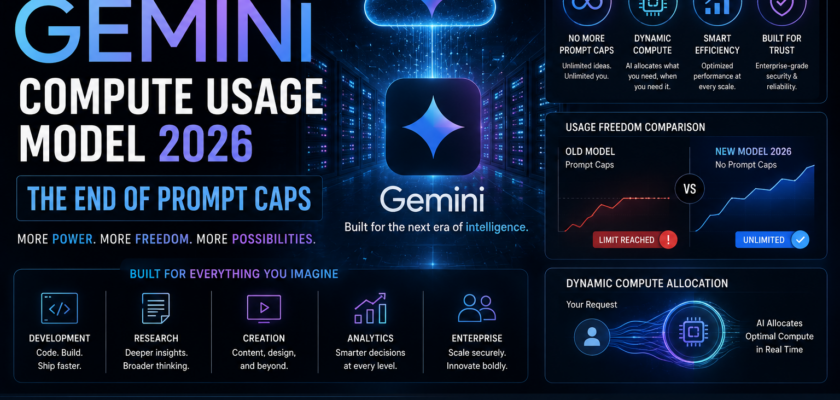
Faced with the massive infrastructure costs of true multimodal inputs, Google has rolled out a total structural overhaul of its ecosystem. Moving away from predictable daily caps, the enterprise has officially deployed the Google Gemini Compute Usage Model 2026.
Effective immediately for all free tiers and paid tiers—including the revamped Google AI Plus ($7.99/mo), AI Pro ($19.99/mo), and the newly tier-split AI Ultra ($99.99 to $200/mo) configurations—Gemini will measure usage based on real-time computational complexity. Here is how the new algorithmic quota system works, the removal of legacy perks, and what it means for high-yield workflows.
1. Deconstructing Compute-Based Quotas: How the Math Shifts
The core mechanism of the new system shifts the billing focus from frequency to resource intensity. Under the Google Gemini Compute Usage Model 2026 paradigm, the Gemini app actively calculates quota drain based on three dynamic vectors: prompt complexity, utilized sub-features, and total chat thread length.
                 [ The 2026 Compute Consumption Scale ]
                                    │
         ┌──────────────────────────┴──────────────────────────┐
         ▼                                                     ▼
┌─────────────────────────────────┐               ┌─────────────────────────────────┐
│     Low-Compute Triggers        │               │     High-Compute Burners        │
│ • Straight text-based queries   │               │ • Multimodal Gemini Omni video  │
│ • Quick conversational replies  │               │ • Deep Research synthesis runs  │
│ • Simple code snippet proofing  │               │ • Extended context "Deep Think" │
└─────────────────────────────────┘               └─────────────────────────────────┘
         │                                                     │
         └──────────────────────────┬──────────────────────────┘
                                    ▼
                     [ Real-Time Micro-Quota Engine ]
           (Refreshes Every 5 Hours Until Weekly Cap Is Met)
Instead of resetting once every 24 hours, usage limits now refresh every 5 hours, backed by an overarching weekly ceiling.
- The Low-Compute Lane: Standard text queries or quick translations draw minimal compute power, allowing casual users to stay well within their limits without operational constraints.
- The High-Compute Lane: Resource-heavy operations—such as video generation using the new Gemini Omni model, executing comprehensive multi-source Deep Research passes, or running extended logic via Deep Think—will drain a user’s 5-hour quota exponentially faster.
- The Soft Landing Mechanism: To prevent sudden access cutoffs, subscribers who exhaust their compute quota will no longer find their accounts locked out. Instead, the system automatically downgrades the session to a lighter, more resource-efficient model (like the newly debuted Gemini 3.5 Flash) until the 5-hour refresh cycle clears.
2. The Paid Tier Hierarchy: Usage Weights Compared
To clear up confusion across its user base, Google has mapped out strict, multiplier-based access tiers. While the exact underlying token allocations remain hidden behind proprietary walls, the structural allowances scale up progressively across plans:
| Subscription Tier | Monthly Cost (USD) | Compute Quota Volume vs. Free Baseline | Core Plan Inclusions & Storage Allocations |
| Free Tier | $0.00 | Standard Baseline | Standard model versions; base storage ceilings. |
| Google AI Plus | $7.99 | 2x Higher Limit | 200GB cloud storage, AI Inbox, Gemini Omni. |
| Google AI Pro | $19.99 | 4x Higher Limit | 5TB cloud storage, YouTube Premium Lite, Pro Models. |
| Google AI Ultra | $99.99 | 20x Higher Limit | 20TB storage, Gemini Spark Agent, YouTube Premium. |
| Google AI Ultra Premium | $200.00 | Uncapped Baseline | 20TB storage, Project Genie world-building engine. |
3. The Developer Backlash: Removal of the 1,000 Credit Perk
While Google emphasized the introduction of premium perks at I/O—such as bundling YouTube Premium Lite into the Pro tier and adding Home/Health Premium access at no extra charge—power users quickly uncovered a significant pain point in the fine print.
The rollout of the Google Gemini Compute Usage Model 2026 framework explicitly removes the 1,000 monthly standalone AI credits that were previously bundled into the AI Pro subscription.
This sudden removal has sparked widespread criticism across developer communities and tech forums. For professionals who relied on those steady credits to power media generation pipelines, build external prototypes, or run heavy agent testing, the new model introduces unpredicted friction.
To keep high-demand workflows running smoothly without model downgrades, power users are now forced to purchase specialized, pay-as-you-go top-up credits for tools like Google Antigravity and Google Flow.
4. Strategic Matrix: Product-Based Quotas vs. 2026 Compute Billing
| Operational Vector | Legacy Product-Based Subscription Era | Google Gemini Compute Usage Model (2026) |
| Quota Metric | Fixed caps tracking total daily prompt counts | Real-time calculation of algorithmic weight |
| Refresh Window | Rigid 24-hour fixed reset boundaries | High-frequency 5-hour rolling refresh phases |
| Cap Exhaustion Result | Complete lockouts or absolute prompt freezes | Graceful downgrades to fast Gemini 3.5 Flash |
| Add-On Capabilities | None; users had to wait for daily clock resets | Pay-as-you-go top-up tokens for advanced apps |
| Risk Characterization | High computing resource waste for basic queries | Minimized Risk; resource-matched corporate efficiency |
Conclusion
Google’s strategic transition toward resource-matched billing marks the end of open-ended, unlimited AI experimentation. The Google Gemini Compute Usage Model 2026 configuration proves that the intense infrastructure realities of processing large-scale video inputs, multi-tiered logic loops, and autonomous background agents are forcing tech giants to act with fiscal discipline.
While casual users will likely enjoy the fast, uninterrupted performance of the 5-hour rolling reset cycles, developers and digital creators must move past chaotic prompt testing. They must learn to treat prompts as direct cloud expenditures.
By trading old school, predictable prompt caps for an adaptive model that directly matches usage complexity, Google is building a sustainable economic blueprint for the agentic era. Success in this new landscape means steering clear of messy, unoptimized chat histories, running clean engineering queries, and managing your compute resources with absolute precision.


