
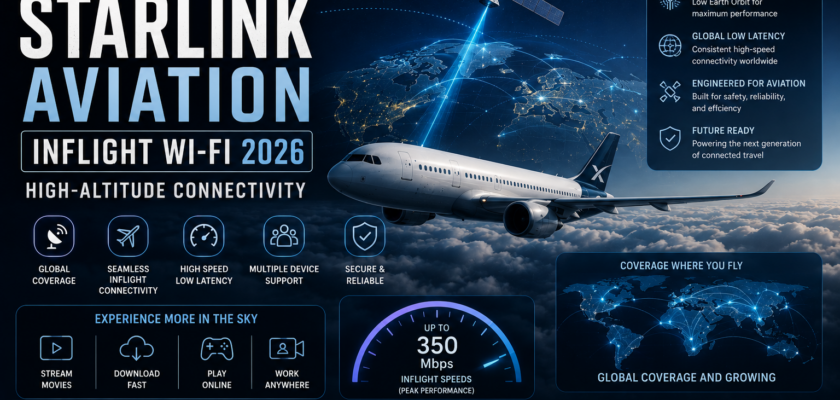
SpaceX Starlink Tourism: How Global Flight Networks are Introducing High-Altitude Hyper-Connectivity.
For decades, the standard commercial flight cabin existed as the final, frustrating dead zone of the modern digital landscape. While terrestrial networks scaled rapidly through fiber-optic speeds and 5G cellular rollouts, checking into a long-haul international flight meant entering a state of absolute communication restriction. Passengers were forced to rely on legacy in-flight internet frameworks—unstable systems plagued by sluggish page loads, severe dropouts, and frustrating restrictions that blocked data-heavy applications. If you wanted to load a basic text email or send a single chat message over the ocean, you had to navigate a high-friction paywall for an experience that felt like early-2000s dial-up.
But as we cross through May 2026, that altitude-based data bottleneck has been permanently shattered. Driven by a massive structural shift in global aviation logistics, airlines are turning cabin connectivity into a premium, standard amenity rather than a paid luxury.
At the absolute center of this transformation is the explosive rollout of Starlink Aviation Inflight Wi-Fi 2026 systems.
By trading the distant, slow architecture of legacy systems for a dense, low-Earth orbit (LEO) satellite mesh, SpaceX is establishing home-broadband performance at 35,000 feet. As major global carriers rapidly retrofit their long-haul and regional fleets, high-altitude hyper-connectivity is fundamentally redefining global aviation tourism.
1. The LEO Advantage: Dismantling the 600ms Latency Trap
To understand the massive jump in performance delivered by the Starlink Aviation Inflight Wi-Fi 2026 platform, we must look at the underlying orbital physics. Legacy in-flight internet providers depend entirely on massive Geostationary (GEO) satellites parked at an extreme altitude of approximately 35,800 kilometers above the equator. Because data signals have to travel an immense distance to space and back, these connections suffer from an unshakeable, built-in latency of 600 to 1,000 milliseconds, a delay that completely breaks real-time corporate applications, live streaming, and gaming protocols.
                 [ The In-Flight Architecture Leap ]
                                  │
         ┌────────────────────────┴────────────────────────┐
         ▼                                                 ▼
┌─────────────────────────────────┐               ┌─────────────────────────────────┐
│   Legacy GEO Satellite Paths    │               │   Starlink LEO Constellation    │
│ ❌ 35,800 km Extreme Distance   │               │ ✅ ~550 km Low-Earth Orbit     │
│ ❌ 600ms+ High Latency Lag      │               │ ✅ Sub-99ms Ultra-Low Latency   │
│ ❌ Ocean & Polar Signal Blinds  │               │ ✅ Inter-Satellite Laser Mesh   │
└─────────────────────────────────┘               └─────────────────────────────────┘
         │                                                 │
         └────────────────────────┬────────────────────────┘
                                  ▼
                    [ The 2026 Passenger Realization ]
               (Free, Un-Bottlenecked 4K Streaming for All)
Starlink completely rewrites this operational architecture. Operating a massive fleet of more than 10,000 active satellites orbiting in a low-Earth ring down around 550 kilometers, the constellation shrinks signal physical travel distances by a staggering 98%.
This extreme proximity drops high-altitude latency to under 99 milliseconds in real-world operation. Furthermore, because the satellites utilize highly advanced optical space lasers (Inter-Satellite Links) to bounce data packets directly across the vacuum of space at up to 200 Gbps, the network operates flawlessly across vast oceans, remote deserts, and high-altitude polar routes where legacy systems completely lose coverage.
2. The 35,000-Foot Speeds: What the Telemetry Proves
Aviation data logs from mid-2026 reveal that Starlink is delivering unprecedented data depth straight to moving airframes. Standard cabin connections across equipped widebody aircraft are recording stable, uncompromised parameters:
- Download Capacity: Ranges continuously between 135 Mbps and 310 Mbps per aircraft, with localized peaks stretching past 450 Mbps under optimal routing configurations.
- Upload Velocity: Holds steady between 20 Mbps and 44 Mbps, allowing executive travelers to easily back up large cloud directories, push high-definition video files, and stream live presentations effortlessly from their seats.
- Simultaneous Access Freedom: The sheer bandwidth available means that every single passenger on a packed, multi-class international flight can stream independent 4K video feeds, jump into corporate VPN networks, or participate in live video conferences simultaneously without a single drop in signal quality.
3. The Fleet Race: 36 Major Carriers Move In
The transition toward Starlink Aviation Inflight Wi-Fi 2026 models is no longer a localized luxury test; it has evolved into an aggressive global fleet race. As of May 2026, 36 major international airlines have formally committed to integrating Starlink across their operational fleets to insulate themselves from brand attrition.
A. The Transatlantic Pioneers
- British Airways & Virgin Atlantic: British Airways has officially begun launching equipped long-haul flights, with test flights registering stellar baseline data. Concurrently, Virgin Atlantic has pulled forward its deployment schedule. Live installations across its Airbus A350 fleet are going active this May, introducing free, uncapped high-speed Wi-Fi as a standard loyalty perk for its Flying Club members.
B. The Mass Domestic Overhauls
- United Airlines & Southwest: United Airlines has established itself as an aggressive frontrunner, outfitting more than 300 regional and mainboard aircraft on its path to cross a massive 800-plane installation target by the close of the year. Southwest Airlines has mirrored this push, executing an aerodynamic overhaul by mounting low-profile, electronically steered aeronautical terminals across 300 of its Boeing 737 aircraft to drive member engagement within its Rapid Rewards ecosystem.
4. Strategic Matrix: Legacy Cabin Wi-Fi vs. Starlink Aviation Ecosystems
| Performance Metric | Legacy Geostationary (GEO) Providers | Starlink Aviation LEO Constellation (2026) |
| Average Download Speeds | 5 to 15 Mbps (Shared across an entire cabin) | 135 to 310 Mbps (Sustained peak performance) |
| System Signal Latency | Exceptionally high (600ms to 1,000ms lag) | Ultra-low, responsive sub-99ms profiles |
| Oceanic/Polar Coverage | Highly fractured; frequent dead-zone drops | Flawless global mesh via space lasers |
| Passenger Monetization | Restrictive, tiered premium paywall portals | Free, un-capped entry via loyalty programs |
| Hardware Drag Profile | Bulky, high-profile physical protective humps | Sleek, low-profile aerodynamic terminals |
5. The Economics of Aerodynamic Retrofitting
Deploying the Starlink Aviation Inflight Wi-Fi 2026 architecture requires an uncompromised upfront capital layout from airline operators. The physical retrofitting process centers on mounting an 85-pound (38.5 kg), electronically steered phased-array antenna directly onto the upper fuselage of the aircraft.
  [ Capital Fleet Investment ] ───► [ $170k - $300k Terminal Installation Per Plane ]
                                                 │
                                                 ▼
                                  [ Aerodynamic Engineering ]
                             "Low-Profile Antenna Minimizes Fuel Burn"
                                                 │
                                                 ▼
                                  [ Long-Term Value Capture ]
                             "Drives Premium Brand Loyalty & Bookings"
Each specialized installation costs between $170,000 and $300,000 USD per aircraft, depending on specific fleet layouts and existing electrical compatibility.
However, airlines are discovering that this investment pays immediate operational dividends. Unlike older, bulbous satellite domes that create massive aerodynamic drag, Starlink’s ultra-low-profile antenna contours smoothly against the airframe. This sleek profile significantly minimizes parasitic aerodynamic drag, actively reducing fuel burn penalties across multi-hour international cruise tracks.
By combining fuel efficiency with an unmatched passenger experience that attracts high-value corporate business travelers, the aviation industry is finding that LEO satellite adoption is the ultimate way to de-risk long-term capital investments.
Conclusion
The sweeping expansion of the Starlink Aviation Inflight Wi-Fi 2026 platform marks a permanent evolution in how humanity experiences global travel. It shatters the old, false narrative that true digital freedom must stop the moment an aircraft retracts its landing gear.
By clearing away the slow, high-friction paywalls of the geostationary era and replacing them with a high-speed, low-latency space laser mesh, SpaceX has transformed the airplane cabin from an isolated metal tube into a fully connected, high-productivity sky office.
The old abacus maze of monitoring scarce mega-byte limits while flying over the Atlantic is dead. As high-altitude hyper-connectivity cements itself as an absolute, non-negotiable baseline for airlines across the globe, it delivers a clear lesson to the broader tech ecosystem: true luxury isn’t about charging a premium for a restricted service—it is about leveraging advanced infrastructure to make seamless, un-bottlenecked connectivity a universal part of the journey.


