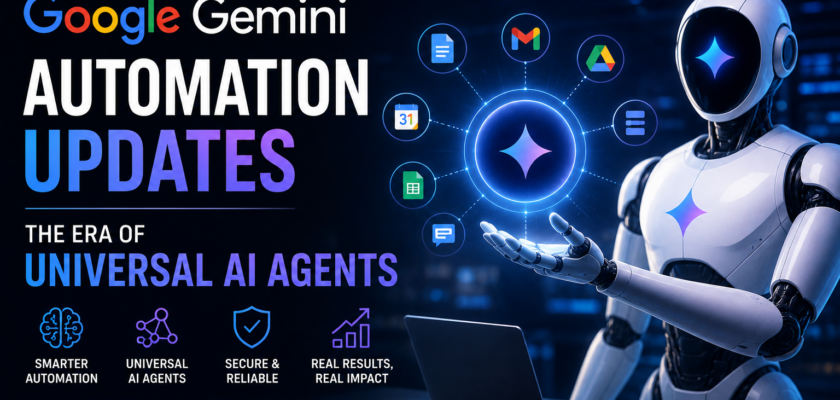
Universal AI Agents Take Over: How Gemini is Transforming From a Chatbot Into an Infrastructure Layer.
The era of conversational artificial intelligence has officially closed its first chapter. For the past three years, consumer and enterprise interactions with Large Language Models (LLMs) operated on a strictly reactive, single-turn foundation. A human user typed a prompt, waited for a chat interface to generate a text response, and manually copied that output into separate applications to get work done. While highly impressive as a search or drafting assistant, this framework suffered from a persistent operational constraint: the AI remained completely isolated from the user’s broader digital system, unable to take independent action or run continuously in the background without constant human supervision.
But following the massive, groundbreaking announcements dropped at Google I/O 2026, that passive chatbot paradigm has been completely dismantled. We are officially witnessing the birth of the Universal AI Agent.
The latest Google Gemini automation updates prove that Google is no longer positioning its flagship model family as a simple web tool. Instead, Gemini is being transformed into a persistent, deeply integrated infrastructure layer that operates across the entire internet and local device ecosystems.
Powered by the lightning-fast performance of Gemini 3.5 Flash and managed by the robust Antigravity 2.0 orchestration harness, these next-gen systems can plan multi-step workflows, coordinate parallel sub-agents, and continuously execute long-horizon enterprise tasks 24/7—even when your laptop is closed and powered down.
1. The Agentic Stack: Demystifying the Antigravity 2.0 Framework
The structural engine enabling Gemini to transition from simple text completion into an autonomous worker is Google’s heavily upgraded agent ecosystem. Rather than forcing developers to manually string together custom code libraries and external databases just to keep an AI running, Google has built agent capabilities directly into its infrastructure layer.
                     [ The 2026 Antigravity 2.0 Stack ]
                                      │
         ┌────────────────────────────┴────────────────____________┐
         ▼                                                         ▼
┌──────────────────────────────────┐              ┌──────────────────────────────────┐
│     The Gemini 3.5 Flash Core    │              │     The Managed Agents Sandbox   │
│ • Optimized for long-horizon tasks│              │ • Isolated secure cloud virtual VMs│
│ • Runs 4x faster token output rate│              │ • Persistent 24/7 background run │
│ • Massive agentic benchmark leaps│              │ • Native tool execution via MCP  │
└──────────────────────────────────┘              └──────────────────────────────────┘
                                      │
                                      ▼
                      [ Google Antigravity Orchestration ]
     (Coordinates Parallel Sub-Agents ──► Automates Complex Software Pipelines)
This structural shift operates across three specific developer-facing surfaces:
- The Antigravity 2.0 Engine: A powerful workspace that lets developers orchestrate multiple AI sub-agents in parallel, schedule automated background workflows, and securely link custom models directly to Google Cloud databases.
- The Managed Agents API: Built directly into the core Gemini API layer, this tool allows teams to package instructions, skills, and tools into a single POST request. Google’s infrastructure instantly builds and spins up the agent inside an isolated, secure sandbox, completely removing the hassle of managing background servers.
- The Model Components (MCP): To help agents interact with the real world, Google rolled out advanced MCP integrations with major platforms like Canva, OpenTable, Instacart, and Microsoft OneDrive—giving agents the direct power to book reservations, manage shopping lists, and update corporate directories autonomously.
2. Gemini Spark: The 24/7 Consumer Agent in the Cloud
While enterprise developers are using these tools to rebuild corporate software pipelines, the most visible, life-changing rollout for everyday users is Gemini Spark. Unlike older mobile voice assistants that only activate when called, Spark functions as a persistent digital companion running on dedicated virtual machines in Google Cloud.
Proactive Automation in Action:
- Continuous Document Auditing: Users can instruct Spark to continuously check their email inbox for specific operational files. It can automatically parse incoming monthly credit card statements, isolate micro-data trends, flag hidden subscription price jumps, and update your personal budget spreadsheet without a single manual click.
- The Daily Brief Agent: Operating seamlessly in the background, Spark coordinates with the new Daily Brief system to review your calendar, extract critical school or work deadlines from message threads, prioritize your morning tasks, and deliver a clean, narrated digest built perfectly for skimming before you head out the door.
3. Strategic Matrix: Chat-Based Assistants vs. Universal Infrastructure Agents
| Technology Axis | Legacy Chat-Based Assistants (Pre-2026) | Universal Infrastructure Agents (Gemini 3.5 Era) |
| Operational State | Reactive; triggers only on direct user prompts | Persistent; runs 24/7 continuously in the background |
| Execution Bounds | Short-term; provides single-turn text answers | Long-horizon; coordinates multi-step workflows |
| Local System Link | Restricted; works within a single browser tab | Native; operates across Chrome, Android, & Apps |
| Financial Security | None; unable to execute external payments | Secure; uses the Agent Payments Protocol |
| Risk Characterization | High risk of data gaps and constant user fatigue | Minimized Risk; tech-backed background automation |
4. Search Re-Engineered: The Rise of Generative UI Search Agents
The most profound, far-reaching impact of the Google Gemini automation updates will completely transform the foundational mechanics of search engine optimization (SEO) and online search. Google is rapidly moving away from its classic search design—where a user types a keyword and receives a static index page filled with ten blue website links.
The new system replaces static lists with Search Agents powered by a highly dynamic design framework called Neural Expressive.
  [ Single Multi-Variable Query ] ───► [ Persistent Search Agent Activation ]
                                                    │
                                                    ▼
                                     [ Continuous Web Scanning 24/7 ]
                                "Tracks Price Drops, Blogs, & Social Metrics"
                                                    │
                                                    ▼
                                     [ Custom Generative UI Assembly ]
                               "Lays Out Interactive Timelines & Data Graphs"
Users can now deploy continuous Information Agents to track the web around the clock. If you are looking for an apartment or tracking a product launch, these agents will actively monitor blogs, news sites, and real-time social posts for updates.
When a relevant change is detected, the agent doesn’t just send an alert; it uses Generative UI to build a custom results page tailored precisely to your query—assembling live data graphs, zoomable images, and interactive timelines in real time.
For content creators and businesses, this means old keyword-stuffing SEO tricks are officially obsolete. To remain visible in an agent-first world, websites must focus on producing high-authority, verifiable data and structured schemas that autonomous agents can seamlessly ingest and present to users—proving that the ultimate goal of modern search isn’t getting clicks, but providing direct utility.
Conclusion
The massive architectural leaps unveiled across the Google Gemini automation updates ecosystem mark a historic turning point in human-computer interaction. The old abacus maze of manually jump-routing data between separate browser tabs, checking multiple apps to coordinate a basic calendar schedule, and constantly tracking web updates is nearing its end.
By building a hyper-efficient, 24/7 background infrastructure layer powered by Gemini 3.5 Flash and Antigravity 2.0, Google is shifting the tech world from passive software usage to absolute delegation.
Of course, maintaining high governance and preventing unwanted spending will require absolute discipline under new systems like the Agent Payments Protocol. However, the efficiency gains for creative workflows, software engineering, and daily organization are undeniable. The chatbot era is officially a thing of the past—proving that the future of digital intelligence belongs to those who build the infrastructure to let agents work seamlessly for us.


