
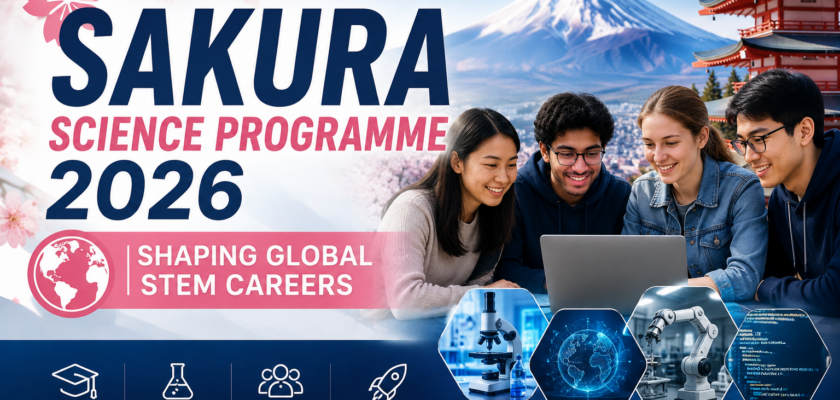
Sakura Science Programme 2026: How International Exchange Initiatives Are Shaping STEM Careers.
The traditional boundaries governing science, technology, engineering, and mathematics (STEM) education have completely shifted. For decades, pursuing a high-level scientific career meant following a highly localized academic pipeline: a student attended neighborhood institutions, learned exclusively from regional board curricula, and engaged in standard textbook experiments. Global scientific exposure was heavily gatekept—reserved almost entirely for senior doctoral researchers, corporate tech executives, or exceptionally wealthy university scholars who could afford the massive expenses of international study.
But as we cross through May 2026, that elitist educational dynamic is being dismantled. Recognizing that early global exposure is the ultimate way to trigger breakthrough innovation, governments are bringing experiential learning straight to young, talented students.
The definitive benchmark for this modern educational shift is the historic rollout of the Sakura Science Programme 2026.
Formally initiated on Saturday, May 23, 2026, the Department of School Education and Literacy (DoSEL), under the Ministry of Education, Government of India, officially flagged off a premium national student delegation at a ceremony held at NCERT, New Delhi.
This high-profile international student exchange Japan initiative gives young prodigies a fully funded, front-row seat inside the world’s most sophisticated technology ecosystem, forever changing how we cultivate the next generation of global innovators.
1. The One-Week Infiltration: How the Immersion Program Works
The core philosophy driving the Sakura Science framework is intensive, highly compressed experiential learning. Rather than burying students under a heavy mountain of technical theory, the program drops selected learners into actual, working world-class laboratories.
                [ The 2026 Sakura Science Launchpad ]
                                  │
         ┌────────────────────────┴────────────────────────┐
         ▼                                                 ▼
┌─────────────────────────────────┐               ┌─────────────────────────────────┐
│     The May 24–30 Deployment     │               │     The Elite Laboratory Access │
│ • 56 School Students Flagged Off│               │ • Top-tier university research  │
│ • 4 Expert Institutional Mentors│               │ • Masterclasses by Nobel Laureates│
│ • Fully funded by JST & DoSEL   │               │ • Advanced robotic/nanotech test│
└─────────────────────────────────┘               └─────────────────────────────────┘
         │                                                 │
         └────────────────────────┬────────────────────────┘
                                  ▼
                   [ Dynamic Brain Circulation ]
      (Fuses Cross-Cultural Friendships with High-Trust STEM Paths)
The May 24 to May 30, 2026 batch comprises an elite cohort of 56 school students (24 boys and 32 girls) alongside 4 specialized supervisors.
Representing government schools across 15 States and Union Territories—including Assam, Rajasthan, Gujarat, Maharashtra, Karnataka, and West Bengal—these young minds are travelling to Japan for a transformative one-week exploration.
During this intensive trip, students break out of standard classroom routines to tour top-tier Japanese research facilities, visit premier engineering universities, engage in real-time cross-cultural problem-solving workshops, and attend private masterclasses led by Japanese Nobel Laureates. This hands-on access provides an unmatched look at true technological excellence.
2. Radical Inclusion: Shifting the Merit Landscape via NMMS
What makes the Sakura Science Programme 2026 layout deeply impactful is its focus on meritocratic accessibility. Historically, elite international exchange invitations naturally gravitated toward affluent private schools in Tier-1 metropolitan centers. The Sakura initiative turns that old system completely on its head.
Empowering Grassroots Talent:
- The NMMS Foundation: Every single one of the 56 selected Indian students is an active beneficiary of the National Means-cum-Merit Scholarship (NMMS) Scheme.
- Bridging the Divide: This rigorous, nationwide scholarship format is explicitly designed to identify and financially protect exceptionally gifted students coming from lower-income families and rural districts.
- The Liftoff Effect: By giving a brilliant student from a village government school direct, cost-free access to advanced Japanese nanotech labs or robotics institutes, the program levels the academic playing field. It ignites an unshakeable passion for research that forever transforms their career trajectory.
3. Strategic Matrix: Conventional Classroom Learning vs. Sakura Immersion Exchanges
| Educational Axis | Traditional In-Classroom STEM Pedagogy | Sakura Science Program Immersion (2026) |
| Learning Methodology | Rote memorization; heavy text-based analysis | Holistic, hands-on experiential learning |
| Financial Entry Barriers | High costs for premium practical setups | 100% Free; fully funded by JST & DoSEL |
| Geopolitical Diversity | Monocultural; restricted to localized classrooms | Global; builds bonds with Ghana, Nigeria, & SA |
| Infrastructure Exposure | Standard school science labs and textbook slides | Top-tier universities & Nobel Laureate lectures |
| Risk Characterization | High risk of student boredom and conceptual drops | Withdrawn Risk; cross-border innovation fuels drive |
4. Aligning with NEP 2020: Accelerating International Brain Circulation
The broad, long-term expansion of the Sakura Science Programme 2026 model is not an isolated event; it is an active reflection of India’s overarching National Education Policy (NEP) 2020. A core tenant of the NEP framework is moving past isolated subject silos and replacing them with holistic, cross-disciplinary education.
  [ NEP 2020 Holistic Blueprint ] ───► [ Focus on Experiential Learning Out of Class ]
                                                     │
                                                     ▼
                                      [ Cross-Border Academic Sync ]
                                  "Japan Science & Technology Agency (JST)"
                                                     │
                                                     ▼
                                      [ Accelerated Brain Circulation ]
                                  "Prepares Modern Youth for Global Careers"
By working directly with the Japan Science and Technology Agency (JST), the Ministry of Education is turning this policy vision into a tangible reality.
Furthermore, this 2026 exchange program introduces an exciting geopolitical dynamic: the Indian cohort is exploring Japan alongside parallel student delegations from Ghana, Nigeria, and South Africa.
This diverse cultural mix turns a short trip into a powerful engine for what scholars term “international brain circulation”. When brilliant young minds from developing economies connect to solve problems using advanced Japanese equipment, they step out of old-school insular habits. They learn to think as global citizens, equipping themselves with the vision, networks, and confidence needed to tackle the world’s most complex challenges.
Conclusion
The spectacular liftoff of the Sakura Science Programme 2026 cohort signals a historic triumph for forward-thinking educational design. The old abacus maze of forcing students to look at grainy textbook diagrams of quantum processors or automated assembly lines is completely dead.
By clearing away financial barriers and providing talented rural scholars with direct access to top-tier universities, the Indian and Japanese administrations are building a powerful framework for future innovation.
This short exchange program doesn’t just offer an exciting travel opportunity; it acts as a permanent catalyst for high-trust scientific progress. As these 56 brilliant young minds complete their intensive week of study and return to their respective schools across India, they bring back a highly valuable asset: a deep, firsthand understanding of global innovation—proving that the best way to secure our technological future is to give our most promising young minds the wings to discover it.


