
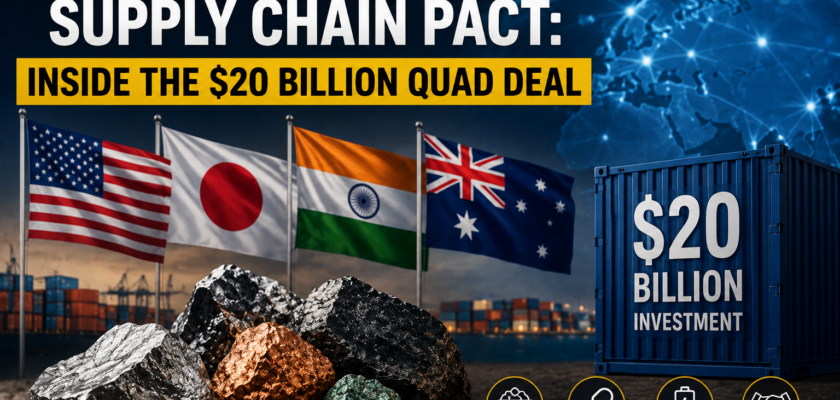
The $20 Billion Supply Chain Pact: Inside the New Quad Deal to Secure Critical Minerals.
The global industrial economy is executing a massive strategic realignment. For over a decade, manufacturing networks for advanced technologies functioned under a highly risky geographic bottleneck. Western and Asian democracies relied almost entirely on a single dominant marketplace for the refining, processing, and distribution of rare earth elements. These rare earth materials are completely vital to build electric vehicle batteries, high-performance semiconductors, renewable energy infrastructure, and modern defense systems. Consequently, any sudden export restrictions from the primary sourcing power immediately sent shockwaves through global electronics factories.
However, a historic diplomatic intervention has officially rewritten the rules of international resource management.
Meeting at the 11th Quad Foreign Ministers’ summit in New Delhi, the democratic alliance has launched a monumental defensive framework.
The newly firmed up critical mineral supply chain pact marks an unprecedented milestone in cross-border economic statecraft.
The joint framework brings together India, Australia, Japan, and the United States to systematically dismantle single-source monopolies. By committing to mobilize up to $20 billion in public and private capital, the alliance is transforming from a diplomatic discussion forum into a concrete investment machine. This shift aims to insulate global technology manufacturing from economic coercion and geopolitical supply disruptions.
1. The New Delhi Accord: Shifting From Words to Hard Capital
The core innovation of the newly unveiled Quad Critical Minerals Initiative Framework is its heavy focus on real-world financial deployment. For years, international mineral discussions produced soft cooperation statements but lacked the financial power to build alternative processing factories.
Therefore, the alliance has built a structured funding system to back strategic resource projects.
                     [ The Quad Resource Funding Loop ]
                                      │
         ┌────────────────────────────┴────────────────____________┐
         ▼                                                         ▼
┌──────────────────────────────────┐              ┌──────────────────────────────────┐
│    The $20 Billion Capital Pool  │              │     Targeted Project Profiles    │
│ • Links government funds with VC │              │ • Focuses on clear "Quad Nexus"  │
│ • Deploys high-utility guarantees│              │ • Operated by member-state firms │
│ • Extends low-friction loan lines│              │ • Feeds direct democratic markets│
└──────────────────────────────────┘              └──────────────────────────────────┘
                                      │
                                      ▼
                      [ Secure Downstream Distribution ]
         (Bypasses Single-Source Monopolies ──► Insulates Advanced Technology Tech)
The unified funding strategy coordinates public capital, export credit agencies, and development finance institutions to attract substantial private sector investment.
- The Financial Toolkit: The framework equips projects with public guarantees, direct loans, equity participation, and commercial off-take agreements. This approach lowers the financial risk of building complex mining operations.
- The Quad Nexus Rule: To qualify for support, a project must demonstrate a direct link to the alliance. This means operations must be located within member borders, run by alliance firms, or directly supply member manufacturing hubs.
- The Strategic Outcome: As a result, the alliance is creating a protected industrial loop that ensures long-term access to foundational materials. This safety shield allows innovation economies to grow without fear of sudden supply cutoffs.
2. Parallel Protections: The India-US Bilateral Rare Earth Framework
While the multi-nation Quad initiative focuses on long-term regional market structures, immediate bilateral actions are accelerating the pace of de-risking. On the sidelines of the central summit, India and the United States signed an independent, high-level Memorandum of Understanding (MOU) to secure rare earth supply chains.
  [ Bilateral Hyderabad Pact ] ───► [ Integrates Indian Mining with US Processing ]
                                                    │
                                                    ▼
                                     [ Streamlining Regulatory Approvals ]
                                "Shares Permitting Best Practices directly"
                                                    │
                                                    ▼
                                     [ Unified National Security Safeguards ]
                                "Blocks Hostile Non-Market Asset Takeovers"
Signed at Hyderabad House by India’s External Affairs Minister S. Jaishankar and US Secretary of State Marco Rubio, the agreement binds the two countries to deep technical and commercial integration.
The bilateral pact focuses heavily on building processing and recycling plants inside India, leveraging American technology and joint investments.
Furthermore, the two countries are combining their regulatory systems.
By sharing best practices to streamline permitting timelines and creating coordinated review boards to block hostile foreign investments in strategic mines, Washington and New Delhi are building a strong protective wall around their shared industrial assets.
3. Strategic Matrix: Fragmented Sourcing vs. Coordinated Quad Supply Chains
| Resource Dimension | Fragmented Legacy Mineral Supply Networks | Coordinated Quad Initiative Framework |
| Capital Mobilization | Isolated private attempts facing high risk limits | Up to $20 Billion in public and private support |
| Processing Footprint | Concentrated heavily within a single state monopoly | Diversified across resilient regional allied hubs |
| Financial Support Tools | Standard commercial bank loans with high interest | Export credits, public loans, and equity stakes |
| Secondary Supply Loop | Minimal; electronic waste ends up in landfills | Systematic e-waste recycling and asset recovery |
| Risk Characterization | High vulnerability to sudden export closures | Withdrawn Risk; tech-backed asset diversification |
4. Mining the Future: E-Waste Recycling as a Strategic Reserve
The final core component defining this comprehensive critical mineral supply chain pact shifts focus away from traditional underground mining toward urban resource recovery. The alliance explicitly recognizes that relying entirely on new extraction projects requires long development timelines and carries clear environmental costs.
Consequently, the framework prioritizes the development of advanced secondary supply chains through large-scale e-waste recycling.
  [ Discarded Consumer Electronics ] ───► [ Automated Regional Collection Networks ]
                                                      │
                                                      ▼
                                       [ Advanced Micro-Refining Facilities ]
                                "Extracts Pure Cobalt, Lithium, and Rare Earths"
                                                      │
                                                      ▼
                                       [ Closed-Loop Battery Manufacturing ]
                               "Feeds Fresh Materials Back to Local Plants"
Member nations are matching their investments to build high-capacity regional collection and processing networks.
These advanced facilities utilize cutting-edge chemical separation technologies to extract high-purity lithium, cobalt, and nickel directly from retired smartphones, laptop computers, and discarded industrial batteries.
Thus, the alliance is transforming electronic waste from a disposal challenge into a secure, predictable source of raw materials.
By circulating these recycled metals back into domestic battery production lines, the pact decreases reliance on raw imports. This closed-loop approach proves that long-term industrial resilience is achieved by building a circular, waste-free, and hyper-efficient domestic ecosystem.
Conclusion
The successful execution of the Quad Critical Minerals Initiative Framework highlights a permanent evolution in modern global politics: true national security is no longer measured solely by military strength, but by the resilience of your technology supply chains. The old abacus maze of leaving the foundational elements of your economy vulnerable to a single-source monopoly is officially over.
By combining deep diplomatic agreements with a hard $20 billion financial commitments, the democratic alliance is charting a clear path toward long-term technological independence.
These proactive measures ensure that the clean energy transitions, computing breakthroughs, and manufacturing plants of tomorrow will be built on a fair, diverse, and reliable market foundation. While building alternative mining and recycling infrastructure will require steady focus and patience over the coming years, this united economic shield provides an extraordinary foundation for global stability—proving that true industrial safety is achieved through deep, uncompromised, and well-funded collaboration.


