
Orbit-Trained AI: How Space-Based Data Centers are Solving Earth’s Power Crunch in 2026.
The global computing infrastructure is facing an unyielding physical wall on Earth. For the past several years, the race to scale generative artificial intelligence models operated under a highly aggressive hardware deployment strategy. Hyperscalers and technology enterprises built massive terrestrial data center campuses packed with hundreds of thousands of high-power graphics processing units (GPUs). However, scaling these multi-gigawatt computing clusters has begun to severely strain local municipal utility grids, consume millions of gallons of fresh water for cooling, and trigger intense regulatory pushback over carbon footprints.
Fortunately, an extraordinary engineering migration is shifting data center design entirely out of our atmosphere.
We have officially entered a historic era marked by the rise of space based AI model training pipelines.
Driven by an unprecedented infrastructure partnership between chip giant Nvidia and aerospace innovator Starcloud, technology firms are bypassing Earth’s electrical bottlenecks entirely.
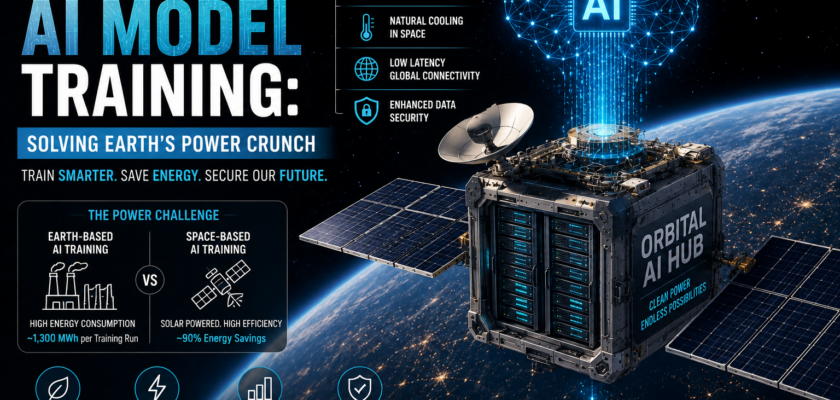
By launching modular, GPU-packed server satellites directly into low Earth orbit (LEO), the industry is turning space into a sustainable computing layer. This orbital approach takes advantage of continuous solar energy and natural cooling to run massive training workloads without burning a single watt of terrestrial electricity.
1. The Orbital Advantage: Utilizing the Space Environment for Hyperscale AI
The primary catalyst pushing artificial intelligence computing into Earth’s orbit is a radical realignment of resource economics. On Earth, running a modern hypercluster requires constructing expensive electrical substations, securing multi-year utility permits, and managing complex power transmission lines.
In contrast, the space environment provides an ideal operational baseline for continuous, heavy computing workloads.
                    [ The Terrestrial Energy Wall ]
     (Grid Power Constraints ──► Heavy Water Cooling ──► Restricted AI Scaling)
                                     │
                                     ▼
                [ The 2026 Space-Based Hypercluster ]
     (Continuous Sunlight ──► Passive Deep Vacuum Radiators ──► Endless Modular Compute)
These advanced orbital data center satellites leverage two unique environmental characteristics to maximize their operational efficiency:
- Limitless Solar Radiance: Satellites deployed in optimized sun-synchronous orbits experience continuous, uninterrupted access to raw sunlight. Free from atmospheric filtering and weather disruptions, thin-film solar arrays generate over five times more energy per square meter than identical configurations on Earth.
- The Absolute Vacuum Cold: Terrestrial facilities consume immense quantities of water and energy to run heavy chillers. Orbital servers completely eliminate this burden by utilizing the natural vacuum of space as a massive heatsink. Large passive radiators point directly toward deep space, instantly radiating away processor heat.
- Un-Bottlenecked Growth: Consequently, space-based infrastructure allows compute arrays to scale linearly without facing land, grid, or environmental permitting barriers.
2. Inside the Partnership: Deconstructing the Nvidia StarCloud Ecosystem
The successful execution of space-based model engineering stems from rapid hardware breakthroughs that have brought server-class computing power safely into orbit.
A. The Vera Rubin Space Module Integration
Nvidia has fundamentally redefined aerospace hardware by deploying specialized, space-hardened computing platforms.
The centerpiece of this architecture is the newly deployed Space-1 Vera Rubin module.
This specialized platform features custom radiation shielding and advanced thermal interfaces engineered to withstand solar flares and intense cosmic rays.
Furthermore, the architecture integrates high-bandwidth memory directly onto the processor die, delivering the extreme speeds needed to run large language models and foundation architectures smoothly in orbit.
B. The Starcloud Orbital Network Deployment
Aerospace operator Starcloud has seamlessly matched this chip innovation by building a robust distributed orbital cloud network:
  [ Ground Training Dataset ] ───► [ High-Speed Optical Laser Uplink ]
                                                    │
                                                    ▼
                                     [ Orbital Multi-GPU Cluster ]
                                "Nvidia Hardware Coordinates Space Training"
                                                    │
                                                    ▼
                                     [ Intersatellite Mesh Transit ]
                                "Laser Networks Sync Weights Across Space"
The infrastructure leverages SpaceX’s high-speed Starlink mini laser communication terminals to form a dense intersatellite mesh network.
This setup allows individual satellite units to share data at blazing speeds, transforming scattered satellites into a single, unified orbital hypercluster.
Thus, operators can seamlessly split complex training datasets across multiple orbital nodes. This laser-linked grid allows teams to train weights, run heavy inference cycles, and download completed model parameters with minimal latency. This interconnected grid effectively establishes space as a reliable, high-performance extension of the global cloud.
3. Strategic Matrix: Earth-Bound Data Centers vs. 2026 Orbital Clusters
| Computing Vector | Terrestrial Hyperscale Data Centers | Space-Based Orbital Data Centers (2026) |
| Power Sourcing Core | Fossil-fuel or regional green grids facing supply caps | Continuous, unfiltered solar energy harvesting |
| Cooling Infrastructure | High water use and complex mechanical chillers | 100% passive radiative heat dissipation to deep space |
| Deployment Speed | Slow; held back by years of local construction rules | Hyper-fast; modular nodes launch in months |
| Primary Data Transit | Terrestrial fiber lines and subsea cable networks | High-speed intersatellite laser communications |
| Risk Characterization | High risk of grid overloads and public pushback | Withdrawn Risk; tech-backed environmental safety |
4. Geopolitical Re-Alignment: The Rise of Sovereign Space Clouds
The long-term impact of this orbital computing pivot extends far beyond pure energy savings; it is rapidly reshaping the boundaries of international data sovereignty. On Earth, cloud infrastructure is heavily bound to national borders, forcing companies to navigate complex, fragmented privacy laws and shifting geographic regulations.
Consequently, forward-thinking nations are bypassing terrestrial data limits by building independent sovereign space clouds.
  [ Terrestrial Regulatory Wall ] ───► [ Move Sensitive Data to Space Networks ]
                                                      │
                                                      ▼
                                       [ International Space Cloud Access ]
                                "Compute Operates Under Global Maritime Rules"
                                                      │
                                                      ▼
                                       [ Secure Cross-Border Analytics ]
                                "Protects Strategic Assets From On-Earth Risks"
For instance, Indian space pioneers Pixxel and AI developers Sarvam AI are actively collaborating on the Pathfinder orbital computing mission.
Scheduled for launch in late 2026, the spacecraft will run data-center-class GPUs directly in orbit, processing hyperspectral imaging data and running language models right in space.
By operating directly within the global commons of orbit, these sovereign server networks protect critical data from local physical infrastructure threats and localized energy blackouts on Earth. This shift proves that the ultimate path to long-term digital resilience is built by shifting our primary data processing layers out of harms way and into secure, sustainable orbits.
Conclusion
The spectacular technical milestones achieved across the space based AI model training paradigm mark a permanent evolution in human industrial infrastructure: the ultimate path to technological progress doesn’t require destroying our home planet’s resources, but expanding our systems to capture the boundless energy of space. The old abacus maze of assuming computing growth must always be bottlenecked by terrestrial power grids, local zoning disputes, and municipal water scarcity is officially a thing of the past.
By combining Nvidia’s advanced space processors with Starcloud’s resilient orbital networks, developers are proving that space is the ultimate environment for heavy data workloads.
These innovative networks don’t just protect Earth’s environment; they provide a highly scalable, zero-emission foundation for tomorrow’s intelligence to grow. As these orbital data clusters continue to expand across the sky, they offer a brilliant promise for the future of technology: a world where our most complex models are built cleanly among the stars, keeping our digital growth infinite and our home planet beautifully protected.


