
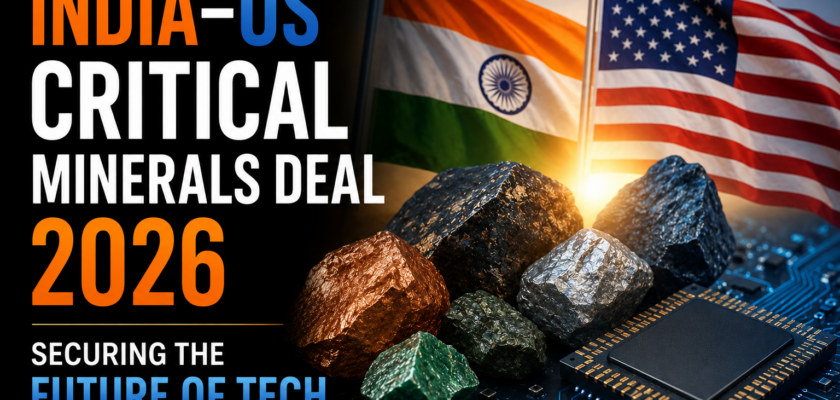
Reducing China Dependence: Inside the Landmark India-US Critical Minerals Strategic Pact.
The global industrial landscape is executing an aggressive, historic shift in resource security. For decades, the high-tech manufacturing sector operated under a dangerous geographic bottleneck, relying almost entirely on a single marketplace for processing rare earth elements. These specialized materials are essential to build high-performance semiconductors, electric vehicle batteries, clean energy grids, and modern defense systems. Consequently, any sudden trade restriction from the dominant processing nation could instantly halt production lines across international technology hubs, threatening economic stability worldwide.
However, a landmark diplomatic breakthrough has officially rewritten the rules of international resource management.
Signed at Hyderabad House in New Delhi on Tuesday, May 26, 2026, the India US critical minerals deal 2026 establishes a resilient bilateral framework.
Formalized by India’s External Affairs Minister S. Jaishankar and US Secretary of State Marco Rubio, the agreement secures mining, processing, and recycling networks.
This historic pact moves beyond simple diplomatic cooperation to establish a secure economic alliance. By integrating resource supply chains, the two nations are building a trusted manufacturing network. This bold initiative shields advanced technology sectors from economic pressure, building a highly sustainable foundation for long-term industrial growth.
1. The Weaponization of Dust: Why Supply Chains Reached a Breaking Point
To understand why Washington and New Delhi executed this urgent strategic intervention, one must examine the critical vulnerabilities within modern electronics manufacturing. The global push to diversify mineral sources intensified dramatically after severe export controls disrupted international manufacturing corridors.
                     [ The Single-Source Monopolized Loop ]
     (Concentrated Processing Nodes ──► Export Restrictions Applied ──► High-Tech Supply Halts)
                                        │
                                        ▼
                     [ The Trusted Allied Network ]
     (Bilateral Sourcing Infrastructure ──► Diverse Processing Hubs ──► Insulated Innovation)
These external supply shocks highlight the immense risk of relying on a single dominant supplier:
- The Rare Earth Magnet Ban: In April 2025, China weaponized its near-monopoly by completely blocking the export of critical rare earth magnets, a retaliatory move triggered by escalating global trade tariffs.
- The Global Manufacturing Shock: This sudden supply cutoff instantly disrupted production schedules across the clean mobility, defense aviation, and high-end electronics industries worldwide.
- The Tactical Response: As a result, the United States is taking proactive steps to stabilize supplies, driving deep structural alliances with key partners like India to build a reliable safety shield.
2. Deconstructing the Accord: Deep Technical and Financial Integration
The newly firmed-up bilateral agreement moves past basic administrative goals to build a practical, well-funded framework designed to upgrade India’s local refining capabilities.
A. Mobilizing Unprecedented Capital Resources
The strategic alliance is backed by massive financial commitments from both public and private sectors.
The US Government is actively mobilizing immense resources to secure these vital resource pathways, supporting projects with more than $30 billion in letters of interest, direct investments, and loans.
This major financial push triggers a powerful multiplier effect, drawing in substantial private capital to fund next-generation mining and processing developments.
B. The Comprehensive Supply Chain Scope
Furthermore, the bilateral framework coordinates action across the entire lifecycle of strategic elements:
  [ Raw Mineral Extraction ] ───► [ Advanced Local Processing Nodes ]
                                                │
                                                ▼
                                 [ Unified Financial Guarantees ]
                            "Lowers Investment Risks for Private Capital"
                                                │
                                                ▼
                                 [ Closed-Loop E-Waste Recovery ]
                            "Recycled Scrap Extends National Reserves"
The joint agreement covers extraction, high-purity chemical refining, and advanced processing technologies.
Additionally, the framework emphasizes clean recycling systems to reclaim valuable elements from electronic waste and manufacturing scrap.
By building advanced refining facilities directly within India, the partnership reduces reliance on external processing centers.
Consequently, both nations secure long-term access to the foundational elements that power modern industrial growth. This structural insulation keeps critical industries running smoothly even during volatile international trade conflicts.
3. Strategic Matrix: Fragmented Sourcing vs. Coordinated US-India Supply Frameworks
| Strategic Resource Vector | Fragmented Legacy Sourcing Networks | Coordinated US-India Supply Frameworks |
| Financial Backing Foundation | Isolated private capital facing high market risks | Over $30 Billion in public loans and investments |
| Refining Node Geography | Concentrated heavily within vulnerable monopolies | Diversified across secure, trusted allied hubs |
| Regulatory Systems Link | Uncoordinated; slow local permitting bottlenecks | Aligned laws to accelerate joint projects |
| Secondary Sourcing Recovery | Minimal; valuable industrial scrap goes to waste | Systematic recycling of e-waste and metal scrap |
| Risk Characterization | High vulnerability to sudden export shutdowns | Withdrawn Risk; tech-backed asset security |
4. Urban Mining: Recycling Scrap as a Strategic Asset Reserve
The final core component defining this historic resource pact looks away from traditional underground mining toward innovative urban resource recovery. Both nations explicitly recognize that establishing brand-new extraction mines requires long development timelines and carries notable environmental costs.
Consequently, the framework prioritizes the development of advanced secondary supply chains through large-scale e-waste recycling.
  [ Discarded Consumer Tech ] ───► [ Automated Local Sorting Networks ]
                                                │
                                                ▼
                                 [ High-Purity Chemical Separation ]
                            "Extracts Pure Elements Safely from E-Waste"
                                                │
                                                ▼
                                 [ Domestic Industrial Re-Entry ]
                            "Feeds Fresh Materials Straight to Factory Lines"
The two nations are aligning their technology frameworks to improve the recovery of critical metals from retired consumer devices and electronic scrap.
Specialized refining facilities utilize advanced, clean chemical separation methods to extract high-purity cobalt, lithium, and rare earth elements from old electronics.
Thus, the partnership transforms electronic waste from an environmental challenge into a vital domestic asset.
By circulating these recycled metals back into domestic manufacturing lines, the deal provides a steady, reliable source of materials. This circular approach proves that long-term industrial resilience is achieved by building hyper-efficient, waste-free systems right at home.
Conclusion
The successful execution of the India US critical minerals deal 2026 highlights a permanent evolution in global politics: true national security is no longer measured solely by military strength, but by the resilience of your technology supply chains. The old abacus maze of leaving the foundational elements of your economy vulnerable to a single-source monopoly is officially over.
By combining deep diplomatic alignment with a massive $30 billion financial foundation, Washington and New Delhi are charting a clear path toward long-term technological independence.
These proactive measures ensure that the clean energy transitions, computing breakthroughs, and manufacturing plants of tomorrow will be built on a fair, diverse, and reliable market foundation. While building alternative mining and recycling infrastructure will require steady focus over the coming years, this united economic shield provides an extraordinary foundation for global stability—proving that true industrial safety is achieved through deep, uncompromised, and well-funded collaboration.


