
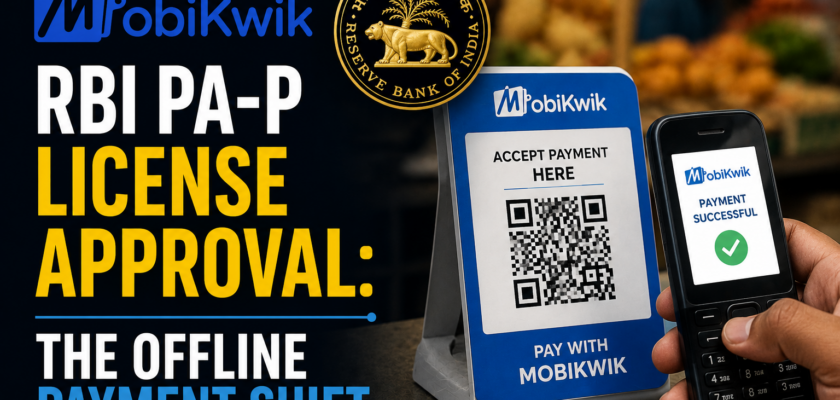
The PA-P License Shift: How Mobile Wallets Are Transitioning to Physical Payment Aggregators.
The regulatory architecture governing India’s digital payments economy is undergoing a massive, structural transformation. For over a decade, consumer-centric mobile wallets and unified payments interface apps focused their entire engineering capital on digital transactions, capturing online checkout fields and app-based commerce. This online framework delivered rapid user acquisition loops, but firms routinely struggled with thin monetization models on consumer payments because they operate largely on zero merchant discount rate frameworks.
However, a major structural pivot toward physical merchant acquiring networks has completely changed the sector’s economics.
The recent market updates surrounding the MobiKwik RBI PA-P license approval confirm a major regulatory milestone.
One MobiKwik Systems has secured in-principle approval for its Payment Aggregator – Physical license from the Reserve Bank of India.
This critical regulatory clearance follows its recent non-banking financial company license win. By moving into physical retail networks, the platform is transitioning into a comprehensive, full-stack merchant infrastructure layer. This strategic expansion bypasses traditional online limits, providing direct access to offline merchant ecosystems and building a reliable system to tap high-margin device rental and transaction fees.
1. The Monetization Inversion: Why Offline Networks Beat Online Channels
The primary financial catalyst driving this sweeping transition from digital apps to brick-and-mortar storefronts centers on a profound structural shift in transaction economics. Consumer-facing digital payment applications face intense profit pressures because mainstream peer-to-peer and peer-to-merchant transaction networks generate minimal transaction revenue.
In contrast, the offline retail environment offers a robust, highly reliable ecosystem for steady revenue collection.
                     [ Low-Margin Consumer App Loop ]
     (Zero-MDR Transaction Rails ──► Heavy User Churn ──► Compressed Fintech Value)
                                      │
                                      ▼
                  [ The 2026 Omnichannel Merchant Node ]
     (Device Rental Income + MDR Transaction Spreads + Data-Backed Credit Cross-Sell)
Fintech platforms use these specialized brick-and-mortar licenses to secure three highly sustainable corporate revenue flows:
- The Device Rental Economy: Deploying physical hardware gives firms steady monthly subscription income from device rentals, shielding them from consumer use drops.
- Capturing MDR Transaction Spreads: Physical card transactions allow companies to capture strong merchant discount rate margins, providing robust merchant business monetization.
- Data-Backed Credit Cross-Selling: Continuous transaction tracking provides valuable analytics, allowing the platform’s new lending arm to disburse low-risk merchant credit safely.
2. Inside the Blueprint: The Hyper-Scale Target Metrics for 2028
The real-world execution of this physical merchant strategy relies on aggressive hardware distribution, targeting massive scale across the country’s under-penetrated regional corridors.
A. Scaling the Connected Merchant Base
The firm is accelerating its physical deployment schedules to significantly expand its hardware footprint.
The company currently supports an active network of over 4.9 million merchants across India using integrated QR codes, soundboxes, and card terminal machines.
The corporate growth strategy aims to scale its merchant operations to achieve an ambitious 10x growth by FY28.
This massive expansion targets small local businesses, organized retail outlets, and oil gas distribution centers over the coming months.
B. Building the Omnichannel Stack
Furthermore, this physical processing clearance integrates with existing digital assets to complete a unified corporate payments ecosystem:
  [ In-Principle Physical Authorization ] ───► [ Integrated with Zaakpay Digital Core ]
                                                         │
                                                         ▼
                                          [ Complete Omnichannel Solution Built ]
                                    "Processes Offline Counter & Online App Flows"
                                                         │
                                                         ▼
                                          [ Full Fintech Stack Consolidation ]
                                    "Links Lending, Stockbroking, & Payments"
The physical authorization coordinates with the online payment aggregator status held by its subsidiary, Zaakpay.
This combination provides business clients with a smooth, omnichannel processing experience covering both physical counter and digital app payments.
By merging these payments with its stockbroking approvals and direct lending licenses, the platform completes a comprehensive corporate stack.
Consequently, the company can process, hold, and monetize merchant transaction capital entirely within its own secure corporate loop. This deep alignment increases capital efficiency and reduces operational dependence on third-party banking networks.
3. Strategic Matrix: Fragmented Consumer Wallets vs. 2026 Omnichannel Aggregators
| FinTech Vector Axis | Fragmented Consumer-Facing Wallets | Omnichannel Physical Aggregators (2026) |
| Primary Revenue Driver | Volatile consumer data and value-added recharges | Stable device rentals, subscriptions, and MDR |
| Merchant Fleet Size | Small; basic digital QR display distributions | Massive; millions of integrated smart terminals |
| Regulatory Stack Tier | Single-purpose consumer wallet or basic tech app | Full stack; licenses span online, physical, & credit |
| Lending Integration | Restricted; acts only as external credit dealer | Native; issues and holds loans on own balance sheet |
| Risk Characterization | High vulnerability to consumer payment switches | Withdrawn Risk; tech-backed system integration |
4. Systemic Resilience: Utilizing Transaction Telemetry for Under-Penetrated Growth
The long-term impact of integrating physical processing models is permanently redefining the scale of digital financial inclusion beyond major urban metros.
By installing secure soundboxes and card terminals in local regional shops, fintech networks build an unshakeable foundation for structural business compounding.
  [ Hardware Installed locally ] ───► [ Captures Daily Merchant Ledger Data ]
                                                    │
                                                    ▼
                                     [ Automated Risk Scoring Models ]
                                "Generates Instant Predictive Credit Limits"
                                                    │
                                                    ▼
                                     [ Capital Disbursed Instantly ]
                                "Fuels Expansion in Emerging Rural Hubs"
The smart analytics infrastructure processes localized ledger data to build highly accurate credit profiles for small business owners.
Instead of forcing a shopkeeper to provide extensive physical documentation, the platform tracks daily transaction histories to verify economic health.
This data-driven approach allows the system to disburse short-term expansion loans safely, helping local enterprises grow.
Thus, physical aggregator networks transform standard processing lines into powerful toolsets for economic advancement. This shift keeps local merchants protected and connected, proving that long-term fintech success is won by building practical, secure solutions that empower real-world commerce.
Conclusion
The impressive structural changes defining the MobiKwik RBI PA-P license approval trend highlight a permanent truth for modern financial leaders: sustainable value in the digital economy requires building deep, omnichannel connections with merchants. The old abacus maze of running heavy consumer applications on low-margin paths is rapidly evolving into a practical, integrated corporate infrastructure.
By linking smart payment hardware with online processing networks and comprehensive lending capabilities, financial innovators are charting a highly profitable path forward.
These sophisticated tools do not replace traditional banking partners; they extend secure payment infrastructure straight into the heart of small business communities. As these integrated physical networks expand their retail operations across the nation, they deliver a powerful promise for the country’s financial future: a world where digital systems support real-world growth, keeping our small businesses strong, efficient, and completely secure.


