
Beyond Grading Systems: How Predictive AI Tutors Are Pre-Assessing Professional Competency.
The structural foundation of higher education is undergoing an unprecedented, technology-led transformation. For generations, traditional universities relied heavily on static, retrospective grading systems to evaluate student intelligence and rank academic capabilities. Professors spent endless evenings manually reviewing thick stacks of term papers, final exams, and standardized worksheets. This legacy approach successfully distributed letter grades, but it routinely failed to identify individual student learning gaps before those subtle struggles compounded into complete academic failures.
Fortunately, advanced machine learning software is completely disrupting those outdated evaluation models.
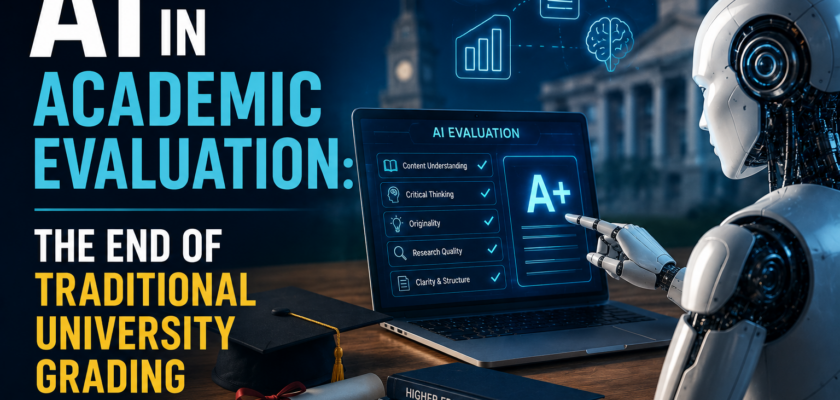
The rapid, widespread deployment of AI in academic evaluation frameworks marks a permanent shift toward proactive student data tracking.
Educational institutions are actively moving past slow, manual end-of-term testing to install continuous predictive assessment loops.
By utilizing sophisticated cloud-based platforms, modern universities can map student understanding in real time. This highly adaptive framework permanently changes the future of university grading structures, allowing systems to predict student competency long before graduation. Consequently, institutions utilize adaptive learning metrics 2026 data to fix learning gaps early, ensuring every single student stays protected and on track for professional success.
1. The Cognitive Feedback Loop: Moving Beyond Static Testing
The primary technological catalyst driving this educational revolution centers on replacing traditional scoring weights with continuous behavioral tracking models. Standard testing frameworks treat every single examination as an isolated, unchangeable data checkpoint.
In contrast, next-generation adaptive software transforms student coursework into a fluid, highly responsive feedback environment.
                    [ Legacy Retrospective Testing ]
     (Static Term Exams ──► Delayed Grade Reports ──► Unresolved Concept Gaps)
                                     │
                                     ▼
                [ The 2026 Predictive AI Architecture ]
     (Continuous Input Ingestion ──► Latent Trait Tracking ──► Custom Lesson Scaling)
These highly complex educational systems track multiple subtle performance signals to build an incredibly detailed profile of a student’s mind:
- The Hesitation Interval: The software monitors the precise time a student pauses before submitting an answer, tracking subtle friction points instantly.
- The Item Response Engine: The system calculates a student’s latent ability level in real time, adjusting subsequent question difficulty automatically.
- The Elimination of Remedial Waste: Consequently, the system skips redundant foundational modules as soon as a student proves mastery, maximizing learning velocity.
2. Pre-Assessing Corporate Readiness: The Tripartite Predictive Architecture
The real-world success of this advanced educational model relies on a highly sophisticated three-part software matrix that predicts real-world working competency.
A. Mapping the Mind of the Learner
Modern academic analytics platforms no longer look at simple percentages to determine if a student understands a complex professional subject.
Instead, the system utilizes a dedicated Learner Model, a Content Model, and an Instructional Model to track mastery.
The software uses advanced hidden Markov chains to calculate the exact probability that a student truly understands a specific professional skill based on past work.
This deep analytical layer allows the system to differentiate between a student who is guessing and one who has reached genuine comprehension.
B. Projecting Professional Competency Vectors
Furthermore, this advanced prediction strategy integrates directly with institutional dashboards to dramatically reduce dropout risks:
  [ Student Tracks Core Modules ] ───► [ AI Predicts Outcome with 90% Accuracy ]
                                                    │
                                                    ▼
                                     [ Real-Time Risk Signaling ]
                                "System Flags Early Attendance and Concept Dips"
                                                    │
                                                    ▼
                                     [ Targeted Academic Interventions ]
                                "Counselors Deliver Tailored Support Paths"
The system’s smart pattern recognition models predict future exam outcomes with an extraordinary accuracy rate of over 90%.
By automatically scanning student data for sudden changes in engagement, the software builds a protective shield around vulnerable undergraduates.
Comprehensive university field logs confirm that these automated early warnings deliver massive improvements, including raising developmental math passing rates up to 89%.
Consequently, institutions lower overall failure rates by intervening with custom tutoring long before traditional exams occur, proving that predictive software directly preserves student success.
3. Strategic Matrix: Traditional Rigid Testing vs. 2026 Predictive Competency Models
| Academic Evaluation Vector | Traditional Rigid Testing Frameworks | 2026 Predictive Competency Models |
| Feedback Delivery Speed | Slow; takes days or weeks for professors to grade | Instant; delivers continuous real-time guidance |
| Evaluation Method Base | Fragmented; relies on a few heavy final exams | Unified; tracks daily learning habits continuously |
| Core Software Stance | Static; presents identical linear paths to everyone | Adaptive; customizes difficulty to individual speed |
| Strategic Goal Objective | Retrospective; records failures after they happen | Proactive; corrects subtle learning gaps early |
| Risk Characterization | High risk of hidden student dropouts and failure | Withdrawn Risk; tech-backed mastery tracking |
4. Re-Engineering the Curriculum: Driving Accountability through Structured AI Tools
The final core trend reshaping higher education protects academic integrity by ensuring students build authentic critical thinking habits.
By shifting away from generic chatbots that encourage lazy copy-pasting, forward-looking universities deploy custom, purpose-built educational systems.
  [ Student Starts Essay Draft ] ───► [ Custom AI Scans Core Argument Logic ]
                                                    │
                                                    ▼
                                     [ Criterion Specific Coaching ]
                                "System Prompts Student to Refine Citations"
                                                    │
                                                    ▼
                                     [ Authentic Student Mastery ]
                                "Saves 70% of Routine Professor Review Time"
These highly specialized educational tools function as on-demand writing coaches rather than simple automated grading machines.
The software analyzes essay structure, thesis clarity, and citation formatting to provide deep, paragraph-level feedback during the drafting stage.
Thus, custom software systems transform how writing assignments are managed, saving professors up to 70% of routine grading time.
This dramatic time savings allows educators to shift focus from tedious paperwork to high-impact classroom mentorship. This balanced approach keeps academic standards high, proving that true educational progress is won by building secure tools that empower human intellect.
Conclusion
The remarkable institutional shifts redefining the AI in academic evaluation landscape deliver an undeniable truth to modern university boards: long-term student success cannot be secured through outdated, once-a-semester grading models. The old abacus maze of judging a student’s entire career potential on a single final exam is rapidly being replaced by continuous, data-driven competency tracking.
By combining real-time behavioral metrics with predictive mastery models and tailored writing platforms, educational leaders are charting a highly resilient path forward.
These sophisticated tools do not distance teachers from their classrooms; they provide the deep insights needed to deliver exceptionally safe, fair, and effective instruction. As these adaptive systems continue to expand across global campuses, they lock in an extraordinary foundation for human development—proving that the highest tier of modern academic achievement is won by turning your grading pipelines into proactive engines for lifelong learning.


