
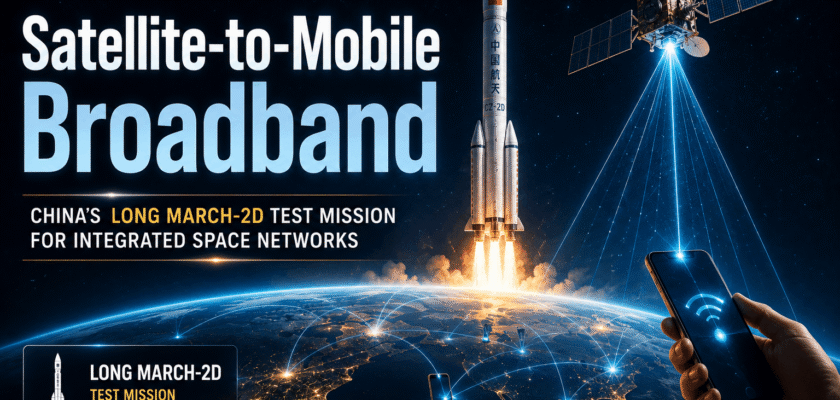
Satellite-to-Mobile Broadband: Why China’s Test Mission Matters
Satellite-to-mobile broadband is becoming one of the most important technology trends of 2026 because it can connect normal phones directly with satellites. China’s latest Long March-2D test mission is part of this bigger shift toward integrated space-ground networks.
The idea is simple but powerful. If mobile phones can connect directly to satellites, people may get connectivity in remote villages, mountains, seas, highways, disaster zones, and areas where mobile towers are weak.
Therefore, this mission is not only another satellite launch. It is a step toward a future where mobile networks may extend from the ground to space.
Why Satellite-to-Mobile Broadband Matters in 2026
Satellite-to-mobile broadband matters because billions of people still face weak network coverage in difficult locations. Even in countries with strong telecom networks, signal gaps exist in forests, border areas, deserts, islands, and high-altitude regions.
Traditional mobile towers cannot cover every place easily. Building towers in remote areas can be costly, slow, and difficult.
However, satellites can cover large areas from orbit. If phone-to-satellite broadband becomes reliable, it may reduce digital gaps and improve emergency communication.
As a result, governments, telecom companies, and space-tech firms are watching this technology closely.
What China Launched on Long March-2D
China launched a new internet technology test satellite from the Xichang Satellite Launch Center on May 31, 2026. The satellite went into preset orbit successfully aboard a Long March-2D carrier rocket.
According to Xinhua, the satellite will support technical tests and verification for direct broadband connectivity between mobile phones and satellites. It will also test integrated space-ground network technologies.
This means the mission focuses on practical communication tests, not only space hardware.
Satellite-to-Mobile Broadband and Space-Ground Networks
Satellite-to-mobile broadband becomes more useful when it works with space-ground networks. A space-ground network connects satellites, ground stations, telecom towers, mobile devices, cloud systems, and network control centres.
In simple words, space and ground infrastructure work together.
For example, a mobile phone may connect to a satellite when there is no tower nearby. Then the satellite may connect with a ground station or a wider internet network. After that, the user can send data, messages, or possibly broadband traffic depending on system capability.
This is why integrated space networks are important.
What Is Direct Phone-to-Satellite Broadband?
Direct phone-to-satellite broadband means a mobile phone can connect with a satellite without needing a large dish or special bulky device.
This is different from old satellite phones, which needed special hardware and were often expensive.
The future goal is to make satellite connectivity work with regular smartphones or slightly upgraded mobile devices.
If this becomes practical, users may get backup internet, emergency alerts, messaging, voice, or data service even when towers fail.
However, full broadband speed through normal phones is technically difficult. It needs advanced satellites, strong antennas, smart software, and regulatory support.
Why the Long March-2D Mission Is Important
The Long March-2D mission is important because it supports China’s satellite internet testing roadmap. China has been launching test satellites to verify internet technology and direct mobile connectivity.
CGTN reported that China launched satellite internet technology test satellites on April 24, 2026, also using a Long March-2D rocket. Those satellites were meant for direct satellite-to-mobile broadband connection tests and space-ground network integration.
So, the May 31 launch looks like part of a continuing test series.
This shows that China is not only talking about satellite internet. It is actively testing the pieces needed for future service.
How Satellite-to-Mobile Broadband Could Help Remote Areas
Satellite-to-mobile broadband could help remote areas where mobile towers are limited or missing.
Useful areas may include:
- Mountain villages
- Border areas
- Desert routes
- Forest regions
- Fishing zones
- Islands
- Rural highways
- Mining zones
- Disaster-hit regions
- High-altitude tourism areas
In these places, ground towers may be expensive or hard to maintain.
Satellite backup can help people stay connected when normal networks are unavailable.
Emergency Communication Could Be the Biggest Use Case
Emergency communication may become one of the biggest early use cases. During floods, earthquakes, storms, landslides, or power failures, mobile towers can stop working.
In such cases, direct phone-to-satellite links can help people send emergency messages, location data, or basic updates.
This can support:
- Rescue teams
- Disaster management authorities
- Travellers
- Rural communities
- Fishermen
- Mountain workers
- Border security teams
- Road accident victims
- Relief workers
- Remote healthcare teams
Even limited connectivity can save lives in emergencies.
Why Full Broadband Is Harder Than Satellite Messaging
Satellite messaging is easier than satellite broadband. A short text needs very little data. Broadband needs much more capacity.
Full broadband from satellite to mobile phones faces several challenges:
- Weak phone antenna size
- Long signal distance
- Spectrum limits
- Satellite power needs
- Network congestion
- Weather impact
- Latency
- Battery drain
- Regulatory approvals
- Cost control
Therefore, early services may start with messaging, alerts, and low-data features before moving toward stronger broadband.
China’s Mega-Constellation Plan
China is also working on a larger satellite internet vision. China Daily reported that China plans to build a mega-constellation of around 13,000 satellites in low-Earth orbit for worldwide internet coverage.
A mega-constellation can provide wider coverage and more capacity than a small number of satellites.
However, building and managing thousands of satellites is complex. It requires launches, ground stations, spectrum coordination, collision avoidance, and constant satellite replacement.
Still, the plan shows how serious China is about satellite internet.
Satellite-to-Mobile Broadband and Telecom Operators
Satellite-to-mobile broadband will not replace telecom operators overnight. Instead, it may work with them.
Telecom companies can use satellite links as an extension of their network. This can help them cover remote areas without building expensive towers everywhere.
A future telecom plan may include:
- Ground mobile towers in cities
- Satellite backup in remote zones
- Hybrid roaming between tower and satellite
- Emergency satellite messaging
- Rural broadband support
- Maritime and aviation connectivity
- Disaster recovery networks
- IoT device connectivity
This hybrid model may become more common.
What Integrated Space Networks Mean for Consumers
For consumers, integrated space networks can make connectivity more dependable. A phone may switch between tower and satellite depending on signal availability.
Imagine travelling through a mountain road. Your phone loses tower signal. Instead of going fully offline, it connects to a satellite for basic communication.
This can reduce anxiety for travellers, drivers, tourists, and remote workers.
In the long term, integrated networks may make “no signal” less common.
Competition in Satellite-to-Mobile Broadband
China is not alone in this race. Around the world, companies and countries are testing direct-to-device satellite connectivity.
Major space and telecom players are exploring:
- Satellite messaging
- Direct phone links
- Emergency SOS services
- Low-Earth orbit broadband
- 5G non-terrestrial networks
- Satellite IoT
- Maritime connectivity
- Aviation internet
- Remote area coverage
- Defence communication
This competition can speed up innovation.
However, it can also create spectrum, regulation, and orbital traffic challenges.
Why Low-Earth Orbit Matters
Low-Earth orbit, or LEO, is important because satellites in lower orbits are closer to Earth. This can reduce signal delay compared with traditional high-orbit satellites.
LEO satellites can support faster communication and better broadband performance.
However, LEO satellites move quickly across the sky. So, a large constellation is needed to maintain continuous coverage.
This is why countries are launching multiple satellites and planning mega-constellations.
Benefits of Satellite-to-Mobile Broadband
Satellite-to-mobile broadband can bring many benefits if it becomes reliable and affordable.
Possible benefits include:
- Better rural connectivity
- Emergency communication
- Less dependence on towers
- Support for disaster response
- Connectivity in mountains and seas
- Better logistics tracking
- Support for remote workers
- Stronger national communication networks
- Backup during network outage
- Digital inclusion for remote communities
These benefits explain why the technology is getting global attention.
Challenges China Must Solve
China’s test mission is important, but many challenges remain.
Key challenges include:
- Reliable direct phone connection
- High-speed data capacity
- Spectrum coordination
- Smartphone compatibility
- Satellite power management
- Ground network integration
- Cost of service
- User privacy
- Cybersecurity
- Space debris risk
A test satellite can prove technology, but a commercial service needs scale, stability, and user trust.
Cybersecurity and Data Control
Satellite-to-mobile broadband also raises cybersecurity questions. If phones connect through satellites and ground networks, data must stay secure.
Important security areas include:
- Encryption
- User authentication
- Network monitoring
- Anti-jamming systems
- Data routing control
- Privacy protection
- Ground station security
- Satellite command protection
- Emergency service priority
- Cross-border data rules
Without strong security, satellite networks can become targets for hacking or disruption.
Space Debris and Orbit Management
Large satellite networks also create space debris concerns. More satellites mean more objects in orbit. If satellites fail or collide, debris can threaten other spacecraft.
Therefore, mega-constellations need strong orbit management.
This includes:
- Collision avoidance
- Satellite tracking
- End-of-life deorbit plans
- Space traffic coordination
- Responsible launch planning
- International standards
- Debris reduction technology
As satellite internet grows, responsible space operations will become more important.
What This Means for India
India will also watch satellite-to-mobile broadband closely. India has many remote areas, mountains, islands, forests, border zones, and rural regions where connectivity remains difficult.
Satellite direct-to-device technology can help in:
- Himalayan regions
- Border security
- Disaster response
- Rural education
- Remote healthcare
- Fishermen safety
- Island connectivity
- Highway emergency support
- Tourism safety
- Agriculture IoT
However, India will need its own regulatory, telecom, and security planning for such services.
What Users Should Expect First
Users should not expect full high-speed satellite broadband on every phone immediately. The technology is still developing.
Early services may focus on:
- Emergency messaging
- Location sharing
- Basic data
- Low-speed internet
- Rural backup links
- IoT connectivity
- Disaster alerts
- Limited voice support
- Premium remote plans
- Enterprise and government use
Full affordable broadband for normal phones may take more time.
Future of Space-Ground Connectivity
The future of space-ground connectivity will likely be hybrid. Ground towers will remain important in cities and towns. Satellites will fill the gaps in remote, mobile, and emergency situations.
Over time, phones, cars, ships, aircraft, and IoT devices may connect through both terrestrial and satellite networks.
This can create a more resilient internet.
In simple words, the next network revolution may not be only 5G or 6G. It may be the merger of mobile networks and satellite networks.
Final Verdict
Satellite-to-mobile broadband is moving from concept to testing, and China’s Long March-2D test mission shows how fast this race is growing. The latest launch focuses on direct mobile phone-to-satellite broadband connectivity and integrated space-ground network technologies.
The technology can help remote areas, emergency communication, rural internet, tourism safety, and national network resilience. However, full broadband through normal phones still faces technical, cost, security, and regulatory challenges.
In simple words, this mission is not only about one satellite. It is about the future of connectivity, where your phone may stay connected even when there is no tower nearby.


