
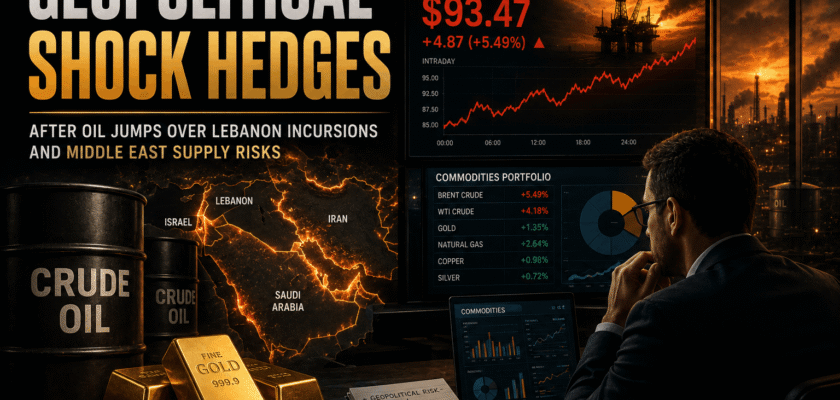
Geopolitical Shock Hedges: Why Oil Risk Is Back This Week
Geopolitical shock hedges are back in focus after oil prices jumped sharply due to fresh Middle East tension. On June 1, 2026, crude prices rose after Israel moved further into Lebanon, while Iran-linked risks around U.S. talks and strategic waterways made traders more nervous.
This matters because oil does not affect only energy stocks. It can affect inflation, airline costs, logistics, paint companies, tyre makers, chemical businesses, currency pressure, and household fuel bills.
Therefore, investors should not treat this week’s oil move as only a headline. They should review how much geopolitical risk already sits inside their portfolios.
Why Geopolitical Shock Hedges Matter Now
Geopolitical shock hedges matter because oil markets can move very fast when supply routes look unsafe. A normal demand-supply chart may change overnight if traders fear disruption near the Strait of Hormuz, Bab el-Mandeb, or other key routes.
Reuters reported that oil jumped over $6 per barrel after Iran halted exchanges with the U.S. and risks grew around key waterways. Brent crude rose 6.6% to $97.14, while U.S. crude rose 7.7% to $94.04.
As a result, investors need a plan. Panic buying after a spike can be risky, but ignoring geopolitical risk can also hurt.
What Triggered the Oil Jump?
The latest oil jump came after Israel stepped up military action in Lebanon despite a ceasefire. Early trade saw oil rise more than 2%, and later reports showed a much sharper move as Iran-related risks increased.
The market reaction had three main drivers:
- Israel-Hezbollah tension in Lebanon
- U.S.-Iran backchannel uncertainty
- Fear around strategic oil routes
When these risks appear together, traders often add a war premium to crude oil prices.
This premium can rise quickly and fade quickly, depending on the next diplomatic or military update.
Geopolitical Shock Hedges and Commodity Portfolios
Geopolitical shock hedges help investors reduce damage when energy prices rise suddenly. A commodity portfolio may include crude oil, natural gas, gold, silver, copper, energy stocks, commodity ETFs, and related mutual funds.
However, hedging does not mean buying everything after prices jump. It means building balance before volatility becomes extreme.
A smart commodity portfolio should answer three questions:
- What happens if oil rises another 10%?
- What happens if oil falls back after a ceasefire?
- What happens if inflation expectations rise?
These questions help investors avoid emotional decisions.
Why Oil Spikes Affect More Than Oil Investors
Oil spikes affect the full economy because crude is a base input for many sectors. When oil rises, transportation, aviation fuel, petrochemicals, shipping, plastics, and logistics can become costlier.
This can hurt companies that depend heavily on fuel and raw materials.
At the same time, oil producers, upstream energy companies, and some commodity-linked businesses may benefit.
So, a portfolio may have winners and losers at the same time.
That is why investors should check sector exposure, not only commodity exposure.
Sectors That Can Benefit From Higher Oil
Higher oil prices can support some sectors and assets.
Possible beneficiaries include:
- Oil exploration companies
- Upstream energy firms
- Oilfield service companies
- Select commodity producers
- Energy ETFs
- Some natural gas-linked assets
- Gold during risk-off phases
- Defensive dividend energy stocks
However, investors should not assume every oil-related stock will rise. Refining margins, government pricing rules, taxes, subsidies, and input costs can change the result.
Therefore, stock selection matters.
Sectors That Can Feel Pressure From Higher Oil
Higher oil can hurt sectors where fuel or petrochemical input costs are high.
Sensitive sectors include:
- Airlines
- Paints
- Tyres
- Logistics
- Chemicals
- Cement
- Autos
- FMCG packaging
- Shipping users
- Consumer discretionary companies
If oil remains high, these companies may face margin pressure.
However, some strong companies can pass costs to customers. Others cannot.
So, investors should check pricing power.
How Gold Fits Into Geopolitical Shock Hedges
Gold often acts as a geopolitical hedge. When global risk rises, some investors move money into gold because it is seen as a safe-haven asset.
However, gold does not always move perfectly with oil. It also reacts to interest rates, the U.S. dollar, inflation expectations, and central bank buying.
For a normal investor, gold can work as a stabilizer if used in limited allocation.
A common approach is to keep gold as 5% to 15% of the portfolio, depending on risk profile. This is not a rule for everyone, but it gives a practical range.
Should You Buy Crude Oil After a Spike?
Buying crude oil after a sharp spike can be risky. If the conflict worsens, prices may rise further. But if talks resume or supply risk reduces, prices can fall quickly.
So, investors should avoid all-in decisions.
A better approach is:
- Use staggered buying
- Avoid leverage
- Keep position size small
- Use stop-loss if trading
- Track news carefully
- Avoid chasing intraday spikes
- Match exposure with risk appetite
- Know whether you are investing or trading
Oil is volatile. It can reward timing, but it can also punish late entries.
Geopolitical Shock Hedges for Conservative Investors
Conservative investors should avoid aggressive commodity bets. Their goal should be protection, not quick profit.
Possible conservative moves include:
- Small gold allocation
- Diversified commodity fund
- Low-debt energy companies
- Defensive equity exposure
- Short-duration debt funds
- Cash buffer
- Avoid leveraged crude products
- Review fuel-sensitive stocks
- Reduce overconcentration
- Maintain emergency liquidity
For conservative investors, the best hedge is often balance.
Geopolitical Shock Hedges for Aggressive Investors
Aggressive investors may take more direct commodity exposure. However, they should control risk.
Possible aggressive tools include:
- Crude oil ETFs or futures-linked products
- Energy sector funds
- Oil and gas stocks
- Commodity baskets
- Tactical gold positions
- Options strategies
- Currency hedges
- Global energy equities
- Natural gas exposure
- Event-based trading positions
Still, aggressive does not mean careless. Position sizing is critical.
Why Diversification Matters This Week
Diversification matters because geopolitical shocks are unpredictable. One headline can push oil up. Another headline can pull it down.
If your portfolio depends too much on one view, risk becomes high.
A balanced portfolio may include:
- Equities
- Debt
- Gold
- Cash
- Limited commodities
- International exposure
- Defensive sectors
- Growth sectors
This mix reduces dependence on one market event.
Indian Investors: Why Rupee and Inflation Matter
Indian investors should also watch the rupee and inflation. India imports a large part of its crude oil needs. When crude prices rise, import pressure can increase.
If the rupee weakens at the same time, oil becomes more expensive in local currency terms.
This can affect:
- Fuel prices
- Inflation expectations
- RBI policy thinking
- Corporate margins
- Current account pressure
- Consumer spending
- Logistics costs
- Government subsidy burden
Therefore, oil risk is also macro risk for India.
How to Review Your Portfolio This Week
Investors can review portfolios with a simple checklist.
Ask yourself:
- Do I own too many fuel-sensitive stocks?
- Do I have any energy exposure?
- Is my gold allocation too low or too high?
- Am I overexposed to airline or logistics stocks?
- Do I have enough cash buffer?
- Am I using leverage?
- Is my portfolio ready for inflation risk?
- Am I reacting emotionally to headlines?
- Do I understand my commodity products?
- What is my exit plan?
This review can prevent poor decisions.
Commodities Portfolio Strategy: A Simple Model
A simple commodities portfolio strategy can include three layers.
1. Protection Layer
This includes gold, cash, and lower-risk assets. It protects against sudden volatility.
2. Inflation Layer
This includes commodity funds, energy exposure, and select resource stocks. It helps when inflation-linked assets rise.
3. Tactical Layer
This includes short-term crude or energy trades. It is only for experienced investors who can handle volatility.
Most retail investors should keep the tactical layer small.
Why Stop-Loss and Time Horizon Matter
If you are trading oil-related assets, stop-loss matters. Oil can move fast after geopolitical headlines.
If you are investing, time horizon matters. A short-term oil spike does not automatically make every energy stock a long-term buy.
Before entering, decide:
- Why am I buying?
- What is my target?
- What is my risk limit?
- What will make me exit?
- Is this a trade or investment?
Clear answers reduce panic.
What Not to Do During Oil Shock
During an oil shock, investors often make emotional mistakes.
Avoid these mistakes:
- Buying only because prices jumped
- Selling good stocks in panic
- Using high leverage
- Ignoring currency risk
- Overbuying one commodity
- Trusting social media tips
- Confusing news with strategy
- Ignoring taxes and costs
- Chasing futures without knowledge
- Forgetting your long-term plan
A crisis headline should trigger review, not blind action.
Key Market Signals to Watch
This week, investors should track a few signals.
Important signals include:
- Brent crude price
- WTI crude price
- Strait of Hormuz updates
- Lebanon military developments
- U.S.-Iran talks status
- OPEC+ comments
- Dollar index
- Rupee movement
- Gold prices
- Inflation expectations
If oil stays high for several sessions, portfolio impact becomes stronger.
What Could Cool Oil Prices?
Oil prices can cool if geopolitical risk reduces.
Possible cooling triggers include:
- Ceasefire extension
- U.S.-Iran message exchange resumes
- Hormuz threat reduces
- Israel-Lebanon tension eases
- OPEC+ supply assurance
- Weak demand data
- China demand weakness
- Strategic reserve comments
- Strong dollar pressure
- Profit booking by traders
So, investors should not assume oil can only go up.
What Could Push Oil Higher?
Oil can rise further if supply risk increases.
Possible bullish triggers include:
- Hormuz blockade threat increases
- Bab el-Mandeb risk rises
- U.S.-Iran conflict escalates
- Israel expands Lebanon operations
- Oil tankers face disruption
- OPEC+ supply tightens
- Refinery disruptions
- Fresh sanctions
- Strong demand surprise
- Inventory drawdown
These triggers can add more geopolitical premium.
Final Verdict
Geopolitical shock hedges are important this week because oil markets have reacted sharply to Lebanon tensions, U.S.-Iran uncertainty, and strategic waterway risks. Brent and WTI moved strongly as traders priced in higher Middle East supply risk.
For investors, the smart response is not panic. It is portfolio review.
Check your exposure to fuel-sensitive sectors, energy stocks, gold, commodities, cash, and leverage. Use hedges carefully. Avoid chasing spikes blindly. Also, remember that geopolitical premiums can rise fast and fall fast.
In simple words, oil shocks reward prepared investors and punish emotional ones. This week, the best strategy is balance, discipline, and clear risk control.


