


Mamata Banerjee Central Kolkata Dharna: Why It Became a Major Political Moment
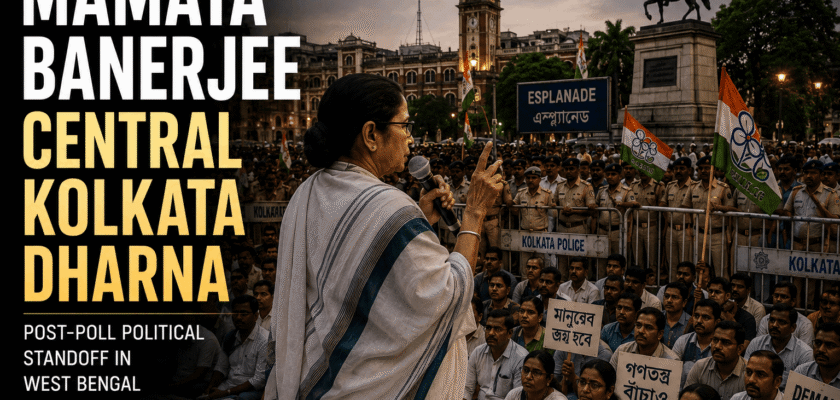
Mamata Banerjee central Kolkata dharna became a major political moment after the Trinamool Congress chief staged a sit-in protest over alleged post-poll violence, attacks on party leaders, and pressure on TMC workers. The protest came after a tense election phase in West Bengal and showed that the political fight is not ending with the poll result.
The dharna was held in central Kolkata after permission issues around Rani Rashmoni Road. Mamata Banerjee used the protest to accuse the BJP and police machinery of targeting TMC leaders and workers.
Therefore, this was not only a street protest. It was a signal that Bengal’s post-poll politics has entered a new standoff phase.
Why Mamata Banerjee Central Kolkata Dharna Matters
Mamata Banerjee central Kolkata dharna matters because it shows a shift from electoral battle to street politics. After elections, parties usually move toward assembly strategy, coalition building, or organisational rebuilding. But in Bengal, the post-poll phase has moved quickly into protest mode.
Hindustan Times reported that Mamata Banerjee held a major dharna in Kolkata against alleged post-poll attacks on TMC workers and leaders, including Abhishek Banerjee. The report also noted BJP’s counter-attack, with Suvendu Adhikari saying TMC’s condition was “pathetic.”
This matters because both sides are now fighting over public perception, not only seats.
What Triggered the Dharna?
The dharna was triggered by alleged post-poll violence and attacks on Trinamool Congress leaders and workers. Reports say TMC leaders accused the BJP and state machinery of intimidation, while BJP leaders rejected the claims and blamed TMC’s own political decline.
Times of India reported that Mamata Banerjee had announced the June 2 sit-in protest at Rani Rashmoni Avenue in Esplanade, Kolkata, over alleged attacks on party leaders and workers after the recent polls.
This made the protest a direct response to the post-poll security and political intimidation debate.
Mamata Banerjee Central Kolkata Dharna and Permission Row
Mamata Banerjee central Kolkata dharna also became controversial because of the permission issue. Reports said Kolkata Police denied TMC permission to hold the sit-in protest at Rani Rashmoni Avenue.
Times of India reported that after the denial, Mamata accused the BJP of trying to break TMC with police help and said, “arrest me if you want.”
This permission row helped Mamata frame the protest as a fight for democratic space.
For TMC supporters, the denial became proof of pressure. For opponents, it became part of a law-and-order debate.
Why Rani Rashmoni Avenue Matters
Rani Rashmoni Avenue and nearby Esplanade areas have symbolic value in Kolkata politics. These spaces often become sites for protests, rallies, and political messaging.
A protest in central Kolkata gets visibility because it is close to administrative, media, and public movement zones.
That is why location mattered.
Even if the exact protest spot changed, the central Kolkata setting helped TMC create a strong political image: leadership sitting in the street and challenging the ruling side.
Post-Poll Standoff: What It Means
A post-poll standoff means the election fight continues even after voting and counting are over. Instead of accepting a quiet transition, parties keep contesting the meaning of the result, the conduct of state machinery, and the safety of workers.
In Bengal, this standoff includes:
- Allegations of attacks on party workers
- Claims of police pressure
- Defection fears
- Leadership challenges
- Public protests
- Counter-statements from BJP
- Internal party stress
- Media battle
- Court and administrative pressure
- Street mobilisation
This makes the political environment unstable.
The Abhishek Banerjee Attack Angle
The alleged attack on Abhishek Banerjee added emotional weight to the dharna. Times of India reported that Abhishek Banerjee faced a hostile crowd during a visit linked to post-poll violence, with eggs, stones, and slippers allegedly thrown at him.
For Mamata Banerjee, this became a powerful example of what she called political intimidation.
For TMC workers, an attack on Abhishek Banerjee was not only a local incident. It became a symbol of pressure on the party’s top leadership.
This gave the dharna sharper emotional force.
Mamata’s Street Politics Strategy
Mamata Banerjee has long used street politics as a core part of her political identity. The central Kolkata dharna fits that style.
A dharna allows a leader to:
- Show personal resistance
- Mobilise party workers
- Control media narrative
- Create emotional connection
- Challenge administrative power
- Signal defiance
- Rebuild morale after setbacks
- Keep supporters active
- Pressure opponents
- Shift focus from defeat to resistance
This is why the protest matters beyond one day.
It may be part of a larger strategy to keep TMC’s base energised.
Why TMC Needed a Strong Public Response
TMC needed a strong public response because post-poll moments are crucial for party morale. After a difficult election result or political pressure, workers often look to leadership for direction.
A major dharna can tell supporters that the party is still fighting.
It can also help stop the narrative that TMC is weakened or silent.
Economic Times reported that Mamata alleged an “organised attempt” to destabilise TMC through intimidation, coercion, and misuse of administrative powers, and called for wider protests.
This shows the protest was also about defending party unity.
BJP’s Counter-Narrative
BJP did not accept Mamata Banerjee’s claims quietly. BJP leaders argued that TMC is facing public anger, internal stress, and political decline.
Hindustan Times live coverage reported Suvendu Adhikari’s claim that TMC’s condition was “pathetic” and that only a limited number of leaders attended the protest.
This counter-narrative is important.
TMC says it is fighting intimidation.
BJP says TMC is trying to cover its weakening position.
The political impact depends on which story voters believe.
Congress Reaction and Wider Opposition Space
The issue also attracted comments from other opposition voices. Hindustan Times reported Congress MP Imran Masood saying there was “no governance in Bengal” and that leaders were being attacked with a spirit of revenge.
This matters because Bengal politics may now affect broader opposition coordination.
If TMC frames the issue as an attack on democratic rights, it may seek sympathy from other opposition parties. However, Bengal’s internal political history makes such alliances complicated.
Opposition unity is easier in statements than in state-level ground politics.
Internal Turmoil Inside TMC
The dharna also comes at a time when TMC is facing internal strain. Times of India reported a “fake signature” row involving two TMC MLAs, which created embarrassment for the party leadership and raised questions about internal cohesion after the poll setback.
This internal turmoil makes the protest more significant.
Mamata Banerjee is not only challenging BJP. She is also trying to hold her organisation together.
A public show of strength can help reduce internal uncertainty.
Defection Pressure and Party Discipline
Post-poll periods often create defection rumours. Leaders who fear losing influence may shift sides or negotiate with stronger parties.
Mamata Banerjee’s protest message included warnings against intimidation and attempts to break TMC.
Times of India also reported that West Bengal BJP president Samik Bhattacharya said the BJP would avoid admitting “tainted” former TMC leaders and wanted to prevent “Trinamoolisation” of the party.
This shows that both parties are managing defection politics carefully.
Why Police Role Is Politically Sensitive
Police role is politically sensitive because law and order after elections can shape public trust. If one side says police are passive or biased, and the other side says police are maintaining order, the issue becomes highly political.
Mamata Banerjee accused police of helping pressure TMC workers and leaders. BJP and administrative voices are likely to frame police action as law-and-order management.
This debate matters because post-poll violence cases often involve local tensions, party revenge claims, and administrative pressure.
A fair investigation process is necessary to build trust.
Public Perception: Sympathy or Fatigue?
The dharna can create two possible public reactions.
Some voters may feel sympathy if they believe TMC workers are under attack. They may see Mamata as fighting back against political intimidation.
Others may feel fatigue if they believe the protest is only political drama after losing power or influence.
This is the main risk for TMC.
A protest works only when voters feel the issue is real and urgent. If people see it as routine politics, the impact may reduce.
Why Central Kolkata Dharna Creates Strong Visual Politics
A central Kolkata dharna creates strong visuals. A leader sitting on the street, surrounded by supporters, gives a message of resistance.
Visual politics matters because people often remember images more than long speeches.
A protest image can travel through:
- TV news
- Instagram reels
- X posts
- WhatsApp groups
- YouTube clips
- Local newspapers
- Political posters
- Party pages
- Meme accounts
- Opposition campaigns
This is why location and optics matter in modern politics.
The Role of Social Media
Social media will shape how the dharna is understood. TMC supporters will share clips showing Mamata’s defiance and allegations of attacks. BJP supporters will share counter-clips questioning turnout, claims, or party condition.
This creates a parallel narrative battle.
Social media can amplify:
- Emotional speeches
- Police permission row
- Crowd visuals
- Attack allegations
- Counter-statements
- Old videos
- Edited clips
- Fact-checks
- Hashtags
- Party propaganda
Readers should verify before believing viral claims.
How the Dharna Affects TMC Workers
For TMC workers, the dharna may work as a morale booster. A top leader publicly protesting can make local workers feel less isolated.
It can also signal that the party will not abandon workers after alleged attacks.
This matters in Bengal because local-level political violence can deeply affect party networks.
If workers feel unsafe or ignored, the organisation weakens. If leadership shows presence, the organisation can stay active.
So, the dharna has organisational value.
How the Dharna Affects BJP
For BJP, the dharna creates both challenge and opportunity.
The challenge is that Mamata can use street politics to keep public focus on alleged post-poll violence. This may put pressure on the new political power structure.
The opportunity is that BJP can frame the protest as a sign of TMC’s desperation.
If BJP can show law-and-order control and avoid excessive reaction, it may reduce the protest’s impact. If the administration appears heavy-handed, Mamata may gain sympathy.
So, BJP’s response matters.
What Voters May Watch Next
Voters may watch whether the protest leads to real action.
Important questions include:
- Will alleged post-poll violence cases be investigated?
- Will affected workers get protection?
- Will TMC organise more protests?
- Will BJP respond with counter-rallies?
- Will police take neutral action?
- Will courts get involved?
- Will defection rumours grow?
- Will TMC’s internal issues deepen?
- Will opposition parties support Mamata?
- Will the issue remain alive beyond one day?
The long-term impact depends on follow-up.
Why Post-Poll Violence Is a Serious Issue
Post-poll violence is serious in any democracy. Elections should end with results, not revenge. If workers, voters, or leaders are attacked after results, democratic participation becomes risky.
All parties should support fair investigation and protection for victims.
Political violence can damage:
- Voter confidence
- Worker safety
- Local peace
- Administrative trust
- Party offices
- Public property
- Community relations
- Future campaigning
- Media freedom
- Democratic culture
So, the issue should not be reduced only to party blame games.
Mamata Banerjee’s Message to Supporters
Mamata Banerjee’s message was one of defiance. Reports quoted her warning that TMC would fight and that intimidation would not weaken the party.
This message was aimed at multiple audiences.
To TMC workers, it said: do not give up.
To BJP, it said: we will resist.
To police, it said: we are watching.
To voters, it said: the fight continues.
To internal dissenters, it said: stay with the party.
That is why the speech mattered politically.
Why This Could Become a Longer Protest Cycle
The dharna may not remain a one-day event. If the situation stays tense, TMC may hold more protests, marches, district-level meetings, or legal campaigns.
Hindustan Times reported TMC leader Kalyan Banerjee saying the party would organise larger protests in coming days.
This suggests the dharna may be the beginning of a longer political campaign.
If that happens, Bengal politics may stay highly charged in the coming weeks.
Risks for TMC
TMC faces several risks.
These include:
- Protest fatigue
- Internal dissent
- Defection rumours
- Weak crowd mobilisation
- Counter-narrative from BJP
- Law-and-order restrictions
- Public anger over past governance
- Media focus on internal issues
- Legal complications
- Difficulty sustaining momentum
To gain impact, TMC must keep the protest message clear and evidence-based.
Risks for BJP
BJP also faces risks.
These include:
- Appearing heavy-handed
- Being blamed for post-poll violence
- Allowing sympathy for Mamata
- Mishandling police response
- Facing national opposition criticism
- Local tensions escalating
- Governance focus getting distracted
- Overpoliticising law-and-order cases
- Letting violence dominate headlines
- Weak victim protection narrative
BJP must show control, fairness, and administrative maturity.
What Neutral Governance Should Look Like
Neutral governance should focus on safety and law, not party advantage.
Authorities should:
- Investigate all complaints fairly
- Protect victims from all parties
- Prevent revenge attacks
- Allow peaceful protest with rules
- Stop misinformation
- Maintain public order
- Act against violence quickly
- Communicate clearly
- Avoid selective policing
- Protect hospitals and public places
This is the best way to reduce tension.
What This Means for Bengal Politics
The central Kolkata dharna shows that Bengal politics remains high-energy, emotional, and confrontational. Mamata Banerjee is using street mobilisation to stay politically central, while BJP is trying to frame TMC as weakened after the polls.
The result is a sharp post-poll standoff.
This can affect:
- Assembly functioning
- Local governance
- Party defections
- Opposition unity
- Law-and-order debate
- Media narratives
- Worker morale
- Future bypolls
- Public trust
- National political positioning
So, the dharna may have impact beyond one protest day.
Final Verdict
Mamata Banerjee central Kolkata dharna is a major post-poll political signal. It shows that TMC is trying to move from setback to resistance by raising alleged post-poll violence, attacks on leaders, police pressure, and party intimidation claims.
For Mamata, the dharna is a way to energise workers, challenge BJP, and control the narrative. For BJP, it is a chance to argue that TMC is weakened and trying to regain relevance through protest politics.
In simple words, the Bengal election may be over, but the political battle is not.
The next phase will depend on whether the dharna becomes a sustained movement, whether violence allegations are investigated fairly, and whether both sides can prevent street politics from becoming street conflict.


