


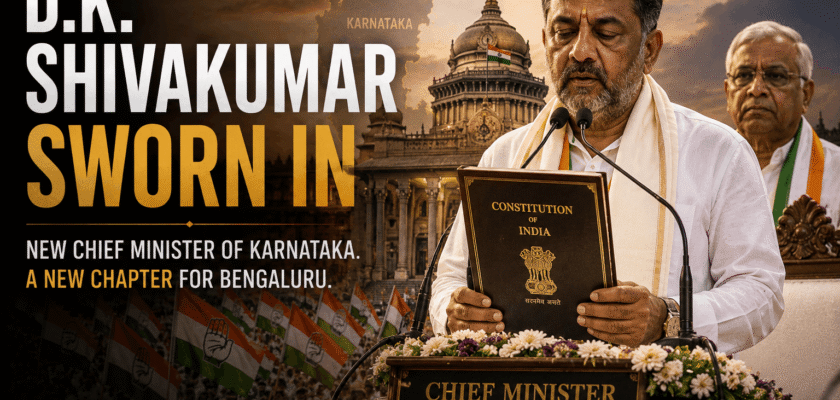
D.K. Shivakumar Sworn In: Why Karnataka’s Leadership Shift Matters
D.K. Shivakumar sworn in as Karnataka Chief Minister marks one of the biggest political transitions in the state’s recent Congress history. The oath ceremony in Bengaluru ended Siddaramaiah’s current chief ministerial phase and opened a new chapter under Shivakumar, a leader known for organisation control, crisis management, and strong regional influence.
This transition matters because Karnataka is one of Congress’s most important states. It is also politically sensitive because the party must balance leadership ambitions, caste equations, governance promises, Bengaluru’s economy, rural development, and the 2028 election roadmap.
Therefore, D.K. Shivakumar sworn in as Chief Minister is not just a routine oath ceremony. It is a power shift with long-term political meaning.
Why D.K. Shivakumar Sworn In Is a Big Political Event
D.K. Shivakumar sworn in is a big political event because it changes the centre of power inside Karnataka Congress. Shivakumar had been Deputy Chief Minister and Karnataka Pradesh Congress Committee president, but becoming Chief Minister gives him direct control over governance and political delivery.
Outlook reported that Governor Thaawarchand Gehlot administered the oath to Shivakumar at Lok Bhavan in the presence of top Congress leadership.
Times of India reported that the event was presented as a united Congress transition, with Siddaramaiah sharing the stage as Shivakumar took oath.
This unity message was important because the Congress needed to show that the leadership change was managed, not chaotic.
What Happened at the Oath Ceremony?
D.K. Shivakumar took oath as Karnataka Chief Minister on June 3, 2026, at Lok Bhavan in Bengaluru. The ceremony included Congress leaders, ministers, supporters, and senior political figures.
New Indian Express live updates described him as Karnataka’s 18th Chief Minister and reported that G. Parameshwara took oath as Deputy Chief Minister, while several ministers also joined the cabinet.
The ceremony was designed to send three messages:
- Congress is still in control
- Siddaramaiah and Shivakumar are publicly together
- The new government has a ready cabinet structure
- Karnataka’s leadership transition is complete
- The party is preparing for the next election cycle
In simple words, the event was both administrative and symbolic.
D.K. Shivakumar Sworn In and the Siddaramaiah Transition
D.K. Shivakumar sworn in also marks the end of Siddaramaiah’s latest term as Chief Minister. Siddaramaiah remains a major Congress leader with strong support among backward classes, minorities, and welfare-focused voters.
To manage this transition, Congress also gave Siddaramaiah a national-level role. Economic Times reported that Congress president Mallikarjun Kharge appointed outgoing Karnataka CM Siddaramaiah as a member of the Congress Working Committee just before the transition.
This was politically important.
It helped Congress:
- Respect Siddaramaiah’s stature
- Avoid public bitterness
- Balance internal power
- Keep his support base engaged
- Show national-level recognition
- Reduce transition tension
A smooth handover was necessary for party unity.
Why Congress Needed a United Front
Congress needed a united front because leadership transitions can create factional damage. If supporters of the outgoing and incoming leaders fight publicly, the opposition gets a strong attack point.
Times of India reported that Congress showcased unity as Shivakumar took oath with Siddaramaiah on stage.
This visual mattered.
It told voters that Congress wanted continuity, not conflict.
It also told party workers that both camps must now support the new government.
In Karnataka politics, perception can become reality quickly. A united photo can reduce rumours. A divided stage can fuel political instability.
The Bengaluru Transition: Why Location Matters
The Bengaluru transition matters because Karnataka’s capital is not only an administrative centre. It is also India’s technology powerhouse, startup hub, real estate engine, and global investment magnet.
A new Chief Minister must manage:
- Bengaluru infrastructure
- Traffic pressure
- IT industry concerns
- Startup ecosystem
- Water supply
- Urban governance
- Housing pressure
- Metro expansion
- Lake protection
- Investor confidence
For Shivakumar, Bengaluru will be one of the biggest governance tests.
A strong political leader must now prove administrative delivery in a complex urban economy.
Who Is D.K. Shivakumar?
D.K. Shivakumar is one of Congress’s most powerful leaders in Karnataka. He is known for his organisational strength, fund-raising ability, crisis management, and loyalty to the Congress high command.
He represents Kanakapura and belongs to the Vokkaliga community, which is politically influential in southern Karnataka.
His political image includes:
- Strong party organiser
- Congress troubleshooter
- Mass leader in Old Mysuru region
- Powerful regional strategist
- Key 2023 victory figure
- Long-time Karnataka Congress face
- Experienced minister
- Known crisis manager
- High-command loyalist
- Ambitious state leader
His rise to Chief Minister is the result of years of political patience and internal negotiation.
Why Shivakumar’s Organisational Style Matters
Shivakumar’s organisational style matters because Congress needs strong ground-level control in Karnataka. BJP and JD(S) will continue to challenge the party, especially in caste-sensitive and region-specific constituencies.
Times of India reported that analysts expect Shivakumar’s rise to affect the political dynamics for both BJP and JD(S), especially because he is known for organisational strength and regional influence.
His style may help Congress in:
- Booth-level strengthening
- Fund mobilisation
- Candidate management
- Coalition pressure handling
- Worker motivation
- Old Mysuru strategy
- Vokkaliga outreach
- Urban-rural balancing
- Opposition response
- 2028 election planning
This makes him more than an administrative replacement.
Impact on Congress in Karnataka
D.K. Shivakumar sworn in can strengthen Congress if he manages both governance and internal unity. Congress won Karnataka in 2023 with strong welfare promises, but retaining power requires delivery.
Under Shivakumar, Congress must focus on:
- Welfare scheme continuity
- Fiscal discipline
- Rural development
- Bengaluru infrastructure
- Farmer issues
- Youth employment
- Industry confidence
- Caste balance
- Cabinet coordination
- 2028 election preparation
If he delivers, Congress can project Karnataka as a model state.
If internal friction grows, the transition may hurt the party.
Impact on BJP
BJP will likely use the transition to attack Congress over internal power sharing, governance delays, and possible factionalism. However, Shivakumar’s rise also creates challenges for BJP because he is considered a strong organiser.
BJP may focus on:
- Alleged Congress factionalism
- Bengaluru infrastructure issues
- Corruption allegations
- Fiscal burden of guarantees
- Law and order
- Hindu identity politics
- Farmer concerns
- Centre-state friction
- Cabinet imbalance
- 2028 electoral strategy
The BJP will try to frame the transition as Congress instability.
Congress will try to frame it as planned leadership renewal.
Impact on JD(S)
JD(S) may face new pressure because Shivakumar has influence in the Vokkaliga belt, where JD(S) traditionally has strength. His rise could help Congress attempt deeper consolidation in Old Mysuru.
This can affect JD(S) in:
- Vokkaliga vote competition
- Local leader retention
- Alliance strategy with BJP
- Old Mysuru seat planning
- Rural base defence
- Candidate selection
- Youth outreach
- Regional identity messaging
- Mandya-Hassan-Mysuru belt politics
- Future bargaining power
JD(S) will need to defend its core vote base more aggressively.
Why Caste Balance Is Important
Karnataka politics often depends on caste and regional balance. Siddaramaiah has strong backward-class appeal, while Shivakumar is a major Vokkaliga leader.
Congress must now balance:
- Vokkaliga representation
- Kuruba and OBC support
- Dalit leadership
- Minority voters
- Lingayat outreach
- Old Mysuru politics
- Kalyana Karnataka concerns
- Coastal Karnataka strategy
- Bengaluru urban voters
- Youth and women voters
A successful Chief Minister must manage social coalitions carefully.
This will be one of Shivakumar’s biggest political tests.
Cabinet Formation: Why It Matters
Cabinet formation is one of the first signs of a new Chief Minister’s strategy. It shows which regions, communities, loyalists, and policy areas the new leader wants to prioritise.
Times of India reported that Shivakumar’s first cabinet included Yathindra Siddaramaiah among 14 ministers, while G. Parameshwara was expected to become Deputy Chief Minister.
This type of cabinet structure can help Congress balance old and new power centres.
However, every cabinet also creates disappointment among those left out.
So, managing ambition will remain important.
PM Modi’s Congratulations and Centre-State Equation
Prime Minister Narendra Modi congratulated D.K. Shivakumar after the oath and said the Centre would work closely with the Karnataka government for people’s welfare.
This message matters because Karnataka needs Centre-state coordination for infrastructure, investment, transport, finance, urban development, and disaster response.
Even when parties oppose each other politically, governments must cooperate administratively.
Key areas needing Centre-state coordination include:
- Metro projects
- National highways
- Urban transport
- Startup policy
- Defence manufacturing
- Disaster relief
- Water disputes
- GST and finance
- Railway expansion
- Industrial corridors
A stable working relationship can benefit Karnataka.
Bengaluru Infrastructure: The First Big Test
Bengaluru infrastructure will be one of the first big tests for Shivakumar. The city is a global tech hub but faces traffic, water, flooding, waste, and planning problems.
The new CM will face pressure to improve:
- Road quality
- Traffic management
- Metro connectivity
- Suburban rail
- Drainage
- Water supply
- Lake rejuvenation
- Waste management
- Real estate regulation
- Tech corridor planning
Bengaluru voters are politically aware and economically important.
If the city sees visible improvement, Shivakumar’s leadership can gain credibility.
Welfare Guarantees and Fiscal Pressure
Congress’s welfare guarantees remain central to Karnataka politics. These schemes helped the party build strong voter connection, especially among women, poor households, and rural voters.
However, welfare delivery also creates fiscal pressure.
The new government must balance:
- Freebie criticism
- Budget discipline
- Revenue generation
- Scheme delivery
- Public expectations
- Infrastructure spending
- Debt management
- Social justice goals
- Investment confidence
- Long-term development
This balance will decide whether Congress can defend its governance model in 2028.
Rural Karnataka Expectations
Rural Karnataka will expect continuity and stronger delivery. Farmers, small traders, workers, and rural youth will watch how Shivakumar handles ground-level issues.
Important rural priorities include:
- Irrigation
- Crop prices
- Rural roads
- Power supply
- Employment
- Drinking water
- Cooperative sector
- Education quality
- Health access
- Local governance
A Chief Minister with strong organisational skills must now show administrative results in villages too.
Industry and Investment Confidence
Karnataka is one of India’s most important investment destinations. Investors will watch whether the new leadership maintains policy stability.
Industry will expect:
- Fast approvals
- Infrastructure upgrades
- Stable power supply
- Skilled workforce
- Ease of doing business
- Reduced bureaucratic delay
- Strong law and order
- Startup support
- Global investor outreach
- Predictable taxation and compliance
Shivakumar must convince industry that political transition will not slow business momentum.
Law and Order Challenges
Law and order will also remain a major governance issue. Karnataka has diverse regions with different political and social tensions.
The government must handle:
- Communal tensions
- Political protests
- Cybercrime
- Bengaluru safety
- Drug enforcement
- Traffic discipline
- Rural disputes
- Women’s safety
- Campus tensions
- Organised crime
A Chief Minister’s credibility often depends on whether citizens feel safe and order is maintained fairly.
Congress High Command’s Role
Congress high command played a major role in the transition. The leadership had to balance Siddaramaiah’s experience with Shivakumar’s long-standing ambition.
India Today had reported earlier that the leadership transition was moving toward a managed handover from Siddaramaiah to Shivakumar after internal power-sharing expectations from the 2023 mandate.
This shows the transition was not sudden.
It was part of a larger internal arrangement.
The challenge now is to ensure the arrangement does not create new friction later.
Why This Transition Affects 2028 Election Strategy
The 2028 Karnataka Assembly election will be the big political test for Shivakumar. Congress will want to return to power under his leadership.
Times of India reported that Congress general secretary K.C. Venugopal said Congress would return to power in Karnataka in 2028 under Shivakumar’s leadership with Siddaramaiah’s support.
This statement shows the party’s intended roadmap.
The next two years may be used to:
- Strengthen organisation
- Deliver welfare schemes
- Improve urban governance
- Expand voter coalitions
- Counter BJP-JD(S) alliance
- Build Shivakumar’s CM image
- Keep Siddaramaiah camp included
- Manage cabinet ambitions
- Prepare candidate strategy
- Create a governance narrative
Every decision from now can shape the 2028 campaign.
Public Expectations From the New CM
Public expectations from Shivakumar will be high. Supporters see him as a strong leader who can act decisively. Critics will watch for controversy, centralisation, or factional politics.
People will expect:
- Faster governance
- Better roads
- Welfare scheme delivery
- Job creation
- Reduced corruption
- Bengaluru improvement
- Farmer support
- Strong administration
- Better public services
- Political stability
A new Chief Minister gets a honeymoon period, but it does not last long.
Delivery must begin quickly.
Risks for Shivakumar
Shivakumar’s biggest risks include internal party balance, opposition attacks, governance complexity, and public expectations.
Key risks include:
- Siddaramaiah camp dissatisfaction
- Cabinet resentment
- BJP attacks
- JD(S) regional pushback
- Bengaluru infrastructure failure
- Fiscal stress
- Corruption allegations
- Welfare delivery gaps
- Caste imbalance
- Over-centralised governance image
To succeed, he must combine political strength with administrative patience.
Opportunities for Shivakumar
The opportunities are also big.
He can build a strong legacy if he delivers on:
- Bengaluru renewal
- Congress unity
- Rural development
- Vokkaliga consolidation
- Welfare delivery
- Industry confidence
- Youth employment
- Transparent governance
- Strong party organisation
- 2028 election victory
Few leaders get the chance to move from organiser to Chief Minister.
Now Shivakumar has that opportunity.
What This Means for Karnataka Voters
For Karnataka voters, the transition should ideally mean better governance, not just political change. People will judge the new CM by results.
Voters will watch:
- Are services improving?
- Are roads getting better?
- Are welfare schemes running?
- Are jobs growing?
- Is Bengaluru being fixed?
- Are farmers getting support?
- Is corruption reducing?
- Is law and order stable?
- Are prices manageable?
- Is the government united?
Political symbolism matters, but delivery matters more.
What This Means for National Politics
Karnataka is important nationally because it is one of Congress’s strongest states. A stable Karnataka government gives Congress political confidence. A weak or divided government gives BJP an opening.
The Shivakumar transition will affect:
- Congress national morale
- Opposition politics
- South India strategy
- BJP’s southern expansion plans
- JD(S) relevance
- 2028 state election narrative
- Lok Sabha preparation
- Governance model debate
- Welfare politics
- Centre-state relations
So, this change is bigger than Karnataka alone.
Final Verdict
D.K. Shivakumar sworn in as Karnataka Chief Minister marks a major shift in state politics. It completes a long-awaited Congress leadership transition and gives Shivakumar the chance to move from party strategist to full administrative leader.
The oath ceremony was designed to show unity, with Siddaramaiah present and Congress projecting a smooth handover. But the real test starts now. Shivakumar must manage internal balance, deliver welfare schemes, improve Bengaluru, keep industry confident, and prepare Congress for the 2028 election.
In simple words, Karnataka has entered the Shivakumar era.
If he combines organisational strength with strong governance, Congress can turn this transition into a long-term advantage. If factionalism or delivery failure grows, the same transition can become a political risk.


