
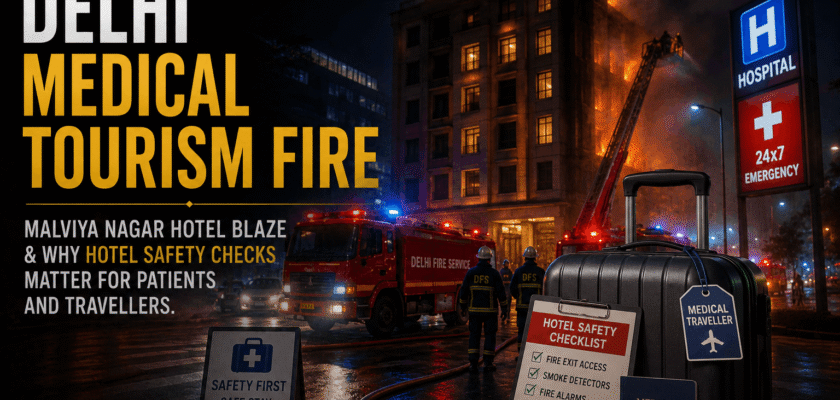
Delhi Medical Tourism Fire: Why This Tragedy Became a Travel Safety Warning
Delhi medical tourism fire has become a painful reminder that hotel safety is not a small detail for patients, attendants, foreign visitors, and domestic travellers. A hotel near a medical hub may look convenient, affordable, and close to hospitals, but if fire exits, alarms, staircases, licenses, and emergency systems are weak, convenience can turn into danger.
On June 3, 2026, a massive fire in Delhi’s Malviya Nagar area killed at least 21 people and injured many others. Reuters reported that many victims were foreign nationals, including people who had travelled to Delhi for medical treatment. The fire reportedly started in a ground-floor restaurant and spread through the building housing a hotel above.
Therefore, this incident is not only a local fire tragedy. It is a serious warning for India’s medical tourism ecosystem.
Why Delhi Medical Tourism Fire Matters
Delhi medical tourism fire matters because Delhi attracts patients from India and abroad for treatment at major hospitals and medical centres. Many patients and attendants choose nearby budget hotels, guest houses, and service apartments because they need easy hospital access.
However, patients are not ordinary tourists. Many may be recovering from surgery, carrying medical reports, travelling with elderly family members, or staying with children. If a fire breaks out, evacuation becomes harder.
Reports say foreign nationals were among the 21 people killed in the Malviya Nagar fire, and several people had to jump from upper floors to escape the flames.
This makes hotel safety a life-or-death travel issue.
What Happened in Malviya Nagar?
The fire broke out in a building in Delhi’s Malviya Nagar area that housed a restaurant and hotel. Reuters reported that the blaze started shortly before 9 a.m., was believed to have originated in the ground-floor restaurant, and was brought under control by midday using eight fire engines. More than 40 people were rescued and taken to hospitals.
Times of India reported that the building had a major safety flaw: only one entry-exit route. That single-route setup made evacuation harder during panic and smoke.
In simple words, the fire spread fast, escape became difficult, and many guests were trapped.
Delhi Medical Tourism Fire and Foreign Patients
Delhi medical tourism fire became especially serious because many victims were reportedly foreign nationals. Reuters reported that the deceased included citizens from Bangladesh, Nigeria, Mozambique, and Liberia.
Many foreign patients come to Delhi for:
- Cancer treatment
- Heart surgery
- Orthopaedic care
- Kidney treatment
- IVF treatment
- Neurology care
- Transplants
- Follow-up consultations
- Dental and cosmetic procedures
- Long recovery stays
Such travellers often rely on local hotel listings, hospital suggestions, agents, or online booking platforms.
This tragedy shows why medical travellers must check safety, not only distance from hospital.
Why Medical Hub Hotels Need Higher Safety Standards
Medical hub hotels need higher safety standards because their guests may not be physically strong during emergencies. A normal tourist may run down stairs quickly. A patient may not.
Guests may include:
- Post-surgery patients
- Cancer patients
- Elderly travellers
- Pregnant women
- Children
- People using walkers
- Dialysis patients
- Patients with oxygen support
- Foreign visitors unfamiliar with area
- Attendants carrying medical documents
A hotel serving such guests must have clear exits, working alarms, trained staff, and safe staircases.
Medical tourism safety must include accommodation safety.
Single Entry-Exit Route: Why It Is Dangerous
A single entry-exit route can become deadly during a fire. If smoke, flames, or crowding block that route, people may have no safe escape path.
Times of India reported that the Malviya Nagar hotel had only one entry-exit route, which hindered evacuation.
A safe hotel should have:
- Multiple exits
- Clear staircases
- Emergency lighting
- Open exit doors
- Fire alarms
- Smoke detectors
- Fire extinguishers
- Evacuation maps
- Trained staff
- No blocked corridors
If a hotel has only one escape route, guests should think twice before staying there.
Why Restaurant-Hotel Buildings Carry Extra Risk
Buildings that combine restaurants and hotels can carry extra fire risk because kitchens use gas, oil, electrical equipment, exhaust systems, and high heat. If fire starts in a restaurant area, smoke can move upward toward hotel rooms.
The Malviya Nagar fire was believed to have started in the ground-floor restaurant before spreading through the building.
Restaurant-linked fire risks include:
- LPG leakage
- Electrical short circuit
- Deep fryer fire
- Poor exhaust cleaning
- Gas cylinder storage
- Overloaded wiring
- Blocked kitchen exits
- Grease buildup
- Basement cooking
- Poor fire separation
Hotels above restaurants need strong fire separation and evacuation planning.
Hotel License and Room Count Must Be Checked
A hotel’s license matters because it shows what the building is officially allowed to operate. Times of India reported that the Delhi hotel was licensed for six rooms but was allegedly running 25 rooms.
This kind of mismatch can be dangerous.
If a hotel has more rooms than approved, it may also have:
- Overcrowding
- Poor evacuation planning
- Weak fire compliance
- Extra partitions
- Illegal construction
- Narrow corridors
- Insufficient exits
- Poor ventilation
- Unsafe electrical load
- Limited emergency access
Travellers rarely check licenses, but this incident shows why they should.
Medical Tourism Safety Checklist Before Booking
Before booking a hotel near any medical hub, travellers should check more than price and distance.
Use this checklist:
- Does the hotel have more than one exit?
- Are staircases clear?
- Are fire alarms visible?
- Are extinguishers present?
- Does the hotel have a fire NOC?
- Is the building overcrowded?
- Are rooms in basement areas avoided?
- Is the reception open 24/7?
- Is there lift plus staircase access?
- Is the hospital reachable by road quickly?
A cheap hotel is not worth the risk if safety is weak.
What Foreign Medical Travellers Should Ask
Foreign medical travellers should ask direct safety questions before booking.
Ask the hotel:
- Do you have a valid fire safety certificate?
- How many emergency exits are there?
- Is there a staircase on every floor?
- Are smoke alarms installed?
- Is there a 24-hour staff member?
- Are rooms accessible for patients?
- Is there oxygen-safe policy?
- Are gas cylinders stored safely?
- Can you share photos of exits?
- Are hospitals nearby by ambulance route?
If the hotel refuses to answer, choose another place.
Why Online Reviews Are Not Enough
Online reviews often focus on cleanliness, food, room size, price, and staff behaviour. They rarely mention fire exits or safety systems.
A hotel may have good ratings but poor emergency planning.
Reviews may miss:
- Fire alarms
- Exit width
- Staircase blockage
- Building license
- Fire NOC
- Restaurant fire risk
- Electrical overload
- Emergency lighting
- Staff training
- Evacuation plan
So, travellers should not rely only on star ratings.
Safety must be checked separately.
What Hospitals Can Do for Medical Tourists
Hospitals that attract medical tourists should guide patients toward safe accommodation. Even if hospitals do not own nearby hotels, they can provide safety guidance.
Hospitals can:
- Share hotel safety checklist
- Partner only with compliant hotels
- Verify fire certificates
- Check patient accessibility
- Provide emergency contacts
- Offer patient transport guidance
- Warn against unsafe buildings
- Provide multilingual safety instructions
- Keep embassy contact support
- Help attendants during emergencies
Medical care does not end at the hospital gate.
Accommodation safety is part of patient care.
Role of Travel Agents and Medical Tourism Facilitators
Travel agents and medical tourism facilitators must act responsibly. Many foreign patients depend on them for hotel booking.
Facilitators should not choose hotels only by commission or low price.
They should check:
- Fire safety compliance
- Distance from hospital
- Ambulance access
- Room accessibility
- Lift and staircase condition
- Cleanliness
- Food safety
- Language support
- Emergency staff availability
- Legal operation status
A facilitator’s duty is patient safety, not only booking convenience.
Why Budget Hotels Need Stronger Audits
Budget hotels often serve students, patients, families, workers, and foreign visitors. They may operate in dense markets with narrow roads and mixed-use buildings. That makes fire safety even more important.
Budget hotel risks can include:
- Old wiring
- Narrow staircases
- No sprinkler system
- Packed rooms
- Restaurant below rooms
- Blocked exits
- Poor staff training
- No smoke alarms
- Illegal partitions
- Weak ventilation
Authorities must audit such properties regularly, especially near hospitals.
Fire NOC: Why Travellers Should Know This Term
Fire NOC means a no-objection certificate from the fire department or relevant authority. It indicates that the building has been assessed for fire safety standards.
Travellers may not always be able to verify every document, but they can ask the hotel for fire safety compliance proof.
A hotel that follows rules should be able to explain:
- Fire NOC status
- Exit plan
- Alarm system
- Fire extinguisher location
- Staff evacuation training
- Emergency assembly point
- Electrical safety checks
- Kitchen fire controls
If the staff looks confused, that itself is a warning sign.
Safety Red Flags While Entering a Hotel
When you enter a hotel, look for red flags.
Avoid or reconsider staying if you see:
- Narrow dark staircase
- Locked exit doors
- No visible fire extinguisher
- Basement rooms without exits
- Heavy smoke smell from kitchen
- Exposed wiring
- Overcrowded corridors
- LPG cylinders near public areas
- No reception staff at night
- No evacuation map
Guests should not ignore discomfort.
Your first safety impression matters.
What Guests Should Do After Checking In
After checking in, guests should take 5 minutes to understand escape routes.
Do this:
- Locate staircase
- Count doors to exit
- Check if exit opens
- Keep room key near bed
- Keep shoes nearby
- Keep phone charged
- Keep passport/documents ready
- Avoid blocking door
- Learn emergency number
- Inform family of hotel address
In fire emergencies, seconds matter.
Preparation saves time.
Emergency Steps During a Hotel Fire
If a hotel fire happens, act fast but do not panic.
Basic steps:
- Leave immediately if safe
- Do not use lift
- Use staircase
- Stay low under smoke
- Cover nose with cloth
- Close doors behind you if possible
- Do not return for luggage
- Call emergency services
- Help children and elderly safely
- Follow firefighters’ instructions
If trapped, move near a window, call for help, and block smoke with wet cloth if possible.
Why Lifts Are Dangerous During Fire
Lifts are dangerous during fire because power may fail, smoke can enter shafts, and doors may open on unsafe floors.
Guests should use staircases, not lifts.
Hotels should clearly display:
- “Do not use lift during fire” signs
- Staircase direction arrows
- Emergency lighting
- Floor evacuation maps
- Exit signs
- Fire alarm instructions
Medical travellers using wheelchairs need special evacuation support, so hotel staff must plan for them.
Smoke Is Often More Deadly Than Flames
In many fires, smoke is more dangerous than flames. Smoke can cause suffocation, confusion, coughing, and unconsciousness.
Guests should understand:
- Smoke rises upward
- Stay low while escaping
- Cover mouth and nose
- Move quickly but carefully
- Do not open hot doors
- Avoid smoke-filled corridors
- Close doors to slow smoke
- Call for help if trapped
A hotel with smoke alarms can warn guests early.
That early warning can save lives.
Why Emergency Training for Hotel Staff Matters
Hotel staff must know how to respond during fire. A good building can still become dangerous if staff panic or delay alarms.
Staff should be trained to:
- Raise alarm quickly
- Call fire services
- Guide guests to exits
- Help elderly and patients
- Use extinguishers safely
- Shut gas supply
- Stop lift use
- Open exit doors
- Coordinate with rescue teams
- Maintain guest list
Medical hub hotels need even more training because guests may need assistance.
Why Guest Registers Matter During Rescue
A proper guest register helps rescuers know how many people are inside. If a hotel does not maintain accurate records, rescue teams may not know who is missing.
Hotels should keep:
- Guest name
- Room number
- Nationality
- Contact number
- Attendant details
- Patient status if relevant
- Check-in and check-out time
- Emergency contact
- Passport/ID record
- Staff shift record
During emergencies, accurate information speeds up rescue and family communication.
Role of Local Authorities
Local authorities must inspect high-risk hotels, especially near hospitals and tourist hubs.
They should check:
- Fire NOC
- Actual room count
- Staircase width
- Exit doors
- Illegal construction
- Kitchen safety
- Electrical load
- Basement use
- Staff training
- Emergency access roads
India Today reported that Delhi Police issued a Look Out Circular against the hotel owner and his wife after the Malviya Nagar fire, while raids were underway.
This shows investigation and accountability are now central to the case.
Why Emergency Roads Must Stay Clear
Fire engines need road access. Dense markets, illegal parking, street encroachment, and narrow lanes can delay rescue.
Hotel areas near hospitals often face traffic pressure. That makes emergency access even more important.
Authorities should ensure:
- Clear approach roads
- No illegal parking near hotels
- Fire tender access
- Visible building numbers
- Working hydrants
- No blocked lanes
- Ambulance access
- Traffic control during emergency
- Local police coordination
- Market safety audits
A safe hotel also needs a safe surrounding road network.
What This Means for Delhi’s Medical Tourism Image
Delhi is a major medical destination. Patients travel from many Indian states and countries for treatment. A tragedy like this can affect trust.
Medical tourism depends on:
- Hospital quality
- Accommodation safety
- Transport support
- Patient assistance
- Clean surroundings
- Transparent pricing
- Emergency response
- Language support
- Embassy coordination
- Safe recovery environment
If hotels near medical hubs are unsafe, the whole ecosystem suffers.
Delhi must treat accommodation safety as part of medical tourism policy.
Impact on Foreign Families
For foreign families, such a tragedy is especially painful. They may be far from home, unfamiliar with local systems, and dependent on hospitals, agents, embassies, and police for help.
They may face:
- Identification delays
- Language barriers
- Hospital coordination
- Embassy paperwork
- Travel document issues
- Family notification stress
- Body repatriation process
- Medical bill confusion
- Insurance claims
- Legal uncertainty
Authorities and hospitals must provide compassionate support.
Travel Insurance and Fire Incidents
Travel insurance can help in emergencies, but coverage varies. Medical tourists should check insurance details before travel.
Check whether policy covers:
- Emergency hospitalisation
- Fire injury treatment
- Trip interruption
- Hotel evacuation
- Emergency accommodation
- Document loss
- Medical repatriation
- Death benefits
- Attendant support
- Embassy assistance
Do not assume all policies cover everything.
Read the terms carefully.
What Medical Travellers Should Pack for Safety
Medical travellers should keep a small emergency bag.
It can include:
- Passport copy
- Visa copy
- Hospital papers
- Medicine list
- Emergency contacts
- Phone charger
- Small torch
- Basic medicines
- Insurance papers
- Local SIM details
Do not keep all documents locked inside a suitcase far from the bed.
In emergencies, quick access matters.
Hotel Room Selection Tips
Room selection can affect safety. Avoid rooms that are difficult to evacuate.
Better choices include:
- Lower-floor rooms
- Rooms near staircase
- Rooms not directly above kitchen
- Rooms with clear window access
- Rooms away from blocked corridors
- Rooms with smoke detector
- Rooms with easy path to exit
- Rooms accessible for patient needs
Very high floors in unsafe budget hotels can be risky, especially for patients.
Special Safety Tips for Elderly Patients
Elderly patients need extra planning.
Before booking, check:
- Lift availability
- Staircase condition
- Ground or first-floor room option
- Wheelchair access
- 24-hour staff support
- Nearby hospital transport
- Emergency bell
- Bathroom safety
- Oxygen safety rules
- Evacuation assistance
During a fire, elderly guests may not move quickly. Hotel staff must be able to help.
Special Safety Tips for Families With Children
Families with children should also prepare.
They should:
- Show children the exit
- Keep children’s shoes nearby
- Avoid locking children in rooms alone
- Keep family phones charged
- Decide meeting point
- Keep emergency numbers saved
- Avoid rooms with blocked windows
- Teach children not to use lift in fire
- Keep documents together
- Stay calm during evacuation
Children panic easily, so adults must plan first.
Booking Platforms Should Add Fire Safety Filters
Online booking platforms should add stronger fire safety filters. Travellers can compare price, rating, Wi-Fi, breakfast, and room photos, but fire safety is often hidden.
Platforms should show:
- Fire NOC status
- Number of exits
- Smoke alarm availability
- Sprinkler system
- Emergency staircase
- Lift safety
- Staff training
- Building license status
- Last safety audit date
- Accessibility for patients
This can help travellers make safer decisions.
Medical Tourism Agencies Need Certification
Medical tourism agencies should be certified and audited. They should not place vulnerable patients in unsafe hotels.
A good agency should verify:
- Hospital tie-ups
- Hotel safety
- Transport safety
- Patient documentation
- Emergency plans
- Interpreter support
- Insurance guidance
- Embassy support
- Transparent pricing
- Complaint system
Medical tourism is not only treatment booking. It is full patient journey management.
Delhi Hotel Fire and Past Safety Concerns
Delhi has seen serious hotel fire incidents before. People reported that the Malviya Nagar tragedy is among the worst hotel fires in Delhi since 2022.
Past incidents show that fire safety cannot be reactive. Authorities should not wait for tragedy before checking compliance.
Recurring problems often include:
- Illegal construction
- Poor wiring
- Blocked exits
- Overcrowded rooms
- Kitchen fire risk
- Lack of alarms
- No sprinklers
- Staff untrained
- Weak enforcement
- Delayed evacuation
A serious audit culture is needed.
What Travellers Should Verify on Arrival in Delhi
After arriving in Delhi, medical travellers should verify hotel safety in person.
Check:
- Is the staircase usable?
- Is the exit locked?
- Is there smoke smell?
- Are corridors blocked?
- Is reception staffed?
- Are extinguishers visible?
- Is the room too cramped?
- Is kitchen below the room?
- Is the building overcrowded?
- Is hospital transport available?
If something feels unsafe, change hotel.
Do not risk recovery for convenience.
What Embassies Can Do
Embassies can help their citizens by sharing medical travel safety advisories.
They can provide:
- Verified hospital lists
- Safety checklist
- Emergency contacts
- Hotel caution advice
- Local legal support
- Translation help
- Victim assistance
- Travel document support
- Repatriation guidance
- Crisis communication
Foreign medical patients need stronger support networks during emergencies.
Responsible Reporting During Fire Tragedies
Fire tragedies should be reported with care. Media should avoid sensational images and unverified claims. Victims and families deserve dignity.
Responsible reporting should:
- Confirm casualty numbers
- Avoid graphic visuals
- Cite official sources
- Protect victim identity until confirmed
- Explain safety lessons
- Track accountability
- Avoid rumours
- Mention emergency helplines
- Correct earlier errors
- Focus on prevention
The goal should be public awareness, not only shock.
What Hotel Owners Must Learn
Hotel owners must understand that safety is not optional. Cutting corners can cost lives.
Owners should ensure:
- Legal license
- Fire NOC
- Proper room count
- Clear exits
- Fire alarms
- Smoke detectors
- Kitchen safety
- Staff training
- Electrical audits
- Emergency plan
A hotel business cannot be built on unsafe construction.
Hospital-area hotels have extra responsibility because their guests may be vulnerable.
What Travellers Should Do Now
Travellers planning stays near Delhi medical hubs should not panic, but they should become more careful.
Before booking:
- Call the hotel
- Ask about fire exits
- Check recent reviews
- Ask for fire NOC
- Prefer known properties
- Avoid overcrowded buildings
- Choose lower floors if patient is weak
- Keep documents ready
- Share location with family
- Save emergency numbers
Careful booking can reduce risk.
Final Verdict
Delhi medical tourism fire is a tragic warning for patients, foreign visitors, attendants, hospitals, hotels, travel agents, and booking platforms. The Malviya Nagar fire killed at least 21 people and exposed serious concerns around hotel safety, emergency exits, room licensing, restaurant-linked fire risk, and evacuation planning.
For medical travellers, the lesson is clear: do not choose accommodation only by price, distance, or online rating. Check exits, fire safety systems, staff readiness, room location, and building compliance.
In simple words, medical tourism safety must include hotel safety.
Delhi can remain a strong medical destination only if hospitals, authorities, hotels, and travel facilitators treat patient accommodation as a critical safety zone, not just a place to sleep.


