


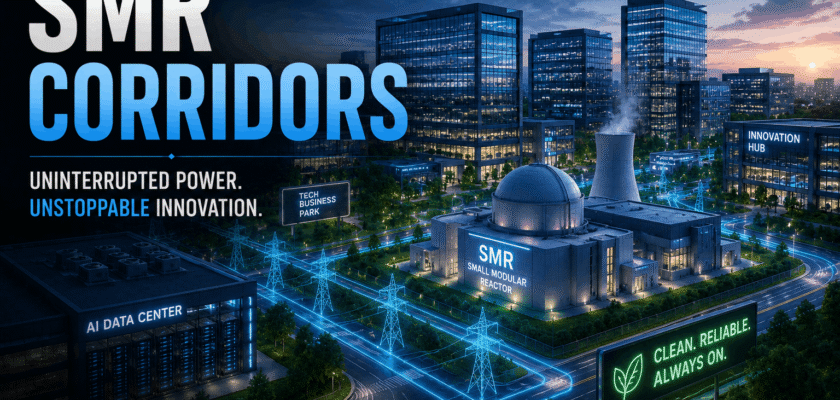
SMR Corridors: Why Tech Business Parks Need a New Power Model
SMR corridors are becoming a serious real estate and infrastructure idea because modern tech business parks need uninterrupted power. Earlier, office parks mainly needed electricity for lighting, air conditioning, elevators, computers, and security systems. Now, AI data centers, cloud campuses, semiconductor labs, R&D zones, and high-performance computing clusters need much more energy.
This shift is changing commercial real estate. A good location is no longer only about road access, metro connectivity, rental cost, or office design. Power availability is becoming a core asset.
Therefore, SMR corridors could become a future model where small modular nuclear reactors support tech parks, data centers, and digital business districts with stable low-carbon power.
Why SMR Corridors Matter in 2026
SMR corridors matter because electricity demand from data centers and AI infrastructure is growing fast. Reuters reported that Duke Energy is discussing potential partnerships with major technology companies to develop nuclear power infrastructure and share financial risk. The reason is clear: power demand is rising quickly in regions where data centers are expanding.
This is not only a U.S. story. India is also preparing for a larger nuclear energy role. The Indian government has allocated ₹20,000 crore under the Nuclear Energy Mission for research, development, and deployment of small modular reactors, with a target of operationalising at least five indigenously designed SMRs by 2033.
For real estate developers, this means one thing: future tech parks must be planned around power security.
What Are SMR Corridors?
SMR corridors are planned industrial or commercial zones where small modular reactors, grid systems, battery storage, data centers, and tech business parks are integrated through a dedicated power strategy.
An SMR corridor may include:
- Small modular nuclear reactors
- AI data centers
- Tech business parks
- Battery energy storage
- Dedicated substations
- Cooling infrastructure
- High-capacity transmission lines
- Emergency backup systems
- Industrial research zones
- Clean power agreements
In simple words, an SMR corridor is a power-first real estate ecosystem.
What Is a Small Modular Reactor?
A small modular reactor, or SMR, is a nuclear reactor designed to be smaller than traditional large nuclear plants. Many SMR designs are factory-built in modules and assembled on site.
The International Atomic Energy Agency says major technology companies are looking at advanced nuclear technologies, including SMRs, to provide clean, reliable, and flexible power for data centers, AI, and other energy-intensive digital operations.
SMRs are attractive because they may offer:
- Smaller footprint
- Modular construction
- Stable baseload power
- Lower carbon emissions during operation
- Potential factory manufacturing
- Better siting flexibility
- Long operating life
- High reliability
- Support for industrial heat
- Possible integration with storage
However, SMRs still need strict regulation, licensing, safety planning, fuel management, and public trust.
SMR Corridors and Tech Business Parks
SMR corridors can change tech business parks because power becomes part of the land value. A business park with reliable clean power can attract AI companies, cloud firms, chip design labs, research centres, and high-end manufacturing tenants.
Tech parks need power for:
- Servers
- Cooling systems
- AI training clusters
- Networking equipment
- Labs
- Clean rooms
- Security systems
- Office towers
- EV charging
- Backup operations
If power is unstable, tenants face downtime. In AI and cloud businesses, downtime can mean huge losses.
This is why uninterrupted power is becoming a real estate advantage.
Why AI Data Centers Are Driving the SMR Debate
AI data centers are driving the SMR debate because they need huge and steady electricity. AI training, inference, cooling, storage, and networking all consume power. As models get bigger and usage grows, power demand rises.
A 2026 research paper on grid-connected data centers powered by SMRs says modern data center growth has increased the need for power infrastructure that is reliable, sustainable, and capable of supporting grid stability. The study modeled an integrated system using an SMR and battery energy storage to supply data center loads and support voltage and frequency stability.
This shows why data centers and SMRs are being discussed together.
AI needs power. SMRs may provide steady clean power.
Why Uninterrupted Power Matters for Real Estate
Uninterrupted power matters because tenants now judge properties by operational reliability. A premium tech park cannot run only on design, glass towers, cafés, and green lawns. It must offer uptime.
Power interruptions can affect:
- Server availability
- Data processing
- Cloud services
- Security systems
- Research operations
- Client delivery
- Cooling systems
- Employee productivity
- Manufacturing processes
- Tenant confidence
A business park with strong power resilience can charge premium rents and attract better tenants.
Modular Power Integration: What It Means
Modular power integration means connecting power generation, storage, cooling, and real estate operations in a planned way. Instead of treating power as an external utility, developers design it into the business park from the start.
A modular power strategy may include:
- SMR-based baseload power
- Battery backup
- Grid connection
- Solar support
- Demand response systems
- Smart metering
- District cooling
- Backup generation
- Energy monitoring dashboards
- Tenant-level power contracts
This model can make tech parks more resilient.
Why SMRs Are Not the Same as Diesel Backup
Many tech parks already use diesel generators for backup. But diesel backup is not a long-term clean power solution. It creates emissions, noise, fuel logistics, and cost volatility.
SMRs are different because they are designed as steady power sources, not emergency-only backup.
A future SMR-backed tech park could reduce dependence on:
- Diesel generators
- Coal-heavy grid power
- Long fuel supply chains
- High-emission backup systems
- Unstable energy contracts
- Price-shock exposure
However, SMRs need much stronger regulation than diesel systems. They are not plug-and-play devices.
Why SMRs Could Suit High-Density Tech Parks
SMRs could suit high-density tech parks because these parks have concentrated energy demand. A single large campus may need steady power for offices, data halls, labs, and cooling.
SMRs may be useful where:
- Power demand is high
- Uptime is critical
- Land is planned carefully
- Cooling is available
- Regulation supports siting
- Public communication is strong
- Grid support is needed
- Tenants want clean energy
- Long-term demand is predictable
- Financing is structured properly
The best use case is not a normal office park. It is a high-demand technology corridor.
India’s SMR Push and Real Estate Opportunity
India’s SMR push can create future real estate opportunities. The government’s Nuclear Energy Mission includes ₹20,000 crore for SMR R&D and deployment, with an aim to develop and operationalise at least five indigenous SMRs by 2033.
India is also targeting much higher nuclear power capacity by 2047, and recent reporting says the country is preparing to open nuclear power more widely to private participation while keeping fuel and waste management under government control.
For real estate, this can matter in the future for:
- Data center parks
- Industrial corridors
- Semiconductor zones
- AI compute campuses
- Defence manufacturing hubs
- Research districts
- EV battery clusters
- Green hydrogen zones
- High-reliability logistics hubs
- Smart city extensions
SMRs may become part of long-term infrastructure planning.
Why Tech Parks Need Clean Baseload Power
Clean baseload power means power that is steady, reliable, and low-carbon during operation. Solar and wind are important, but they depend on sunlight and wind conditions. Batteries help, but long-duration reliability can still be expensive.
Nuclear power offers steady generation.
For tech parks, clean baseload power can support:
- 24/7 data center operations
- Cooling systems
- High-performance computing
- Lab equipment
- Stable tenant services
- Lower carbon reporting pressure
- Green lease commitments
- ESG targets
- Grid resilience
- Long-term energy planning
This is why nuclear power is again part of the tech infrastructure conversation.
SMR Corridors and Data Center Real Estate
Data center real estate is one of the biggest beneficiaries of SMR corridors. Data centers need enormous power density, cooling, fibre connectivity, security, and reliable land-use approvals.
An SMR-powered data center corridor could offer:
- Dedicated baseload power
- Lower grid congestion risk
- Better uptime planning
- Lower carbon intensity
- Long-term energy contracts
- Campus-scale expansion
- Integrated cooling strategy
- Better tenant confidence
- Stronger ESG positioning
- Higher infrastructure value
This can turn power access into a competitive advantage for developers.
Why Hyperscalers Are Watching Nuclear
Hyperscalers are watching nuclear because they need long-term energy security. Cloud and AI companies cannot depend only on short-term power contracts if their compute demand keeps rising.
Reuters reported that Duke Energy is exploring partnerships with major tech firms so those companies may share some of the risks of building nuclear infrastructure.
This tells us that tech companies may not remain only energy buyers. They may become energy partners.
In future, a tech park developer may need to work with utilities, nuclear developers, and anchor tenants together.
Risk-Sharing Is Critical
Risk-sharing is critical because nuclear projects are expensive and complex. Even SMRs, which are smaller than traditional reactors, need licensing, engineering, safety approvals, construction discipline, and long-term fuel planning.
Utilities may not want to carry all the financial risk alone. Tech companies may want power security but may hesitate to own nuclear risk directly.
So, future SMR corridors may use models like:
- Utility-led projects
- Public-private partnerships
- Anchor tenant power agreements
- Government-backed financing
- Long-term power purchase agreements
- Industrial consortiums
- Special purpose vehicles
- Regulated asset models
- Green infrastructure funds
- Sovereign or institutional capital
The right finance model will decide whether SMR corridors become real.
Regulatory Approval Is the Biggest Gate
Regulatory approval is the biggest gate for SMR corridors. Nuclear energy cannot be built like a normal commercial power plant. It needs strict safety standards, site approvals, emergency planning, security zones, environmental review, and public consultation.
Developers must consider:
- Reactor licensing
- Land-use rules
- Environmental clearance
- Emergency planning zone
- Security control
- Fuel supply
- Waste handling
- Cooling water
- Transmission access
- Public acceptance
Without regulatory clarity, SMR-backed real estate remains only a concept.
Public Trust and Local Acceptance
Public trust is essential. Many people support clean energy but become concerned when nuclear power is proposed near business parks or cities.
Developers and governments must explain:
- Safety systems
- Emergency protocols
- Radiation protection
- Waste handling
- Distance rules
- Monitoring systems
- Regulatory oversight
- Community benefits
- Job creation
- Environmental impact
Trust cannot be forced. It must be earned through transparent communication.
Why Safety Planning Must Come First
Safety planning must come before real estate ambition. Nuclear technology has strict safety expectations for good reason.
A future SMR corridor must include:
- Passive safety design
- Emergency response planning
- Physical security
- Cybersecurity
- Radiation monitoring
- Independent inspections
- Staff training
- Community warning systems
- Fuel security
- Decommissioning plan
A tech park should never treat SMR power as a branding gimmick.
It is serious infrastructure.
Cybersecurity Risk in SMR-Powered Tech Parks
Cybersecurity becomes important because SMR corridors may connect nuclear infrastructure, smart grids, data centers, cooling systems, building management systems, and tenant networks.
A cyberattack on energy systems can create serious disruption.
Security planning should include:
- Network separation
- Zero-trust architecture
- Physical security
- Real-time monitoring
- Incident response
- Vendor risk checks
- Access controls
- Backup operations
- Regular audits
- Government coordination
Power resilience and cyber resilience must go together.
Cooling Infrastructure Is a Hidden Factor
Cooling infrastructure is a hidden factor because both data centers and nuclear plants need thermal management. Data centers need cooling for servers. Reactors need safe heat removal.
SMR corridors must plan cooling carefully.
Key questions include:
- Is water available?
- Is air cooling possible?
- What is the local climate?
- Can waste heat be used?
- Can district cooling improve efficiency?
- What happens during heatwaves?
- Is backup cooling available?
- What is the environmental impact?
A power-first corridor must also be a cooling-first corridor.
SMRs and Battery Storage Can Work Together
SMRs and battery storage can work together. An SMR can provide steady baseload power, while batteries can respond quickly to sudden changes in demand.
The 2026 data center stability study modeled an integrated energy system using an SMR and battery energy storage and found improved voltage and frequency stability compared with a conventionally grid-connected data center.
This combination could help tech parks manage:
- Peak demand
- Backup transitions
- Grid disturbances
- Cooling load spikes
- AI training surges
- Emergency operations
- Power quality
- Tenant reliability
- Renewable integration
- Frequency support
So, SMRs do not replace all other power tools. They can work with them.
Why SMR Corridors Could Raise Real Estate Value
SMR corridors could raise real estate value because power security is becoming a premium feature. Tenants may pay more for campuses that offer reliable clean energy.
Real estate value may rise through:
- Higher tenant demand
- Better lease rates
- Longer commitments
- Lower downtime risk
- ESG-friendly positioning
- Data center attraction
- Industrial tenant confidence
- Future expansion capacity
- Infrastructure branding
- Better investor interest
In the future, “power-ready land” may become as valuable as “metro-connected land.”
Impact on Tech Business Park Design
SMR corridors may change tech business park design. Developers will need to plan energy systems, safety zones, secure perimeters, cooling routes, fibre pathways, and emergency access from day one.
Future tech parks may include:
- Energy command centres
- Dedicated substations
- Cooling plants
- Secure utility corridors
- Battery buildings
- Data center zones
- Office zones
- Research labs
- Emergency routes
- Monitoring rooms
The master plan will need engineers, energy experts, nuclear regulators, and real estate planners working together.
Why Location Selection Becomes More Complex
Location selection becomes more complex because SMR corridors need more than land and demand. They need regulatory suitability, grid connection, emergency planning, water availability, local acceptance, and safe distance from dense populations.
Developers must check:
- Land stability
- Seismic risk
- Flood risk
- Water supply
- Transmission access
- Security needs
- Distance from population centres
- Road access
- Regulatory compatibility
- Environmental impact
This makes SMR corridors hard to build but potentially valuable if done correctly.
Benefits for Tenants
Tenants in SMR-powered tech parks may get several benefits.
These include:
- More reliable power
- Lower carbon footprint
- Better uptime
- ESG reporting support
- Predictable energy contracts
- Stronger backup systems
- Better cooling planning
- High-quality infrastructure
- Premium campus environment
- Long-term expansion security
For AI companies, cloud firms, and R&D labs, these benefits can be critical.
Benefits for Developers
Developers may benefit by creating differentiated real estate. A normal office park can be copied. A power-secure tech corridor is harder to replicate.
Developers can gain:
- Premium tenant pipeline
- Higher brand value
- Long-term leases
- Infrastructure-led pricing
- Data center attraction
- Investor interest
- ESG positioning
- Government partnership opportunities
- Industrial corridor relevance
- Future-proof asset design
However, developers must also accept higher planning complexity.
Benefits for Cities
Cities may benefit if SMR corridors reduce grid pressure and attract high-value employers. A well-planned tech business park can create jobs, taxes, innovation, and infrastructure upgrades.
Possible city benefits include:
- Skilled jobs
- Better infrastructure
- More investment
- Cleaner power mix
- Higher tax revenue
- Research ecosystem growth
- Data center economy
- Startup support
- Industrial clustering
- Reduced diesel generator use
But cities must also manage safety, land use, public communication, and emergency planning.
Risks for Developers
Developers face major risks with SMR corridors.
These include:
- Regulatory delay
- Public opposition
- High upfront cost
- Technology uncertainty
- Financing complexity
- Construction delay
- Safety concerns
- Nuclear liability issues
- Tenant hesitation
- Political risk
A developer should not announce an SMR corridor without deep technical and legal groundwork.
This is not normal real estate marketing.
Technology Risk and Timeline Risk
SMR technology is promising, but many commercial deployments are still in planning or early stages. Reuters reported that EDF’s SMR design work targets conceptual design finalisation and future deployment plans, but timelines stretch into the 2030s for prototypes and production goals.
This shows why timelines matter.
A real estate developer planning for SMR power must understand that commercial deployment can take years.
So, SMR corridors are more likely to shape long-term infrastructure planning than immediate office launches.
Why SMR Corridors Need Hybrid Energy Planning
SMR corridors should not depend on one energy source only. A resilient tech park should combine multiple layers.
A hybrid plan may include:
- Grid power
- SMR baseload
- Solar rooftops
- Battery storage
- Backup generators
- Smart load management
- Demand response
- District cooling
- Energy dashboards
- Redundant transmission
This reduces single-point failure.
Even if SMR development is delayed, the park still needs reliable power.
SMR Corridors and ESG Reporting
ESG reporting is becoming important for commercial real estate tenants. Large companies need to report emissions, energy use, climate targets, and sustainability commitments.
A tech park with low-carbon power can help tenants reduce Scope 2 emissions linked to purchased electricity.
This can attract:
- Global tech firms
- AI companies
- Cloud providers
- R&D labs
- Financial firms
- Semiconductor design centres
- ESG-focused investors
- Green funds
- Multinational tenants
- Sustainability-conscious occupiers
Clean power can become a leasing advantage.
How India Could Use SMR Corridors
India could use SMR corridors in carefully selected areas where high power demand meets industrial policy goals.
Possible locations may include:
- Data center clusters
- Semiconductor zones
- Defence corridors
- AI compute campuses
- Industrial parks
- Smart city extensions
- High-tech manufacturing hubs
- Port-linked logistics zones
- Green hydrogen zones
- Research corridors
However, every site must pass safety, regulatory, environmental, and public acceptance checks.
SMRs should be planned with national energy policy, not random real estate ambition.
Why Private Sector Participation Matters
Private sector participation matters because infrastructure demand is too large for government alone. FT reported that India is preparing to open nuclear power more to private companies, with major groups like Tata Power and Adani preparing investments, while the government retains control over nuclear fuel and waste management.
This could create new models for nuclear-linked industrial and technology infrastructure.
But private participation must be tightly regulated.
Nuclear safety cannot be weakened for speed.
International Examples to Watch
Internationally, tech and industrial users are exploring advanced nuclear power. The IAEA notes that data centres, AI, and cryptocurrencies are pushing major tech companies to look at advanced nuclear technologies such as SMRs for clean and reliable energy.
Examples to watch include:
- Utility-tech nuclear partnerships
- SMR-linked data center studies
- Industrial zone nuclear planning
- Public-private reactor financing
- Nuclear-battery hybrid systems
- Advanced nuclear for AI campuses
- SMR-powered manufacturing clusters
- Long-term clean energy contracts
- Regulatory pilots
- Community acceptance models
These examples may guide future Indian planning.
Why SMR Corridors Are Not for Every Real Estate Project
SMR corridors are not suitable for every project. A small office building, mall, or residential township does not need nuclear-backed power. The model only makes sense where demand is high, continuous, and strategically important.
Good use cases include:
- Hyperscale data centers
- Semiconductor parks
- AI compute corridors
- Defence technology parks
- High-end manufacturing zones
- Critical R&D campuses
- Large industrial clusters
Normal commercial real estate should focus on energy efficiency, solar, grid reliability, and battery backup first.
What Real Estate Investors Should Watch
Real estate investors should watch SMR corridors as a long-term theme, not a short-term quick-profit trend.
Important signals include:
- Nuclear policy changes
- SMR pilot project approvals
- Private sector partnerships
- Tech company power deals
- Data center demand growth
- Grid capacity constraints
- Clean power contracts
- Industrial corridor planning
- Public acceptance progress
- Regulatory timelines
Investors should avoid hype and focus on actual approvals, land, financing, and tenant commitments.
Final Verdict
SMR corridors could become a major future model for tech business parks that need uninterrupted, clean, and high-capacity power. As AI data centers, cloud campuses, semiconductor labs, and digital business districts grow, power security will become one of the most important real estate features.
Small modular reactors may help provide stable baseload power, especially when combined with battery storage, grid backup, solar, smart load management, and strong cooling infrastructure. India’s ₹20,000 crore SMR mission and global tech-nuclear partnerships show that this idea is moving from theory toward serious planning.
However, SMR corridors are not simple real estate projects. They need strict regulation, safety planning, public trust, financing, cybersecurity, emergency systems, and long timelines.
In simple words, the future of premium tech parks may depend less on glass towers and more on guaranteed clean power. SMR corridors could become the next big infrastructure layer behind AI-era commercial real estate.


