
RudraM-II Flight Test: Why This Missile Matters
RudraM-II flight test has become a major milestone for India’s defence technology because it strengthens the Indian Air Force’s ability to target enemy radar and air-defence systems from the air. The missile is designed for air-to-surface strike missions and is especially important for suppressing or destroying hostile air defence networks.
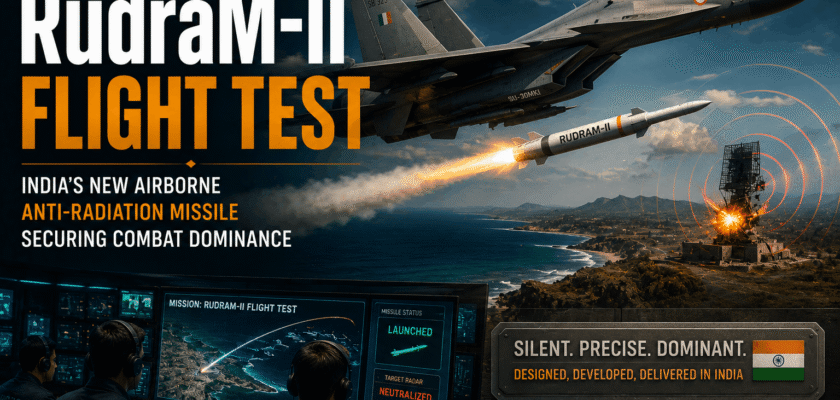
DRDO and the Indian Air Force successfully conducted fresh flight tests of the indigenous RudraM-II missile from an airborne platform at the Integrated Test Range in Chandipur. Reports say the missile was tested from a Su-30MKI fighter aircraft and hit the target with pin-point accuracy.
Therefore, this is not just another missile test. It is a signal that India is building stronger indigenous air combat hardware for modern warfare.
Why RudraM-II Flight Test Is Important for India
RudraM-II flight test is important because future air battles will not depend only on fighter jets. They will depend on how well a country can detect, jam, suppress, and destroy enemy air-defence systems.
Modern air defence networks use radar, missile batteries, electronic sensors, and command systems. If these systems stay active, they can threaten fighter jets before they reach the target area.
An anti-radiation missile like RudraM-II helps solve this problem. It can target radar-emitting systems and reduce the enemy’s ability to track aircraft.
In simple words, RudraM-II helps the Indian Air Force enter dangerous airspace with better confidence.
What Is RudraM-II?
RudraM-II is an indigenous air-to-surface missile developed for the Indian Air Force. It belongs to the Rudram family of missiles, which are designed for strike and anti-radiation roles.
An anti-radiation missile is built to detect and attack enemy radar sources. When enemy radar sends signals, the missile can use those emissions to locate and strike the target.
RudraM-II is important because it supports:
- Air defence suppression
- Radar targeting
- Precision strike missions
- Standoff attack capability
- Fighter aircraft survivability
- Indigenous missile development
- Electronic warfare support
- High-speed air combat operations
This makes it a key weapon for advanced air operations.
RudraM-II Flight Test and Su-30MKI Platform
RudraM-II flight test was conducted from a Su-30MKI fighter aircraft, according to reports. The Su-30MKI is one of the Indian Air Force’s most important heavy fighter platforms. It can carry large weapons, fly long distances, and perform complex strike roles.
Using the Su-30MKI as a launch platform is important because the aircraft already forms a major part of India’s combat air fleet.
The combination of Su-30MKI and RudraM-II can support:
- Long-range strike operations
- Suppression of enemy air defence
- Deep penetration support
- Fighter escort missions
- Electronic warfare-linked targeting
- High-speed weapon release
- Multi-role combat flexibility
This gives the IAF more options during conflict.
What Happened During the Latest Test?
The latest RudraM-II test was carried out under extreme release conditions. Reports say the test validated the performance of critical subsystems throughout the missile’s flight trajectory. The missile also demonstrated pin-point accuracy against the target.
This matters because missile testing is not only about launch. Engineers must check whether the missile behaves correctly after release, follows its planned path, maintains stability, uses guidance systems properly, and reaches the target accurately.
A successful test under difficult release conditions gives more confidence before operational induction.
Why Extreme Release Conditions Matter
Extreme release conditions mean the missile is tested in challenging launch situations. In real combat, a fighter aircraft may not always release weapons in perfect conditions.
It may be flying at high speed, changing altitude, manoeuvring, or operating under threat.
Testing under extreme conditions checks whether the missile can handle:
- High-speed launch
- Aircraft movement
- Aerodynamic stress
- Guidance transition
- Separation from aircraft
- Control stability
- Trajectory correction
- Seeker performance
- Target approach
- Final accuracy
This is why such trials are important before full operational confidence.
RudraM-II and Combat Dominance
RudraM-II supports combat dominance because it targets the systems that protect enemy airspace. Before fighter jets can strike key targets, they often need to weaken enemy radars and missile batteries.
This mission is called Suppression of Enemy Air Defences, or SEAD. In stronger cases, it becomes Destruction of Enemy Air Defences, or DEAD.
RudraM-II can help the IAF by making hostile radar operators vulnerable.
If enemy radar stays on, it can be targeted.
If enemy radar shuts down, its air-defence network becomes weaker.
Both outcomes help Indian aircraft.
What Is an Anti-Radiation Missile?
An anti-radiation missile is a weapon designed to detect and strike radar emissions. Radar systems send electromagnetic signals to detect aircraft. Anti-radiation missiles use those signals as a clue.
This type of missile can attack:
- Surveillance radars
- Fire-control radars
- Air defence radars
- Communication emitters
- Radar-linked command nodes
- Electronic warfare sources
The goal is not only to destroy one radar. The bigger goal is to reduce the enemy’s ability to see and shoot.
That is why anti-radiation missiles are valuable in modern air warfare.
RudraM-II Flight Test and SEAD Missions
RudraM-II flight test matters most for SEAD missions. SEAD missions are designed to make enemy air defence weaker, confused, or less effective.
In a modern conflict, SEAD is often one of the first tasks before a larger air campaign.
A SEAD mission may include:
- Detecting enemy radars
- Jamming enemy sensors
- Launching anti-radiation missiles
- Forcing radar shutdown
- Destroying missile batteries
- Opening safer routes for aircraft
- Protecting strike packages
- Supporting ground forces
- Reducing air defence confidence
- Enabling follow-up strikes
RudraM-II gives India a stronger indigenous option for this mission.
Why Indigenous Missile Development Matters
Indigenous missile development matters because dependence on foreign weapons can create supply risk during conflict. If a country depends heavily on imported missiles, it may face delay, sanctions, high costs, or spare-part issues.
RudraM-II strengthens India’s self-reliance in advanced air-launched weapons.
It supports:
- Make in India defence goals
- DRDO technology growth
- Indian Air Force modernization
- Domestic supply chain development
- Strategic autonomy
- Faster upgrades
- Better local integration
- Reduced foreign dependency
- Export potential in future
- Long-term defence resilience
This makes the missile important beyond one test.
RudraM-II vs Older Imported Anti-Radiation Missiles
India has used foreign-origin anti-radiation missiles in the past. RudraM-II is important because it can eventually reduce dependence on older imported systems.
Reports around RudraM-II describe it as a future replacement for older Russian-origin Kh-31 anti-radiation missiles in the IAF inventory. Some reports describe RudraM-II as capable of around 300 km range, Mach 5.5 terminal speed, and up to a 200-kg warhead, though exact operational details should be treated as sensitive and final official specifications may vary.
The key point is simple: India wants a newer, locally developed, more integrated anti-radiation capability.
Why Speed Matters in Anti-Radiation Missiles
Speed matters because air defence targets are time-sensitive. Radar operators may switch off systems, move assets, or change emission patterns once they detect threat.
A fast missile reduces enemy reaction time.
High speed helps in:
- Faster target engagement
- Reduced interception chance
- Less time for radar shutdown
- Better survivability
- Higher mission pressure
- Stronger psychological effect
- Better strike success probability
However, speed alone is not enough. Guidance, seeker quality, target discrimination, and reliability matter just as much.
Why Precision Targeting Matters
Precision targeting matters because anti-radiation missions often happen in complex environments. There may be multiple radar emitters, civilian signals, electronic clutter, decoys, and moving systems.
A missile must identify the correct target and avoid wasteful engagement.
Good precision helps:
- Reduce collateral damage risk
- Improve mission success
- Use fewer missiles
- Hit high-value targets
- Support follow-up air operations
- Build confidence among pilots
- Improve battlefield efficiency
This is why the reported pin-point accuracy in the latest test is important.
RudraM-II and Electronic Warfare
RudraM-II fits into a wider electronic warfare environment. Modern air combat includes jamming, radar detection, decoys, electronic intelligence, and networked targeting.
An anti-radiation missile works best when pilots and commanders know where enemy radars are active.
This may involve:
- Fighter sensors
- Electronic intelligence aircraft
- Ground-based monitoring
- Data links
- Mission planning systems
- Radar warning receivers
- Electronic support measures
- Real-time threat libraries
- Coordinated strike packages
- Follow-up battle damage assessment
So, RudraM-II is part of a larger combat network.
How RudraM-II Helps Fighter Pilots
RudraM-II helps fighter pilots by giving them a way to attack air-defence threats without flying directly over them. This is called standoff capability.
A standoff weapon allows pilots to launch from safer distance.
This improves:
- Pilot survivability
- Mission flexibility
- Strike reach
- Airspace access
- Confidence during deep missions
- Protection for other aircraft
- Ability to challenge enemy radar zones
For pilots, a strong anti-radiation missile can make dangerous missions more manageable.
Why Air Defence Suppression Is Critical
Air defence suppression is critical because no air force wants to send aircraft blindly into radar-guided missile zones. Even advanced fighters can face serious risk from modern surface-to-air missile systems.
Before launching major air operations, forces often try to suppress enemy radar and missile systems.
This protects:
- Fighter aircraft
- Transport aircraft
- Helicopters
- Drones
- Ground forces
- Strategic targets
- Follow-up strike packages
- Air superiority missions
RudraM-II gives India a stronger tool for this stage of conflict.
RudraM-II and Network-Centric Warfare
Network-centric warfare means connecting sensors, shooters, command centres, and battlefield information. A missile like RudraM-II becomes more powerful when it is connected with good intelligence and targeting data.
In future combat, aircraft may receive updated threat information from multiple sources.
This can help pilots decide:
- Which radar to target
- When to launch
- Which route to take
- Whether to use jamming
- Whether to coordinate with other aircraft
- Whether to follow up with another weapon
A missile is strongest when the whole combat network supports it.
DRDO’s Role in Advanced Missile Technology
DRDO’s role is central because the RudraM-II is part of India’s effort to build advanced missile systems locally. The latest successful flight tests show that Indian laboratories are improving air-launched precision strike capability.
The New Indian Express reported that RudraM-II cleared fresh trials under extreme conditions and described it as purpose-built for SEAD/DEAD missions.
This shows that the missile is being developed for a very specific and important battlefield role.
A focused missile program is often more valuable than a general-purpose weapon.
Why IAF Integration Matters
A missile is useful only when it integrates well with aircraft, mission systems, maintenance teams, and operational doctrine.
IAF integration includes:
- Aircraft carriage checks
- Weapon release trials
- Pilot training
- Mission computer integration
- Safety certification
- Maintenance process
- Storage and handling
- Targeting workflow
- Operational tactics
- Live firing validation
Successful flight tests show progress, but full operational use needs a complete ecosystem.
RudraM-II and India’s Regional Security Needs
India’s regional security environment requires strong air power. Potential adversaries may use layered air defence systems, mobile radars, long-range missiles, drones, and electronic warfare tools.
A weapon like RudraM-II helps India build deterrence.
It tells adversaries that their radar and air-defence systems may not remain safe during conflict.
This creates strategic pressure.
If enemy air defence becomes vulnerable, India’s air operations become more flexible.
Why Airborne Anti-Radiation Missiles Are Hard to Build
Airborne anti-radiation missiles are technically difficult because they must work in a fast-changing environment. They must separate safely from the aircraft, identify radar emissions, survive high-speed flight, guide accurately, and strike a target that may try to hide.
Challenges include:
- Seeker sensitivity
- Signal discrimination
- High-speed stability
- Target lock reliability
- Electronic countermeasures
- Radar shutdown problem
- Navigation accuracy
- Aerodynamic heating
- Aircraft integration
- Warhead effectiveness
This is why every successful test matters.
What “Radar Shutdown Problem” Means
The radar shutdown problem is a classic challenge for anti-radiation missiles. If an enemy radar detects danger, operators may switch it off to avoid being targeted.
A good missile must still handle this situation.
It may use:
- Last known location
- Inertial navigation
- Seeker memory
- Additional guidance modes
- Pre-planned target data
- Terminal guidance support
The goal is to keep the missile effective even if the target tries to disappear electronically.
This is one reason modern anti-radiation missiles are complex.
Why RudraM-II Boosts India’s Air Campaign Planning
RudraM-II can boost India’s air campaign planning because it creates more choices for mission commanders. Instead of depending only on imported weapons or risky direct attacks, the IAF can plan more layered strike packages.
A layered mission may include:
- Electronic surveillance
- Jamming support
- RudraM-II launch
- Fighter escort
- Drone reconnaissance
- Follow-up precision strikes
- Battle damage assessment
- Airspace control
- Ground force support
Such planning increases combat effectiveness.
Possible Operational Use Cases
RudraM-II may be useful in several mission types.
Possible use cases include:
- Suppressing enemy radars before strike missions
- Destroying mobile air-defence systems
- Supporting deep strike packages
- Protecting high-value aircraft
- Opening safer air corridors
- Attacking hostile communication emitters
- Reducing enemy air defence confidence
- Supporting joint operations
- Enhancing deterrence
- Training for electronic warfare missions
These roles make it an important next-gen air defence hardware asset.
Why This Test Matters for Atmanirbhar Bharat
This test supports India’s Atmanirbhar Bharat defence goals because it shows progress in locally designed and developed advanced weapons.
Defence self-reliance is not only about making rifles or vehicles. It also means building high-end missiles, seekers, propulsion, guidance systems, and aircraft integration capability.
RudraM-II helps India strengthen:
- Indigenous design
- Indigenous testing
- Indigenous production base
- Indigenous subsystem ecosystem
- Strategic autonomy
- Export potential in future
- Long-term defence technology depth
This is why the test has symbolic and strategic value.
What Happens After Successful Tests?
After successful flight tests, a missile program usually moves through more validation, user trials, production planning, integration steps, and operational training.
Possible next steps may include:
- More flight trials
- Expanded envelope testing
- Platform integration checks
- User evaluation by IAF
- Production readiness review
- Quality assurance
- Maintenance manual development
- Pilot training modules
- Weapon storage protocols
- Operational deployment planning
A successful test is important, but induction depends on full validation.
Why Defence Tests Should Be Reported Carefully
Defence tests should be reported carefully because not every technical detail can be public. Some specifications may remain classified or may change during development.
Writers should avoid exaggerating claims that are not officially confirmed.
Safe reporting should focus on:
- Official test date
- Launch platform
- Test location
- Trial objective
- Confirmed success points
- Strategic role
- Indigenous development
- Broad capability
- Defence modernization
- Public statements
This keeps defence reporting responsible and accurate.
Final Verdict
RudraM-II flight test is a major step for India’s air combat capability. The successful tests by DRDO and the Indian Air Force show progress in indigenous airborne anti-radiation missile development. Tested from an airborne platform and reported to have hit the target with pin-point accuracy, RudraM-II strengthens India’s ability to suppress and destroy enemy air defence systems.
For the Indian Air Force, this missile can improve strike package survivability, radar suppression capability, and combat flexibility. For India’s defence ecosystem, it shows growing self-reliance in advanced missile technology.
In simple words, RudraM-II is not just a missile. It is a force multiplier for modern air warfare.
If future trials and induction move smoothly, RudraM-II can become a key part of India’s next-generation combat dominance strategy.


