
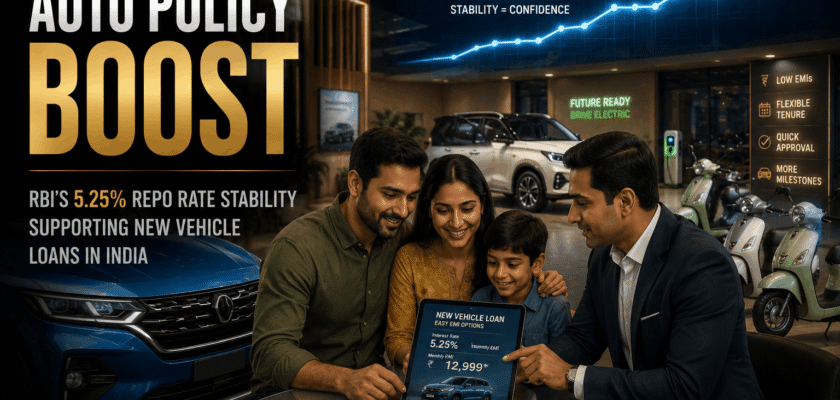
Auto Policy Boost: Why RBI’s 5.25% Repo Rate Stability Matters for Vehicle Buyers
Auto policy boost is becoming an important automobile finance story after the Reserve Bank of India kept the repo rate unchanged at 5.25% on June 5, 2026. For car and bike buyers, this stability matters because vehicle loans are highly sensitive to interest-rate expectations.
When RBI keeps the repo rate stable, banks and NBFCs usually get more room to keep lending rates predictable. This does not mean every vehicle loan becomes cheaper overnight. But it does mean buyers do not face an immediate EMI shock due to a fresh rate hike.
Reuters reported that RBI kept the policy repo rate steady at 5.25% while choosing currency-stability steps instead of raising rates, despite inflation risks from oil prices, rupee pressure, and foreign outflows linked to the Iran war.
Therefore, the auto policy boost is not a direct subsidy. It is a stability signal for borrowers, dealers, lenders, and automakers.
Why Auto Policy Boost Matters in 2026
Auto policy boost matters because India’s vehicle market depends heavily on financing. Many buyers do not pay full cash for cars, SUVs, two-wheelers, and commercial vehicles. They compare down payment, EMI, loan tenure, interest rate, insurance, fuel cost, and resale value before making a decision.
Economic Times reported that RBI held the repo rate at 5.25% during its June 2026 MPC meeting and retained a neutral stance amid crude oil pressure, weak rupee risk, and West Asia conflict uncertainty.
This stable rate environment helps buyers plan better.
It supports:
- New car loans
- Two-wheeler loans
- EV loans
- CNG vehicle loans
- Used car finance
- Dealer financing
- Commercial vehicle loans
- Fleet replacement decisions
- Rural vehicle demand
- Auto stock sentiment
In simple words, stable rates make vehicle buying less scary.
What Is the Repo Rate?
The repo rate is the rate at which the Reserve Bank of India lends short-term money to commercial banks. When the repo rate rises, loans can become costlier. When the repo rate falls, loans may become cheaper over time.
Vehicle loan rates are not always directly equal to the repo rate. Banks add their own spread, risk premium, customer credit score factor, tenure risk, and processing fees.
But repo rate still matters because it affects the broader cost of money.
A stable repo rate gives lenders more confidence to keep loan pricing steady.
That is why RBI’s 5.25% pause matters for vehicle buyers.
RBI’s 5.25% Repo Rate: What Happened on June 5, 2026?
On June 5, 2026, RBI kept the key repo rate unchanged at 5.25%. Reuters reported that the central bank kept rates steady and focused on rupee defence measures instead of raising interest rates. The report also said RBI raised FY2026 inflation forecast to 5.1% from 4.6% and cut GDP growth forecast to 6.6% from 6.9%.
This decision shows RBI is trying to balance two goals:
- Control inflation risk
- Avoid hurting growth and borrowing demand too quickly
For the auto sector, this is important.
If RBI had raised rates, vehicle loan EMIs could have become costlier. Since RBI paused, buyers get more short-term stability.
How Repo Rate Stability Supports New Vehicle Loans
Repo rate stability supports new vehicle loans because lenders can price loans with more confidence. When policy rates jump suddenly, banks may increase lending rates or become more cautious. When rates remain stable, loan products can remain easier to understand.
For buyers, this helps with:
- EMI planning
- Loan eligibility
- Down payment decisions
- Car model selection
- Tenure comparison
- Dealer negotiation
- EV vs ICE comparison
- Used vs new vehicle decision
- Family budget planning
- Business fleet planning
A stable EMI environment can push fence-sitters toward booking.
That is why automakers and dealers usually prefer interest-rate stability.
Why Vehicle Loan EMI Stability Matters
Vehicle loan EMI stability matters because even a small interest-rate change can affect monthly affordability. A buyer planning a ₹10 lakh car loan may choose a different model if EMI rises too much.
For example, a buyer may compare:
- Hatchback vs compact SUV
- Petrol vs CNG
- ICE vs EV
- New vs used car
- 5-year vs 7-year loan
- Higher down payment vs lower EMI
- Bank loan vs dealer finance
- Fixed vs floating rate
- Add-on warranty vs lower cost
- Insurance bundled vs separate
When rates are stable, buyers can make decisions with less uncertainty.
This supports showroom conversion.
Auto Policy Boost for First-Time Car Buyers
Auto policy boost is especially useful for first-time car buyers. These buyers are usually more EMI-sensitive and may delay purchase if rates look uncertain.
First-time buyers often worry about:
- Down payment
- Monthly EMI
- Fuel cost
- Insurance
- Maintenance
- Registration charges
- Loan approval
- Credit score
- Resale value
- Job stability
A stable repo rate does not remove all costs, but it gives them one less worry.
That can improve buying confidence.
Auto Policy Boost for Two-Wheeler Buyers
Two-wheeler buyers are also rate-sensitive, especially in entry-level commuter motorcycles and scooters. In India, many two-wheeler purchases happen through finance schemes.
Stable repo rates can support:
- Bike loan affordability
- Scooter EMI stability
- Rural demand
- Student and worker mobility
- Electric scooter finance
- Dealer schemes
- Low down payment offers
- Short tenure loans
- NBFC lending confidence
- Festival season preparation
For two-wheelers, even a small EMI difference matters because buyers often have tighter monthly budgets.
Auto Policy Boost for EV Buyers
EV buyers also benefit from rate stability because electric vehicles often have a higher upfront price than comparable petrol or CNG models. Buyers usually calculate total cost of ownership through fuel savings, charging cost, loan EMI, and incentives.
Stable loan rates help EV buyers compare:
- EV EMI vs petrol EMI
- Battery warranty
- Charging cost
- Home charger cost
- Range needs
- Resale value
- Insurance premium
- Subsidy availability
- Maintenance savings
- Long-term fuel savings
If loan EMIs stay predictable, EV adoption becomes easier.
This is important because EV demand depends on both technology and finance.
Auto Policy Boost for CNG Vehicle Buyers
CNG vehicles are popular among cost-conscious drivers, especially in metro and urban markets. Many buyers choose CNG because running cost is lower than petrol.
However, CNG variants often cost more upfront than petrol variants. That extra price is usually financed through loans.
Repo rate stability helps buyers calculate:
- CNG price premium
- Monthly EMI
- Daily running cost
- Fuel savings
- Break-even period
- Service cost
- Boot-space compromise
- Resale demand
- City gas availability
- Loan tenure
For high-running users, stable EMI plus lower fuel cost can make CNG attractive.
Auto Policy Boost for Commercial Vehicle Loans
Commercial vehicle buyers are deeply linked to financing. Truck owners, taxi operators, delivery fleets, school van operators, and small transport businesses often depend on loans.
Rate stability can support:
- Fleet replacement
- Small truck purchase
- Taxi financing
- Bus loans
- Last-mile delivery vehicles
- Electric fleet adoption
- Working capital planning
- EMI predictability
- Business cash-flow stability
- NBFC lending confidence
Commercial buyers care about EMI because vehicle income must cover loan cost.
If borrowing cost jumps, fleet expansion slows.
Why Banks May Still Be Careful
Even though repo rate stability supports vehicle loans, banks may still remain careful. Reuters reported that RBI is dealing with rupee pressure, higher oil prices, and foreign investor outflows.
These macro risks can make lenders cautious.
Banks may still check:
- Credit score
- Income stability
- Existing loans
- Job profile
- Down payment
- Vehicle segment
- Loan-to-value ratio
- Repayment history
- Co-applicant strength
- Dealer profile
So, buyers should not assume approval is automatic.
Stable repo rate helps, but strong borrower profile still matters.
Why Oil Prices Still Affect Auto Demand
Oil prices are a key risk for the auto sector. If crude oil rises, petrol and diesel cost expectations can rise. This may affect buyer preference.
RBI’s June 2026 pause happened while oil shock and West Asia war risks remained high. Economic Times reported that crude oil, weak rupee, and geopolitical uncertainty were major concerns around the RBI decision.
Oil volatility can push buyers toward:
- CNG cars
- EVs
- Hybrid vehicles
- High-mileage hatchbacks
- Diesel commercial vehicles with cost planning
- Two-wheelers
- Public transport
- Used cars
- Smaller engines
- Lower running cost options
So, loan stability helps, but fuel cost still influences buying decisions.
Weak Rupee and Vehicle Prices
A weak rupee can affect vehicle prices because automakers import some components, electronics, batteries, chips, and raw materials. If rupee pressure continues, input costs can rise.
Reuters reported that the rupee had depreciated around 5% amid oil price pressure and foreign investor outflows.
This can affect:
- Imported components
- EV battery materials
- Luxury cars
- Premium bikes
- Electronic systems
- Semiconductor-linked parts
- Tyres and rubber inputs
- Dealer inventory cost
- Insurance value
- Future price hikes
So, buyers may see a stable EMI rate but higher vehicle prices if input costs rise.
That is why early purchase planning can matter.
Stable EMI vs Rising Ex-Showroom Prices
A repo rate pause keeps interest-rate pressure stable, but it does not stop automakers from raising prices. If raw material, currency, logistics, or compliance costs rise, ex-showroom prices can still increase.
Buyers should compare:
- Current ex-showroom price
- Upcoming price hike possibility
- Loan interest rate
- Insurance quote
- Registration cost
- Dealer discount
- Exchange bonus
- Waiting period
- Delivery date
- Total on-road price
Sometimes, a stable interest rate does not fully protect buyers if vehicle prices rise.
So, total cost matters more than only loan EMI.
Why Dealers Benefit From Rate Stability
Dealers benefit because stable rates make it easier to convert enquiries into bookings. When buyers fear EMI hikes, they delay decisions. When rates remain stable, sales teams can explain finance options confidently.
Dealers can use rate stability to promote:
- Low EMI schemes
- Exchange offers
- Corporate discounts
- EV financing
- CNG cost savings
- Pre-approved loans
- Faster delivery offers
- Insurance bundles
- Extended warranty packages
- Festival booking plans
Rate stability gives dealers a stronger sales pitch.
That is why the RBI pause can support showroom activity.
How Auto Companies Benefit
Auto companies benefit when financing conditions remain stable because more buyers can afford vehicles. In India, auto sales often depend on credit availability.
Stable rates can support:
- Passenger vehicle demand
- Two-wheeler recovery
- EV adoption
- Rural sales
- Commercial vehicle replacement
- Dealer inventory movement
- Premium model upgrades
- SUV bookings
- CNG variant demand
- Financing partnerships
However, automakers still face input cost, fuel price, and consumer confidence risks.
So, rate stability is helpful but not the only factor.
Why Nifty Auto Investors Watch RBI Policy
Nifty Auto investors watch RBI policy because interest rates affect demand, financing cost, consumer sentiment, and valuations. When borrowing costs are stable, auto stocks may get support.
Investors usually track:
- Repo rate decision
- Inflation forecast
- GDP growth forecast
- Rural demand
- Fuel prices
- Rupee movement
- Auto sales numbers
- Dealer inventory
- EV policy
- Commodity costs
RBI’s neutral stance gives the market a wait-and-watch signal.
It is not a strong boom signal, but it reduces immediate rate-hike fear.
Vehicle Loan Buyers: What Should You Do Now?
Vehicle loan buyers should use the repo rate pause to compare offers carefully. Do not rush only because RBI paused. Use the stability to negotiate better.
Check:
- Interest rate
- Processing fee
- Prepayment charges
- Foreclosure rules
- Loan tenure
- EMI amount
- Insurance bundling
- Dealer discount
- Credit score benefit
- Total repayment amount
The lowest EMI is not always the best deal.
A longer tenure reduces EMI but increases total interest.
Fixed vs Floating Vehicle Loan
Most vehicle loans are fixed-rate or semi-fixed in practice, but some may have floating structures depending on lender and product. Buyers should ask clearly.
Ask the lender:
- Is the rate fixed or floating?
- Can EMI change later?
- Is there a reset period?
- What is the processing fee?
- Are there foreclosure charges?
- Can I prepay without penalty?
- Is insurance mandatory from dealer?
- What happens if rates rise?
- What is the total interest?
- What is the final on-road cost?
A smart buyer understands the full loan, not only the monthly EMI.
EMI Example: Why Rate Stability Helps
Suppose a buyer takes a ₹10 lakh vehicle loan for 5 years. If the interest rate rises sharply, EMI can increase and affect affordability.
Even a small rate increase can change:
- Monthly EMI
- Loan eligibility
- Total interest paid
- Model choice
- Down payment need
- Budget comfort
A stable repo rate reduces the chance of sudden loan-cost shock.
This is why the RBI pause supports buyers psychologically and financially.
Credit Score Still Matters
Credit score still matters even when repo rate is stable. A buyer with a strong credit profile can get a better vehicle loan rate than a risky borrower.
Improve loan chances by:
- Paying credit card bills on time
- Avoiding too many loan applications
- Keeping low credit utilization
- Closing old overdue payments
- Maintaining stable income proof
- Keeping bank statements clean
- Avoiding bounced EMIs
- Checking credit report errors
- Adding co-applicant if needed
- Making higher down payment
RBI policy helps the market. Your credit profile helps your loan.
Higher Down Payment Can Save Money
A higher down payment can reduce total interest cost. Many buyers choose low down payment because it feels easier, but that increases loan amount.
A higher down payment helps by:
- Reducing EMI
- Reducing total interest
- Improving loan approval chances
- Lowering debt burden
- Reducing negative equity risk
- Improving financial comfort
However, do not use your emergency fund fully for down payment.
Keep enough cash for unexpected expenses.
Shorter Tenure vs Lower EMI
Shorter tenure means higher EMI but lower total interest. Longer tenure means lower EMI but higher total interest.
Choose based on:
- Monthly income
- Job stability
- Other EMIs
- Family expenses
- Fuel cost
- Insurance cost
- Maintenance cost
- Emergency fund
- Future goals
- Total interest comfort
Vehicle is a depreciating asset.
So, avoid very long loans unless necessary.
Auto Policy Boost and Rural Demand
Rural auto demand can benefit from stable interest rates, especially for two-wheelers, tractors, small commercial vehicles, and entry-level cars. Rural buyers are often sensitive to credit cost, crop income, monsoon outlook, and fuel prices.
Rate stability helps, but rural demand also depends on:
- Monsoon performance
- Crop prices
- Rural employment
- Fuel prices
- Dealer reach
- NBFC credit
- Government schemes
- Farm income
- Local roads
- Consumer confidence
The RBI pause provides one supportive factor.
But rural auto recovery needs broader economic support.
Used Car Loans: What Buyers Should Know
Used car loans are usually costlier than new car loans because lenders see higher risk. The vehicle is older, resale value is uncertain, and condition varies.
Repo rate stability may help overall lending, but used car buyers should still compare carefully.
Check:
- Vehicle age
- Ownership history
- Service record
- Accident history
- Loan rate
- Processing fee
- Insurance cost
- RC transfer
- Hypothecation status
- Inspection report
Used cars can save money, but only if the vehicle and loan both are clean.
EV Loan Offers May Become More Competitive
EV loan offers may become more competitive as banks and NBFCs compete for green mobility customers. Stable repo rate can make lenders more comfortable designing attractive EV schemes.
EV loan offers may include:
- Lower interest rates
- Longer tenure
- Battery warranty-linked finance
- Green loan branding
- Corporate EV schemes
- Fleet EV packages
- Charging partner benefits
- Low processing fee
- Insurance bundles
- Exchange bonuses
Buyers should compare total ownership cost, not only loan rate.
Battery warranty and charging access matter.
What Could Hurt Vehicle Loan Demand Later?
Vehicle loan demand can still weaken later if macro risks worsen. RBI may maintain neutral stance now, but future policy depends on inflation, rupee, oil prices, and growth.
Reuters reported that RBI indicated a watchful approach and possible tightening later if conditions worsen.
Risks include:
- Oil price spike
- Rupee weakness
- Inflation rise
- Future rate hike
- Weak monsoon
- Job market stress
- Higher vehicle prices
- Insurance cost rise
- Fuel price pressure
- Lower consumer confidence
So, buyers should plan responsibly.
Do not overborrow just because rates are stable today.
What Automakers Should Do Now
Automakers should use this rate-stability window to strengthen demand without overloading buyers.
They can focus on:
- Transparent EMI calculators
- EV/CNG cost comparison
- Dealer finance training
- Exchange programs
- Low down payment schemes
- Rural finance partnerships
- Fleet finance offers
- Digital loan approval
- Service cost transparency
- Warranty confidence
Customers want clarity.
The brand that explains total cost better can win more buyers.
What Dealers Should Tell Customers
Dealers should avoid overpromising. They should explain that RBI has paused rates, but final loan rate depends on bank, credit score, tenure, and borrower profile.
Dealers should clearly show:
- On-road price
- Down payment
- Loan amount
- EMI
- Interest rate
- Tenure
- Processing fee
- Insurance cost
- Total interest
- Total cost of ownership
Honest finance explanation builds trust.
A confused buyer may delay purchase.
A confident buyer books faster.
What Buyers Should Avoid
Buyers should avoid common loan mistakes.
Do not:
- Choose only the lowest EMI
- Ignore total interest
- Skip comparing banks
- Accept unnecessary add-ons blindly
- Use full emergency savings
- Ignore insurance cost
- Forget fuel and service cost
- Take too long a tenure casually
- Buy bigger car than budget allows
- Ignore resale value
A car loan should fit your life, not stress your life.
Best Strategy for New Vehicle Buyers
The best strategy is to use the RBI pause as a planning advantage.
Do this:
- Check your credit score
- Decide maximum EMI
- Compare loan offers
- Calculate total on-road cost
- Compare fuel options
- Ask for dealer discounts
- Keep emergency fund safe
- Avoid unnecessary accessories
- Choose practical tenure
- Book only when budget is comfortable
This makes the vehicle purchase smarter.
Final Verdict
Auto policy boost from RBI’s 5.25% repo rate stability is a supportive signal for India’s vehicle loan market. It keeps immediate EMI pressure stable and gives buyers, dealers, banks, and automakers more confidence in a period of global uncertainty.
However, buyers should not treat the rate pause as a free pass to overborrow. Oil prices, rupee weakness, inflation risk, and possible future tightening still matter. Vehicle prices may also rise if input costs increase.
In simple words, RBI’s repo rate pause helps vehicle loans by keeping borrowing conditions predictable.
For buyers, this is a good time to compare finance offers, calculate total ownership cost, and make a practical car or bike purchase decision. For the auto sector, stable rates can support showroom demand, especially in EMI-sensitive segments like entry cars, two-wheelers, CNG vehicles, EVs, and commercial vehicles.


