
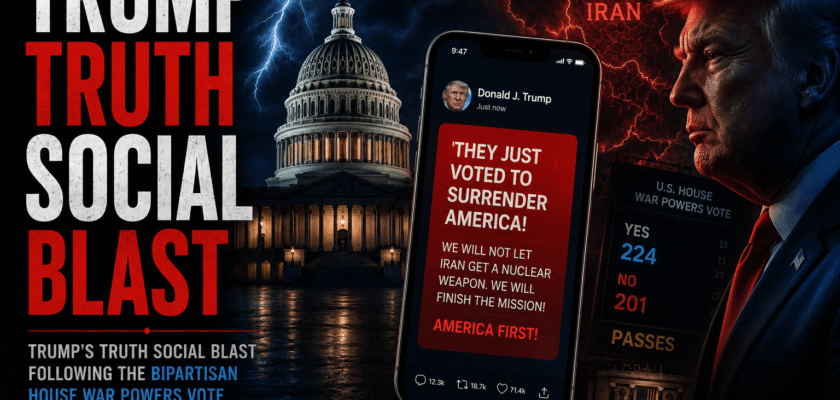
Trump Truth Social Blast: Why the Iran Vote Triggered a Washington Rebuke
Trump Truth Social blast became a major U.S. politics moment after the House passed a war powers resolution aimed at limiting President Donald Trump’s authority over Iran conflict operations. The vote was narrow, but it carried strong political meaning because a few Republicans crossed party lines and joined Democrats.
The House voted 215–208 to pass the measure. Reuters reported that four Republicans voted with Democrats, and the resolution directs Trump to withdraw U.S. troops from Iran unless Congress declares war or authorizes the use of military force.
Trump reacted sharply on Truth Social. He called the vote “meaningless,” attacked Democrats, and accused the Republican defectors of undercutting him while he was “right in the middle” of negotiating peace.
That phrase became the political headline.
Why Trump Truth Social Blast Matters in 2026
Trump Truth Social blast matters because it shows the Iran conflict is now creating pressure inside Washington, not only overseas. Earlier, the conflict was mostly framed as a foreign policy and national security issue. Now, it has become a constitutional, political, and party-discipline fight.
The House vote was the first final House vote of this kind since the conflict began. AP reported that the resolution was a rare congressional rebuke of Trump, with a handful of Republicans joining Democrats to halt U.S. military action against Iran.
This matters because presidents usually try to keep their party united during military conflict.
But this vote showed cracks.
In simple words, Trump’s anger was not only about Democrats. It was also about Republicans who broke ranks at a sensitive moment.
What Was the House War Powers Vote?
The House war powers vote was based on the 1973 War Powers Resolution. This law was created to limit a president’s ability to keep U.S. forces in hostilities without congressional approval.
In this case, the resolution aimed to stop Trump from continuing military action against Iran unless Congress gave formal authorization.
Reuters reported that the measure passed 215–208 and directs withdrawal from Iran unless Congress declares war or authorizes force.
The vote matters because it raises a core constitutional question:
Who controls war decisions — the president or Congress?
The president commands the military.
Congress has power to declare war and fund military action.
That tension is at the centre of the dispute.
Why the Vote Was Bipartisan
The vote was bipartisan because four Republicans joined Democrats. That number may look small, but in a narrow House vote, it was enough to pass the resolution.
The Guardian reported that the House passed the resolution with four Republicans joining Democrats, creating rare pushback against Trump’s Iran policy.
This bipartisan element made the vote more serious.
If only Democrats had supported it, Trump could dismiss it as normal opposition politics. But when members of his own party joined, the message became stronger.
It suggested that some Republicans were uncomfortable with:
- The length of the conflict
- Lack of formal authorization
- Rising political cost
- Fuel-price concerns
- U.S. troop risk
- Executive overreach
- Unclear exit strategy
- Public fatigue
- Negotiation uncertainty
- Constitutional limits
That is why Trump reacted so strongly.
Trump’s “Right in the Middle” Argument
Trump’s “right in the middle” argument was that the House vote weakened his administration during sensitive peace negotiations. According to reports, Trump said Republicans who supported the measure were undercutting him while he was working to end the conflict with Iran.
This is a classic executive-branch argument.
The president says:
Do not weaken my negotiating hand.
Congress says:
Do not continue war without authorization.
Both sides claim they are protecting the country.
Trump’s supporters may see the vote as political sabotage.
Critics may see the vote as constitutional oversight.
That is why the phrase “right in the middle” became powerful.
It captures the whole dispute.
Why Trump Called the Vote “Meaningless”
Trump called the vote “meaningless” because the resolution still needs Senate action and could face a presidential veto. The Times of India reported that Trump blasted the vote as “meaningless” and accused critics of trying to disrupt his administration’s strategy to resolve the conflict.
This is important.
The House vote alone does not automatically end U.S. involvement in Iran. But politically, it sends a message.
It shows that congressional patience is weakening.
Even if the resolution fails later, the vote creates pressure on the White House.
In politics, symbolic votes can still matter.
They can shape public debate, media coverage, party discipline, and Senate momentum.
Why Democrats Supported the Resolution
Democrats supported the resolution because they argue Trump continued military action without proper congressional authorization. Many Democrats see this as a constitutional issue, not only an Iran issue.
Their argument is simple:
- Congress did not declare war.
- The conflict has continued for months.
- U.S. troops remain exposed.
- The president must seek authorization.
- War powers cannot be unlimited.
- Voters deserve accountability.
The Guardian noted that the 90-day threshold matters because the 1973 War Powers Resolution requires presidents to seek congressional approval for prolonged hostilities.
That legal argument is central to Democratic support.
They are framing the vote as Congress reclaiming its authority.
Why Some Republicans Broke With Trump
Some Republicans broke with Trump because the conflict has become politically and strategically difficult. A president can often keep party support during short military operations. But a long conflict creates more questions.
Possible Republican concerns include:
- No formal war authorization
- Risk to U.S. troops
- Higher fuel costs
- Public opposition
- Unclear peace plan
- Iran escalation risk
- Budget pressure
- Constitutional concerns
- Voter fatigue
- District-level political pressure
Reuters said the vote reflected growing concern among members of Trump’s party about the three-month-old conflict.
This does not mean Republicans are becoming anti-Trump overall.
It means the Iran file is becoming harder to defend.
The White House Position
The White House position is that Trump has authority to act as commander-in-chief and protect U.S. interests. Trump’s allies argue that Congress should not limit the president while negotiations and military pressure are active.
The New York Post reported that the White House maintains the War Powers Resolution is unconstitutional because it infringes on the president’s foreign affairs authority.
This is a long-running argument in U.S. politics.
Presidents from both parties have often resisted congressional limits on military action.
They argue that fast-moving threats require executive flexibility.
Congress argues that war cannot be one-person decision-making.
That battle is older than Trump, but the Iran conflict has revived it.
The Senate Question
The Senate is the next major question. The House vote increases pressure, but the resolution still needs Senate action.
The Washington Post reported that the Senate had already advanced a similar war powers resolution on a procedural vote, reflecting growing impatience with a conflict Congress has not formally authorized.
This matters because Senate movement could make the fight much more serious.
If the Senate passes a similar measure, Trump could face a direct institutional challenge.
Then the debate would move to:
- Presidential veto
- Override attempt
- Funding limits
- Court questions
- Party pressure
- Public opinion
- Negotiation strategy
- Military planning
- Election impact
- Congressional oversight
The House vote was the opening shot of a bigger Washington fight.
Why War Powers Debates Are So Difficult
War powers debates are difficult because military action often sits between law, politics, intelligence, and public emotion. Presidents argue that they need speed. Congress argues that it needs oversight.
The War Powers Resolution was designed to stop open-ended war without Congress.
But enforcement has always been complicated.
Courts often avoid direct war-powers fights. Congress may pass resolutions, but presidents can veto them. Funding restrictions are stronger but politically harder.
So, war powers debates become messy.
They are not only about law.
They are about leverage.
Iran Conflict Operations and Domestic Politics
Iran conflict operations have now become a domestic political issue. Military action overseas can affect voters at home through fuel prices, inflation, troop safety, and public anxiety.
The Guardian reported that Trump’s Iran messaging is struggling with Americans and members of Congress, with public dissatisfaction and fuel-cost concerns becoming part of the political debate.
This matters because foreign policy rarely stays foreign.
A war can affect:
- Gas prices
- Food prices
- Stock markets
- Military families
- Budget priorities
- Election campaigns
- Party unity
- Public trust
- Media narratives
- Voter turnout
That is why the House vote became politically explosive.
Why Truth Social Is Trump’s Political Weapon
Truth Social is Trump’s direct communication weapon. Instead of waiting for press conferences or official statements, he can speak directly to supporters, attack opponents, shape headlines, and force allies to respond.
A Truth Social post can:
- Set the news cycle
- Pressure Republicans
- Mobilize supporters
- Attack Democrats
- Frame the issue emotionally
- Test political messages
- Defend executive power
- Create viral quotes
- Distract from legal details
- Push loyalty tests
Trump’s Truth Social blast worked exactly this way.
The vote passed.
Trump posted.
Media covered the reaction.
Republicans had to respond.
That is modern political communication.
Why Trump Targeted Republicans Too
Trump targeted Republicans because party loyalty is central to his political style. When Democrats oppose him, he expects it. But when Republicans break ranks, he often treats it as betrayal.
The New York Post reported that Trump criticised Republican “grandstanders” after the House vote.
This matters because Trump uses public pressure to discipline his party.
Republicans who vote against him may face:
- Primary threats
- Social media attacks
- Donor pressure
- Conservative media criticism
- Local party backlash
- Trump-aligned challenger rumours
- Loss of committee influence
- Voter anger
- Public loyalty tests
- Campaign complications
So, Trump’s post was not only anger.
It was a warning.
The “Unpatriotic” Frame
Trump also framed the vote as unpatriotic. Spanish outlet Cadena SER reported that Trump criticised the House resolution as “senseless” and “unpatriotic” on Truth Social.
This framing is politically powerful but controversial.
Supporters may see the resolution as weakening America during conflict. Critics may say patriotism means respecting constitutional limits.
This creates two competing ideas of patriotism:
Trump’s Frame
Support the commander-in-chief during conflict.
Congressional Frame
Defend Congress’s constitutional war powers.
Both sides claim national interest.
That is why the debate becomes emotional quickly.
Why “Peace Negotiations” Complicate the Vote
Peace negotiations complicate the vote because Trump says the resolution undercuts diplomacy. If talks are ongoing, the White House may argue that military pressure is part of the negotiation strategy.
However, critics argue that diplomacy does not justify indefinite military action without authorization.
This creates a difficult question:
Can a president continue hostilities while saying peace talks are close?
Trump’s phrase “right in the middle” suggests he wants maximum flexibility during negotiations.
Congressional critics argue that this flexibility has limits.
The conflict between flexibility and accountability is the core issue.
The Rubio Factor
Secretary of State Marco Rubio has also been part of the messaging battle. RFE/RL reported that Rubio insisted U.S. operations against Tehran had ended, even as the House passed the war powers resolution and broader conflict concerns continued.
This creates messaging complexity.
If operations are over, why is Congress worried?
If hostilities continue, why does the administration say they have ended?
This mixed messaging can weaken public trust.
Clear communication matters during war.
When the administration sends unclear signals, Congress becomes more aggressive.
Why the Ceasefire Argument Is Contested
The White House has pointed to ceasefire claims, but critics argue the ceasefire has been broken repeatedly. The Guardian reported that the administration cited a temporary ceasefire since April 8, though it has been broken several times by the U.S., Israel, and Iran.
This is important because the War Powers timeline depends on whether hostilities are continuing.
If the ceasefire is real, the administration has a stronger argument.
If fighting continues, Congress has a stronger argument.
That is why the definition of “hostilities” matters.
Law and facts meet on the battlefield.
Why the Vote Was a Rebuke
The vote was a rebuke because it came from a Republican-led House. A Democratic-led House opposing Trump would be expected. A Republican-led House passing a war-powers restriction is more politically damaging.
Reuters called the vote a reflection of growing concern among Republicans about the conflict.
This means the political message was clear:
Even with Trump’s party in control, support is not unlimited.
That is why the result hurt.
A narrow vote can still create a wide political shock.
What This Means for Republican Unity
The vote exposes Republican unity problems. Most Republicans still supported Trump, but the four defections were enough to create headlines.
This creates a party management challenge.
Republican leaders must balance:
- Loyalty to Trump
- Constitutional conservatives
- Anti-war voters
- National security hawks
- Military families
- Energy-price concerns
- Election-year optics
- Donor expectations
- Senate coordination
- White House pressure
The Iran vote showed that Republican unity has limits when war powers are involved.
What This Means for Democrats
For Democrats, the vote gives a strong political message. They can argue that Trump’s Iran policy is losing support even among Republicans.
Democrats may use the vote to say:
- Trump overreached
- Congress must reclaim authority
- Iran war lacks legal backing
- Republican unity is cracking
- The public wants restraint
- Fuel prices are hurting families
- Troops should not be exposed indefinitely
- Diplomacy should replace escalation
- War powers law must matter
- Trump’s messaging is failing
This creates an election-style attack line.
The vote gives Democrats a constitutional and political argument.
What This Means for U.S.-Iran Diplomacy
The vote could affect U.S.-Iran diplomacy in two ways.
First, Iran may see Trump as politically constrained. That could make Iranian negotiators believe Washington has less room for escalation.
Second, Iran may also doubt whether any deal Trump negotiates can survive congressional pressure.
This creates mixed incentives.
A weaker executive hand may reduce war risk.
But it may also complicate negotiations.
Diplomacy works best when both sides know who can deliver.
The House vote raises that question.
What This Means for U.S. Allies
U.S. allies will watch the vote closely. Allies want to know whether Washington’s Iran policy is stable.
The vote may create concern among:
- Israel
- Gulf states
- European allies
- NATO partners
- Asian energy importers
- Shipping partners
- Military coalition members
- Diplomatic mediators
- Oil-market participants
- U.S. base-hosting countries
Allies may ask whether Trump has domestic support for continued operations.
If support weakens, they may adjust their own strategy.
What This Means for Markets
Markets care about political uncertainty. The House vote may signal reduced risk of open-ended escalation, but it also creates uncertainty about U.S. policy direction.
Markets may watch:
- Oil prices
- Defence stocks
- Airline stocks
- Shipping rates
- Gold
- U.S. dollar
- Bond yields
- Energy equities
- Emerging markets
- Inflation expectations
If investors believe Congress can restrain military escalation, risk may ease.
If investors see political chaos, volatility may rise.
That is why war-powers politics can move finance headlines too.
Why Voters Care About War Powers
Voters care about war powers because military action affects real life. It affects soldiers, families, fuel costs, taxes, inflation, and national mood.
A war powers debate is not abstract.
It asks:
- Who decides war?
- Who pays for war?
- Who sends troops?
- Who explains casualties?
- Who controls escalation?
- Who ends the conflict?
- Who is accountable to voters?
These questions matter in every democracy.
The House vote brought them back into the centre of U.S. politics.
Could Trump Veto the Resolution?
Yes, if the resolution reaches his desk, Trump could veto it. Al Jazeera reported that the bill is likely to face a presidential veto if it succeeds in the Senate.
That means the resolution may not become binding law unless Congress can override the veto.
A veto override is difficult because it requires a two-thirds majority.
So, the bigger impact may be political rather than legal.
The resolution may not immediately stop operations, but it can weaken the administration’s narrative.
Funding Limits: Congress’s Stronger Tool
If Congress wants stronger action, funding limits may matter more than symbolic resolutions. Congress controls spending, and military operations need money.
However, funding fights are politically risky.
Cutting funds during conflict can be framed as abandoning troops. But continuing funds can be framed as enabling unauthorized war.
Congress may face choices like:
- Restrict future strikes
- Limit offensive operations
- Require reports
- Set withdrawal deadlines
- Block certain funds
- Demand authorization votes
- Condition funding on diplomacy
- Protect defensive operations only
Funding is the harder battlefield.
The House vote may be only the first step.
Why Courts May Not Solve This
Courts often avoid deciding war-powers fights between Congress and the president. These cases can be treated as political questions.
That means the dispute is more likely to be solved through:
- Votes
- Funding
- Elections
- Negotiations
- Party pressure
- Public opinion
- Media scrutiny
- Congressional hearings
- Senate action
- Presidential veto politics
So, this is a political struggle, not only a legal one.
The Constitution gives both branches tools, but politics decides how they use them.
What Readers Should Watch Next
Readers should watch the next phase carefully.
Important signals include:
- Senate vote timing
- Republican Senate defections
- Trump’s next Truth Social posts
- White House legal argument
- Iran negotiation updates
- Oil price movement
- U.S. troop posture
- Gulf security developments
- Democratic messaging
- Republican primary reactions
The House vote was not the end.
It was a trigger.
The next fight may happen in the Senate, the White House, or the 2026 campaign narrative.
Final Verdict
Trump Truth Social blast after the House war powers vote showed how deeply the Iran conflict has entered U.S. domestic politics. The House passed the resolution 215–208, with four Republicans joining Democrats to restrict Trump’s ability to continue military action in Iran without congressional authorization.
Trump responded by calling the vote meaningless and accusing opponents of undercutting him “right in the middle” of peace negotiations. That reaction turned a constitutional vote into a loyalty fight inside Washington.
In simple words, the Iran war powers vote is now about more than Iran.
It is about presidential authority, congressional power, Republican unity, Democratic strategy, public fatigue, and America’s ability to control military escalation.
The next test will be the Senate. If the pressure grows there too, Trump’s Iran strategy may face its biggest domestic challenge yet.


