
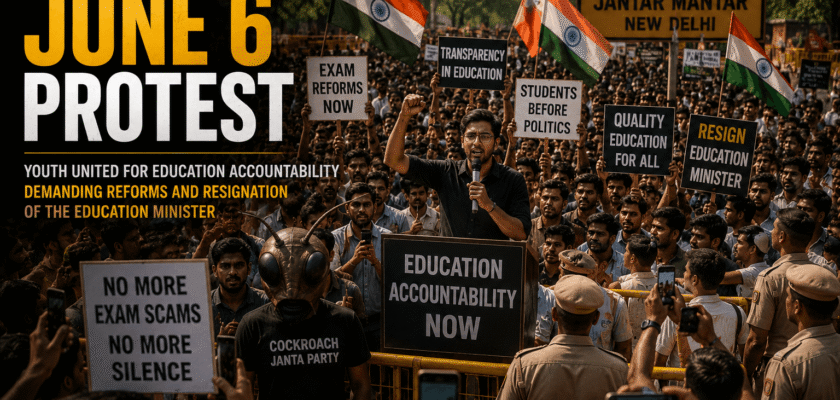
June 6 Jantar Mantar Protest: Why It Became a National Political Story
June 6 Jantar Mantar protest became a major political story because a movement born through memes, satire and social-media frustration moved into a physical public demonstration for the first time.
The Cockroach Janta Party, founded by 30-year-old Abhijeet Dipke, mobilized supporters around alleged irregularities in competitive and school examinations. Protesters demanded the resignation of Education Minister Dharmendra Pradhan and raised wider concerns about unemployment, exam credibility and the future of young Indians.
The event mattered because it tested whether a massive online following could become an organized offline political force.
Who Is Abhijeet Dipke?
Abhijeet Dipke is the founder of the Cockroach Janta Party. Reuters reported that he had lived in the United States for two years and returned to India to lead the June 6 protest.
His arrival attracted political and security attention because:
- The movement had grown rapidly online
- Supporters feared he could be arrested
- Police deployed around Jantar Mantar
- Roads near the protest site were barricaded
- The protest represented the group’s first major street action
Dipke positioned the event as a peaceful youth movement rather than a conventional party rally.
What Is the Cockroach Janta Party?
The Cockroach Janta Party is a satirical youth-led online movement that uses humour, memes and political parody to discuss unemployment, exam scandals and government accountability.
It is not a traditional political party with an established electoral organization.
Its appeal comes from:
- Humour-driven political communication
- Youth frustration
- Viral social-media content
- Exam-related grievances
- Anti-establishment language
- A strong online community
- Easy-to-share visual symbols
The cockroach identity is used as a symbol of survival and frustration rather than as a literal political label.
Why Jantar Mantar Was Chosen
Jantar Mantar in New Delhi is a well-known site for authorized public demonstrations. It allows groups to raise demands near the centre of national political power.
Delhi Police granted permission for the June 6 protest, which was scheduled to begin at 10 a.m.
The site offered:
- National media visibility
- A recognized protest space
- Easier crowd management
- Symbolic proximity to government
- A legal route for public dissent
The move from digital platforms to Jantar Mantar gave the campaign greater political seriousness.
What the Protesters Demanded
The main demand was the resignation of Education Minister Dharmendra Pradhan over alleged examination irregularities.
The movement raised concerns connected with:
- NEET
- CBSE examinations
- CUET
- SSC-related examinations
- Paper leaks
- Re-testing uncertainty
- Delayed results
- Student mental pressure
- Accountability for exam failures
- Youth employment prospects
The protest combined a specific resignation demand with a wider complaint about institutional trust.
Why Exam Irregularities Create Political Anger
Competitive examinations can decide access to medical seats, government jobs and higher education. A leak or cancellation can destroy months or years of preparation.
Students may lose:
- Time
- Money
- Confidence
- Age eligibility
- Admission opportunities
- Family savings
- Mental stability
- Trust in institutions
This is why exam-management failures can quickly become political issues rather than only administrative problems.
The Role of Youth Unemployment
Reuters reported that India’s urban youth unemployment rate was nearly 14% in April 2026. Many educated young people also remained in low-paid or insecure work that did not match their skills.
Exam frustration becomes more intense when secure jobs are already limited.
The political pressure therefore comes from two connected problems:
1. Access to education and jobs feels unfair
2. The number of stable opportunities is not keeping pace with youth expectations
This combination creates fertile ground for digital protest movements.
How a Meme Movement Became a Street Movement
Online movements often grow quickly but struggle to create real-world organization.
The June 6 protest tested whether the CJP could manage:
- Permission
- Crowd safety
- Spokespersons
- Messaging discipline
- Media communication
- Police coordination
- Volunteer structure
- Peaceful conduct
- Clear demands
- Post-protest follow-up
The ability to move from memes to logistics is a major test for any digital movement.
The Movement’s Social-Media Power
Reports differed on the exact number of followers. Reuters placed the Instagram following at roughly 22 million, while the Associated Press reported more than 15 million followers within weeks.
The difference may reflect rapid growth or different measurement times.
The larger point is clear: the movement developed extraordinary digital reach in a very short period.
That reach gave it:
- Fast message distribution
- Low-cost mobilization
- Direct access to young audiences
- Strong visual identity
- National media attention
- Pressure on political leaders
But followers do not automatically equal committed voters or long-term organizers.
Delhi Police Permission and Security
Delhi Police approved the protest and deployed personnel near Jantar Mantar. Roads around the area were barricaded, and loudspeakers were used to direct people to the designated site.
Security planning was important because:
- The founder was returning from abroad
- Large online participation was expected
- The protest involved a sensitive resignation demand
- Authorities wanted to avoid airport disruption
- Crowd estimates were uncertain
Permission gave the protest legal space while allowing police to manage movement and safety.
The Peaceful-Protest Message
The movement repeatedly described the June 6 event as peaceful. Organizers issued practical instructions such as carrying the national flag, using sunscreen and staying hydrated.
This messaging served several purposes:
- Reduce confrontation
- Reassure families
- Prevent legal trouble
- Present the movement as responsible
- Improve public sympathy
- Limit attempts to portray the crowd as violent
Peaceful discipline is essential when an online movement seeks wider legitimacy.
Why the Education Minister Became the Target
Movements often need a clear symbol of accountability. By demanding the education minister’s resignation, the CJP converted several exam-related grievances into one direct political demand.
The government may argue that exam administration involves multiple agencies, boards and state institutions. Protesters argue that national leadership must accept responsibility for repeated failures.
This is the core political debate:
- Is the problem isolated administrative failure?
- Or does it reflect deeper systemic weakness?
The resignation demand keeps that debate in public view.
Government and Ministerial Response
Senior cabinet minister Kiren Rijiju accused the group of seeking support from hostile and anti-India elements. The government also blocked the movement’s X account in India, according to Reuters, and the group challenged that action in court.
These responses raised additional debates about:
- National security claims
- Online speech
- Platform blocking
- Political dissent
- Foreign influence allegations
- Judicial review
The protest therefore expanded beyond education into digital rights and political communication.
Why Account Blocking Can Strengthen a Movement
Blocking an account may reduce reach on one platform, but it can also increase attention.
A ban can create:
- Media coverage
- Curiosity
- Support on other platforms
- Claims of censorship
- Legal challenges
- Stronger group identity
However, platform restrictions can also make coordination harder and increase misinformation if official communication channels disappear.
The Role of Sonam Wangchuk and Public Support
Reports said climate activist Sonam Wangchuk supported the June 6 protest and the demand for accountability over exam issues.
Support from a recognized public figure can help a new movement by providing:
- Credibility
- Wider media coverage
- Cross-issue connection
- Access to new audiences
- A more serious public image
At the same time, the movement must remain clear about its own leadership and demands.
Why the Movement Appeals to Young Indians
The movement’s appeal comes from combining serious frustration with accessible humour.
Young audiences respond to:
- Short videos
- Memes
- Satirical names
- Direct language
- Shared exam experiences
- Anger over unemployment
- Distrust of formal politics
- Desire for visible accountability
Traditional political communication can feel distant. Meme culture allows people to participate quickly and emotionally.
Online Popularity vs Offline Political Power
The June 6 protest was the first major test of offline power.
Real political strength requires more than follower counts. It needs:
- Local organizers
- Issue research
- Legal knowledge
- Consistent funding
- Volunteer management
- Negotiation skills
- Internal democracy
- Clear leadership
- Long-term campaigns
- Voter conversion
Many viral movements disappear after one news cycle. Sustained organization will decide whether CJP becomes a lasting force.
Could the Movement Enter Electoral Politics?
The movement’s name includes the word party, but it currently operates mainly as a satirical campaign and youth platform.
Entering electoral politics would require:
- Formal registration
- Candidates
- Funding disclosure
- Local units
- Policy positions
- Electoral strategy
- Compliance with election law
- Internal governance
It may instead remain a pressure group focused on education, jobs and accountability.
What the Protest Means for the BJP Government
Reuters reported that political analysts believed the movement’s popularity could damage Prime Minister Narendra Modi’s image despite recent state-election victories.
The pressure comes from:
- Youth unemployment
- Exam controversies
- Fuel-price frustration
- Perceived institutional failure
- Social-media criticism
- A large young population
The government must decide whether to dismiss the movement, confront it or respond to its policy demands.
Why India’s Youth Vote Matters
India has nearly 400 million people aged 15 to 29, according to Reuters.
This population can shape:
- Elections
- Labour markets
- Education policy
- Online political culture
- Consumer trends
- Protest movements
A movement that connects exam integrity with jobs can reach a very large political audience.
The Kota and Coaching-City Connection
Exam scandals have special meaning in coaching centres such as Kota, where families spend heavily on preparation.
Students face:
- High fees
- Intense competition
- Mental-health pressure
- Uncertain exam systems
- Re-test risk
- Limited seats
- Family expectations
A protest about exam fairness can therefore resonate far beyond Delhi.
What Meaningful Exam Reform Could Include
A serious reform agenda could include:
- Secure question-paper systems
- Independent audits
- Faster leak investigations
- Clear re-test rules
- Compensation for affected students
- Transparent result correction
- Stronger cyber security
- Accountability timelines
- Mental-health support
- Public reporting
Resignation demands create attention, but institutional reform must follow.
What Protest Organizers Must Do Next
After the June 6 gathering, the movement needs to decide its next steps.
Possible actions include:
- Submit a written charter
- Seek a meeting with officials
- Publish verified evidence
- Create a legal support team
- Track government responses
- Build local student chapters
- Avoid misinformation
- Maintain peaceful discipline
- Define leadership roles
- Report funding transparently
Without follow-up, even a large protest can lose momentum.
Risks Facing the Movement
The CJP faces several risks:
- Internal divisions
- Leader-centric organization
- False information
- Political co-option
- Legal pressure
- Platform bans
- Public fatigue
- Violence by fringe participants
- Lack of clear policy
- Failure to sustain offline support
Trust will depend on transparency and consistency.
What Responsible Media Coverage Should Do
Media should avoid treating the protest only as entertainment.
Responsible coverage should:
- Verify crowd and follower figures
- Explain the exam grievances
- Separate satire from formal party status
- Include government responses
- Avoid unverified arrest rumours
- Track peaceful conduct
- Report legal developments
- Examine policy solutions
The movement’s unusual name should not hide the seriousness of student concerns.
Final Verdict
The June 6 Jantar Mantar protest marked a major transition for the Cockroach Janta Party. A satirical online youth movement entered real-world politics by demanding the resignation of Education Minister Dharmendra Pradhan over alleged exam irregularities.
The protest drew attention because it combined viral reach, youth unemployment, exam anxiety and distrust of institutions. Delhi Police granted permission, security was tightened, and organizers emphasized peaceful participation.
In simple words, the June 6 gathering was not only a protest about one minister. It was a test of whether online youth anger can become disciplined, sustained and policy-focused political action.
The movement’s future will depend less on follower counts and more on organization, evidence, transparency and its ability to secure real reforms.


