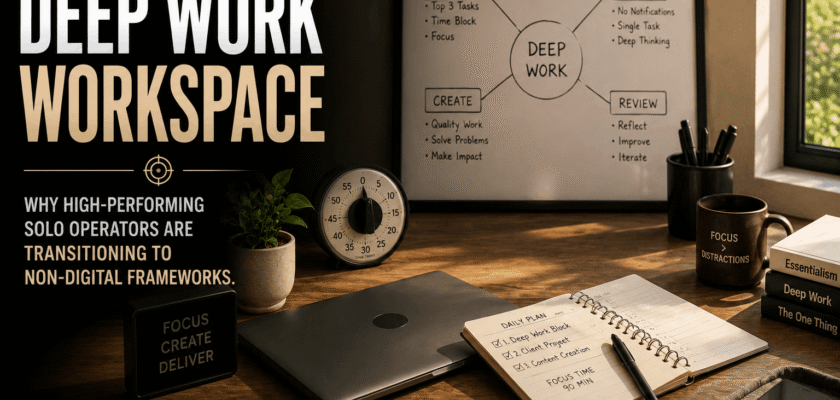
Deep Work Workspace: Why Solo Operators Are Redesigning Focus
Deep Work Workspace is becoming a serious lifestyle and productivity trend because modern solo operators are drowning in digital noise. Freelancers, founders, writers, designers, traders, creators, consultants, and independent professionals often work alone, but their screens are full of constant interruption: messages, dashboards, analytics, AI tools, meetings, emails, social media, payment apps, and project notifications.
The problem is not technology itself. The problem is uncontrolled technology. A high-performing solo operator needs intense focus, clean decisions, and long blocks of uninterrupted output. When every task lives inside the same laptop tab jungle, focus becomes fragile.
That is why many professionals are moving toward non-digital frameworks: paper planning, analog dashboards, whiteboards, phone-free desks, printed checklists, single-task notebooks, and scheduled digital windows. The goal is simple: use digital tools for execution, but use non-digital systems to protect attention.
Why Deep Work Workspace Matters in 2026
Deep Work Workspace matters in 2026 because the modern workday has become more fragmented than ever. Microsoft WorkLab reported that heavily pinged workers can be interrupted every two minutes during core work hours, with meetings, emails, and chats creating a constant “infinite workday” pattern. This is a strong warning for anyone whose income depends on focused output.
For solo operators, the problem is even sharper. There is no manager to protect focus. There is no team assistant to filter interruptions. The same person must sell, create, deliver, invoice, research, learn, and manage clients.
If the workspace does not protect attention, the business slowly becomes reactive. The person feels busy, but the real output drops.
What Is a Deep Work Workspace?
A Deep Work Workspace is a physical and mental work setup designed to reduce distraction and support high-value thinking. It is not only a clean desk. It is a complete environment built around focus.
A deep work setup usually includes a clear desk, one main task, limited devices, paper planning tools, fixed work blocks, no-notification rules, and a visible priority system. It may look simple, but that simplicity is the point.
In simple words, a Deep Work Workspace tells your brain: this space is for serious work, not endless checking.
Why Non-Digital Frameworks Are Returning
Non-digital frameworks are returning because screens are too flexible. The same laptop can hold your business plan, YouTube, WhatsApp, email, analytics, Netflix, invoices, news, trading dashboard, AI tools, and social media. That flexibility is useful, but it also creates temptation.
Paper, whiteboards, printed checklists, index cards, and physical calendars are slower. But slowness can be a feature. A paper page does not push notifications. A whiteboard does not open reels. A notebook does not show breaking news.
This is why high-performing solo operators are rediscovering analog systems. They create friction against distraction.
The Science Behind Attention Residue
Attention residue is one of the strongest ideas behind the Deep Work Workspace. Sophie Leroy’s 2009 research on attention residue found that people need to stop thinking about one task to fully shift attention to another task, and unfinished work can keep part of the mind stuck behind.
This explains why checking messages for “just two minutes” can damage a deep work session. The message may end quickly, but part of the brain keeps processing it.
For solo operators, attention residue can be expensive. A distracted writer writes weaker. A distracted designer misses details. A distracted founder makes reactive decisions. A distracted trader overreacts. A distracted consultant produces shallow strategy.
Why Multitasking Is Not a Superpower
The American Psychological Association explains that doing more than one complex task at a time takes a toll on productivity. Task switching makes the brain shift mental gears, and that switch carries a cost.
Many solo operators call multitasking a skill, but in reality they are often just switching quickly between unfinished loops. The result is mental fatigue, lower quality, and longer work hours.
A Deep Work Workspace reduces multitasking by making one task physically visible and everything else temporarily invisible.
The Solo Operator Problem
Solo operators face a unique challenge: they are both worker and manager. They must decide what matters, then also execute it. This creates constant context switching.
A solo creator may move from video idea to brand email to analytics to invoice to Instagram reply to script writing within one hour. A freelance developer may move from code to client chat to billing to debugging to proposals. These switches feel productive, but they break deep output.
Non-digital frameworks help by separating thinking, planning, and execution. The screen becomes a tool, not the control center of the whole day.
Digital Minimalism Is Not Anti-Tech
Digital minimalism does not mean rejecting technology. It means using technology with intention. A solo operator still needs AI tools, search, email, cloud docs, payments, CRM, and social platforms. But these tools should not control the day.
A digital-minimalist workspace asks three questions before opening any tool: What is the task? Why is this tool needed? When will I close it?
This simple discipline changes the relationship with technology. The operator becomes the driver, not the passenger.
The Non-Digital Framework Stack
A strong Deep Work Workspace can use a simple non-digital framework stack. This stack does not need expensive equipment. It needs clarity.
Core tools include a daily paper plan, a weekly priority board, a deep work timer, a distraction capture notebook, a printed project checklist, and a physical shutdown ritual.
The purpose is to keep the brain focused on decisions that matter instead of constantly reopening apps to remember what to do next.
Digital Workspace vs Deep Work Workspace
| Area | Typical Digital Workspace | Deep Work Workspace |
| Planning | Scattered across apps, tabs, chats | One paper priority list for the day |
| Focus | Notifications and open loops everywhere | Phone away, one task visible |
| Task switching | Frequent switching between tools | Batching and scheduled digital windows |
| Progress tracking | Analytics checked repeatedly | End-of-day written review |
| Decision making | Reactive to messages and dashboards | Proactive based on planned output |
| Recovery | Scrolling during breaks | Walking, breathing, silence, or analog reset |
Paper Planning for High-Value Output
Paper planning works because it slows the mind down. When you write the top three tasks by hand, you are forced to choose. This reduces the fake productivity of keeping twenty tasks open in a digital tool.
A good paper plan should include three things: the main output of the day, the first deep work block, and a shutdown checklist. That is enough for most solo operators.
The goal is not decoration. The goal is execution clarity.
The Daily Deep Work Card
A daily deep work card is a small paper card or notebook page that defines the day’s real work. It can include one primary task, one secondary task, a start time, a finish time, and a distraction list.
Example: Primary task: write 1,500 words of client strategy. Deep work block: 9:00 to 11:00. Distractions captured: invoices, WhatsApp reply, analytics check. These distractions are not ignored; they are parked for later.
This method protects the session from mental leakage.
The Distraction Capture Notebook
A distraction capture notebook is a simple notebook kept beside the workspace. When a random thought appears, you write it down instead of opening another app.
For example, if you suddenly remember “reply to client,” write it in the notebook and return to work. This tells the brain the thought is saved, so it can let go more easily.
This is one of the simplest ways to fight attention residue.
The Phone-Free Desk Rule
The phone-free desk rule is powerful. During deep work, the phone should not be face down on the desk. It should be outside reach, in another room, or inside a drawer.
Even a silent phone can create attention temptation. A visible phone tells the brain that a second world is waiting.
A deep work desk should make the right behavior easier and the wrong behavior harder.
Scheduled Digital Windows
Scheduled digital windows mean checking email, messages, analytics, and social platforms at fixed times instead of continuously. For example: 11:30 a.m., 3:30 p.m., and 6:00 p.m.
This approach does not ignore communication. It makes communication predictable.
For solo operators, this is important because clients and platforms can easily take control of the whole day if access is always open.
Why Whiteboards Work for Solo Operators
Whiteboards work because they make priorities visible. A digital task manager can hide inside a tab. A whiteboard sits in front of you.
A useful whiteboard can show weekly priorities, active projects, revenue targets, content pipeline, and key deadlines. It should not become cluttered. It should show only the few things that matter this week.
Visual clarity creates mental clarity.
Non-Digital Framework for Creators
Creators often lose deep work because content platforms pull them into analytics and comparison. A non-digital creator framework separates creation from distribution.
Morning can be for scripting, writing, filming, designing, or editing. Afternoon can be for publishing, analytics, comments, and messages. This separation protects creative energy.
Creators should not check performance metrics before doing the day’s creative work. Metrics can wait. Output should come first.
Non-Digital Framework for Freelancers
Freelancers need both client management and focused delivery. If client messages stay open all day, delivery quality suffers.
A freelancer can use a paper client board with three columns: active work, waiting for client, and next invoice. This keeps business control visible without opening ten apps repeatedly.
Then, client communication can be handled in scheduled windows.
Non-Digital Framework for Founders
Founders often confuse speed with scattered attention. A founder may spend the whole day reacting to Slack, email, investor notes, customer issues, product bugs, and marketing ideas.
A founder-focused non-digital framework should identify one strategic decision, one customer problem, and one growth action per day. Everything else should be batched.
This keeps the founder from becoming a full-time notification manager.
Non-Digital Framework for Writers and Researchers
Writers and researchers need long attention spans. Digital tabs can destroy that attention by creating endless research loops.
A better method is to print key notes, create a handwritten outline, and write the first draft without internet access. Research windows and writing windows should be separate.
This prevents “research” from becoming disguised procrastination.
The Deep Work Block Structure
A practical deep work block can last 60 to 120 minutes. Beginners should start smaller. The key is not heroic intensity. The key is repeatability.
A strong block has four stages: setup, focus, capture distractions, shutdown. Setup means choosing one task. Focus means doing it. Capture means writing distractions on paper. Shutdown means recording progress and next step.
This structure makes deep work easier to repeat.
The Analog Shutdown Ritual
An analog shutdown ritual helps the brain stop carrying unfinished tasks into the evening. At the end of the workday, write what was completed, what remains, and the first task for tomorrow.
This reduces mental open loops. It also protects sleep and recovery.
A solo operator needs recovery because the business depends on one brain. If that brain stays overloaded, performance falls.
Why Boredom Is Part of the System
Boredom is part of deep work because the brain needs low-stimulation recovery. Many people finish a deep work block and immediately open social media. That keeps the nervous system overloaded.
A better break is walking, stretching, drinking water, looking outside, or sitting quietly for five minutes.
The break should restore attention, not spend it.
Minimal Desk, Maximum Output
A Deep Work Workspace should not look busy. A good desk may include a laptop, notebook, pen, water bottle, timer, and one project document. That is enough.
Extra screens, gadgets, sticky notes, and decorative clutter can create visual noise. Some people need multiple monitors for technical work, but even then, each screen should have a clear purpose.
The goal is not aesthetic minimalism. The goal is cognitive minimalism.
The Role of AI Tools in a Non-Digital Framework
AI tools can support solo operators, but they should not become another distraction layer. AI is best used in scheduled execution windows: research summarization, draft improvement, code support, idea expansion, and checklist creation.
The deep thinking should still be guided by the operator. If AI tools are opened without a clear task, they can create endless prompt loops.
Use AI as a tool, not as the boss of your attention.
Why High Performers Are Choosing Fewer Tools
High performers are choosing fewer tools because tool overload creates operational drag. Every new app adds notifications, logins, dashboards, settings, updates, and learning time.
A solo operator should ask whether a tool reduces complexity or adds another place to check.
In 2026, the smartest workspace may not be the one with the most tools. It may be the one with the fewest tools that still produces the best output.
The 7-Day Deep Work Workspace Reset
Try this simple 7-day reset if your workday feels scattered.
Day 1: Remove non-essential items from your desk. Day 2: Write tomorrow’s top three tasks on paper. Day 3: Keep your phone away during one 60-minute block. Day 4: Use a distraction capture notebook. Day 5: Check messages only in two fixed windows. Day 6: Create a weekly whiteboard priority list. Day 7: Review what changed in your focus, stress, and output.
This reset is simple, but it can expose how much digital noise was controlling the day.
Mistakes to Avoid
Do not make the system too complicated. A deep work system should reduce decisions, not create a new hobby.
Do not buy expensive productivity products before fixing basic habits. A clean notebook and quiet block are more useful than a premium app stack.
Do not expect perfect focus immediately. Deep work is trained like a muscle.
Final Verdict
Deep Work Workspace is becoming important because high-performing solo operators need protected attention more than ever. The modern digital environment creates constant interruptions, attention residue, task switching, and shallow productivity.
Non-digital frameworks solve this by making priorities physical, limiting screen temptation, separating planning from execution, and creating clean work rituals. Paper plans, whiteboards, phone-free desks, distraction notebooks, and scheduled digital windows may look old-school, but they protect the most valuable asset a solo operator has: focused attention.
In simple words, the future of productivity is not more apps. It is better boundaries.
The solo operators who win in 2026 will not be the ones who stay online the longest. They will be the ones who create the deepest output with the least digital noise.


