
Strong El Niño Warning: Why the UN Message Matters Now
Strong El Niño warning is now a global politics issue because climate risk no longer stays inside weather departments. It affects food prices, water security, public health, energy systems, migration, disaster budgets, and national planning.
On June 2026 climate updates, the UN and WMO moved the conversation from distant possibility to urgent preparation. The warning is simple: countries should not wait for impacts to arrive before acting.
El Niño is a natural climate pattern, but in a warmer world its impacts can become sharper. Heatwaves can become hotter. Drought can become deeper. Flood risk can rise in some regions. Crop planning can become more uncertain. That is why this warning matters for governments, businesses, farmers, travellers, and families.
What the UN Secretary-General Warned
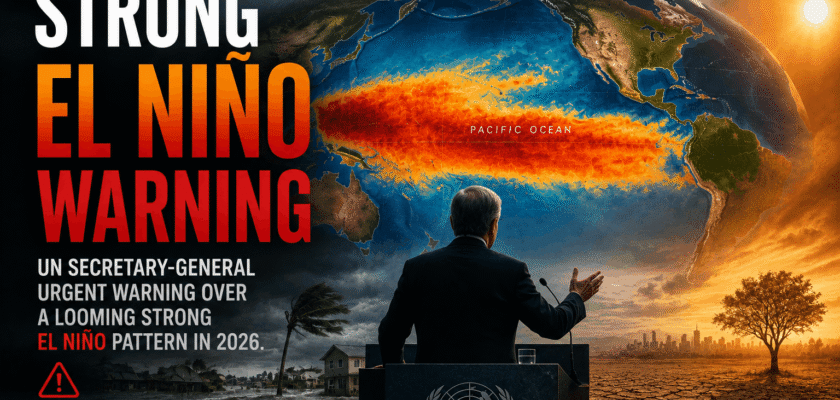
UN Secretary-General Antonio Guterres warned that El Niño is arriving on our doorstep in the coming months with high certainty. His message focused on preparedness because El Niño conditions can intensify heat, drought, flooding, storms, and humanitarian pressure.
The warning is not only about one year of bad weather. It is about how climate change can amplify natural patterns. The same El Niño that once caused difficult seasons can now interact with record ocean heat, urban heat islands, fragile food systems, and stressed water supplies.
For readers, the main point is practical: this is not just climate science. It is a risk-management alert.
What WMO Forecasts Say
WMO says there is an 80% likelihood of an El Niño event during June-August 2026. It also says the probability of persistence through at least November is near or above 90%. Most forecast models suggest the event may be moderate, with a possibility of strong development.
The WMO Global Seasonal Climate Update for June-July-August 2026 also points toward rapid transition to a strong El Niño, with the multi-model ensemble mean forecast to clear the El Niño threshold and reach about 1.8°C for the seasonal average.
This matters because El Niño is not only a Pacific Ocean issue. It reshapes rainfall and temperature patterns across many regions of the world.
El Niño Explained in Simple Words
El Niño is a climate pattern that happens when surface waters in the central and eastern tropical Pacific Ocean become warmer than usual. This warming changes wind patterns, rainfall behaviour, storm tracks, and global temperature signals.
Its impact is not the same everywhere. Some regions may face drought and heat. Others may see heavier rainfall and flood risk. Some places may experience weaker monsoons, while others may face stronger storms.
That is why El Niño planning must be local. A farmer, a city planner, a hospital, an airline, and an energy company all need different preparation.
Why “On Our Doorstep” Is a Serious Phrase
The phrase “on our doorstep” matters because it signals near-term risk. It means the climate pattern is not a vague future threat. It is approaching within the planning window of governments, companies, and households.
For agriculture, this can affect sowing decisions. For cities, it can affect water storage and heat action plans. For hospitals, it can affect disease surveillance and heat illness preparation. For power grids, it can affect electricity demand forecasts.
When the UN uses urgent language, the message is that preparation should begin before emergency headlines dominate the news.
How Climate Change Supercharges El Niño
El Niño is natural, but global warming changes the background conditions in which it happens. The planet is already warmer than in the pre-industrial era, and oceans have absorbed enormous amounts of heat. That makes extreme weather more dangerous.
When El Niño arrives in a warmer world, it can add extra heat to already stressed climate systems. This can make hot months hotter and raise the chance of temperature records.
The key lesson is this: El Niño is the trigger, but climate change is the amplifier.
Asia Risk: Heat, Drought, Floods and Food Prices
Asia is highly exposed to El Niño impacts because large populations depend on monsoon rainfall, agriculture, hydropower, fisheries, and outdoor labour. The Guardian reported that Asia is bracing for unpredictable and extreme weather as El Niño develops.
For India, the concern is monsoon disruption, crop stress, reservoir pressure, and heatwave intensity. For Southeast Asia, drought, haze, water shortage, wildfire risk, and food inflation can become major challenges. For China, rainfall shifts and heat stress may require emergency preparedness.
This is why El Niño is also a food-security and public-health issue.
India and Monsoon Sensitivity
India has a special reason to watch El Niño closely because the Indian monsoon supports agriculture, reservoirs, rural income, food prices, and electricity planning. El Niño does not guarantee a failed monsoon every time, but it increases concern.
A weak or uneven monsoon can affect rice, pulses, oilseeds, sugarcane, vegetables, and fodder. It can also raise irrigation demand and power consumption for cooling and pumping.
Policy teams should watch district-level rainfall, reservoir storage, soil moisture, crop advisories, and food-price trends instead of depending only on national averages.
Food Security: Why the Warning Matters for Families
Food security is one of the biggest reasons the strong El Niño warning matters. Weather disruption can reduce yields, delay planting, increase pest pressure, affect transport, and raise storage losses.
When crop supply becomes uncertain, food prices can rise. Poor households feel this first because food takes a larger share of their income.
Governments should prepare grain stocks, drought advisories, irrigation planning, crop insurance awareness, market monitoring, and nutrition support for vulnerable groups.
Water Security and Reservoir Planning
Water security becomes critical during El Niño risk. Some regions may face drought, while others may receive intense rainfall that does not store well. Cities must plan reservoir levels, groundwater use, leakage control, tanker systems, and emergency supply.
Water managers should review storage capacity, rainfall forecasts, demand projections, and heat-driven consumption. Households should also reduce wastage and store water safely where local advisories recommend it.
A strong El Niño year can expose weak water planning very quickly.
Heatwave Risk and Public Health
Heatwave risk can rise during El Niño years because global temperature patterns may shift upward. Heat affects the elderly, children, outdoor workers, pregnant women, people with chronic disease, and people living in dense urban areas.
Public-health systems should prepare heat action plans, cooling centres, hospital readiness, worker-safety advisories, school timing adjustments, and public messaging.
Heat illness is preventable when early warning reaches people on time.
Disease Surveillance During Climate Extremes
Climate extremes can influence disease risk. Flooding can increase waterborne disease exposure. Drought can affect hygiene and water safety. Heat can worsen air pollution and stress health systems.
Disease surveillance should monitor diarrhoeal illness, dengue, malaria, heatstroke, respiratory issues from wildfire smoke, and malnutrition risk in vulnerable areas.
Climate preparedness is not only about weather stations. It is also about clinics, labs, schools, and local government response.
Energy Systems: Power Demand and Hydropower Stress
Energy systems can face pressure during El Niño. Heat raises cooling demand. Drought can reduce hydropower output. Water shortage can affect thermal power cooling in some regions. Grid planners must prepare for demand peaks and supply stress.
Businesses should review backup power, cooling efficiency, energy bills, and operating hours. Cities should prepare demand-response plans and protect vulnerable communities from heat-related blackouts.
Climate risk is now an energy-security issue.
Agriculture: What Farmers Should Watch
Farmers should watch official advisories, not rumours. Key indicators include monsoon onset, rainfall distribution, soil moisture, reservoir releases, pest alerts, seed advisories, and crop insurance deadlines.
Practical steps may include crop diversification, drought-tolerant varieties, water-saving irrigation, mulching, fodder planning, and early pest monitoring.
The best farm response depends on local conditions. National El Niño headlines should be translated into district-level action.
Urban Planning: Why Cities Need Preparedness Now
Cities face a double risk. In some regions, El Niño can intensify heat and water stress. In others, it can contribute to heavy rainfall and flooding. Urban planning must prepare for both extremes.
Cities should clean drains, audit heat hotspots, protect informal settlements, prepare water supply plans, improve cooling shelters, and communicate clearly with residents.
Urban resilience is not built during disaster week. It is built before the season begins.
Disaster Management: From Alert to Action
A strong El Niño warning is only useful if it becomes action. Disaster management teams should update risk maps, coordinate departments, test communication systems, prepare relief supplies, and identify vulnerable communities.
Early action can reduce damage from droughts, floods, heatwaves, wildfires, and storms. It can also save money because prevention is often cheaper than emergency response.
Preparedness should be measured by practical readiness, not by how many alerts were issued.
What Businesses Should Do
Businesses should treat El Niño as a supply-chain risk. Food companies, travel firms, logistics operators, insurers, energy users, retailers, and construction companies may all be affected.
Business leaders should review supplier locations, water dependency, heat exposure, insurance coverage, delivery risks, crop-linked input costs, and employee safety plans.
Climate risk should be part of business continuity planning, not only sustainability reporting.
Travel and Tourism Risks
Travellers should track heat, storms, wildfires, flooding, and water advisories during an El Niño year. Destinations may experience unusual weather patterns that affect flights, outdoor activities, road travel, and health safety.
Tour operators should prepare flexible itineraries, heat-safety advice, emergency contacts, hydration plans, and weather-alert systems for travellers.
Climate-aware travel planning is becoming normal, especially during global events and peak tourism seasons.
Insurance and Household Preparedness
Households should review insurance, emergency supplies, water storage, medicines, heat protection, and local warning channels. Families in flood-prone areas should know evacuation routes. Families in heat-prone areas should prepare cooling strategies.
Insurance companies may also review claims exposure for crops, homes, vehicles, logistics, and business interruption.
Prepared households recover faster than households that wait for the emergency to arrive.
Why Early Warning Systems Matter
Early warning systems save lives when warnings reach people clearly and in time. A forecast hidden in a technical report is not enough. Farmers, drivers, students, patients, workers, and local businesses need simple guidance.
Effective warning systems need weather data, communication channels, local language alerts, trusted community messengers, and clear do-this-now instructions.
The UN warning should push countries to strengthen this last-mile communication.
Misinformation Risk During Climate Events
Extreme weather creates misinformation risk. Fake rainfall maps, panic-driven food-price rumours, false disease claims, and misleading weather screenshots can spread quickly.
Readers should rely on official meteorological agencies, WMO updates, government advisories, university climate centres, and credible news outlets.
Good information is part of climate resilience.
What Governments Should Prioritize
Governments should prioritize water planning, heat action, food stocks, farmer advisories, disease surveillance, power-grid readiness, disaster funding, and clear public communication.
They should also coordinate across departments. El Niño is not only a meteorological issue. It touches agriculture, health, energy, transport, education, finance, and social welfare.
A whole-of-government response is needed because climate impacts do not respect department boundaries.
What Citizens Can Do This Week
Citizens can take small but useful steps. Save official weather-alert sources. Avoid wasting water. Check heat-safety guidance. Keep basic medicines ready. Protect elderly family members during heatwaves. Follow crop advisories if farming.
Businesses can review supply chains. Schools can prepare heat guidelines. Local communities can identify vulnerable people who may need help during extreme weather.
Preparedness is not panic. It is responsibility.
Final Verdict
Strong El Niño warning from the UN and WMO should be treated as a practical global preparedness alert. The forecast points to high likelihood of El Niño during 2026, with persistence likely through late year and a possibility of strong development.
This matters because El Niño can intensify heat, drought, floods, storms, water stress, disease risks, crop pressure, energy demand, and food-price volatility. Climate change makes those impacts more dangerous by adding heat to the system.
In simple words, El Niño is on our doorstep, and preparation must begin before the impacts become headlines. Governments, businesses, farmers, cities, hospitals, and families should use this warning window wisely.
Quick Preparedness Checklist
| Group | Main Risk | Immediate Action |
| Families | Heat, water stress, price rise | Track official alerts, reduce water waste, keep medicines and emergency contacts ready |
| Farmers | Weak rainfall, pest risk, crop stress | Follow district advisories, plan irrigation, check crop insurance and seed guidance |
| Cities | Heat islands, flooding, water shortage | Clean drains, prepare heat shelters, monitor reservoirs and communicate clearly |
| Hospitals | Heat illness and disease spikes | Prepare heatstroke response, surveillance, medicines and patient communication |
| Businesses | Supply-chain disruption | Review supplier locations, inventory buffers, insurance and employee safety |
| Schools | Heat risk and attendance disruption | Plan timing flexibility, hydration guidance and safe classroom conditions |


