
CENTCOM Missile Interception: What Happened
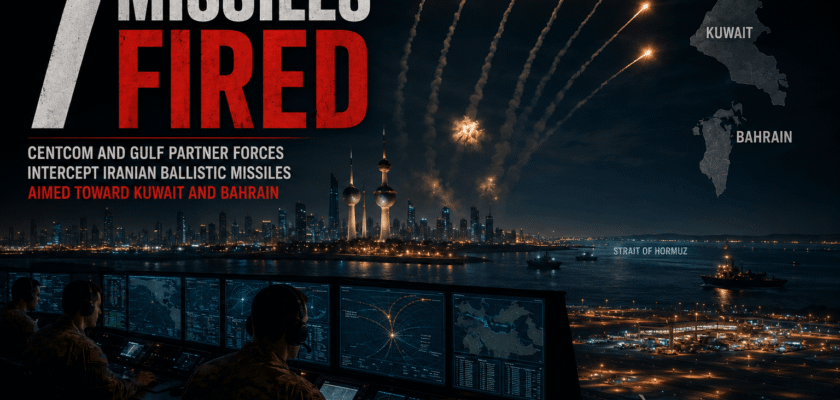
CENTCOM missile interception became the latest flashpoint in the Gulf after Iran launched seven ballistic missiles toward targets in Kuwait and Bahrain on June 6, 2026.
According to U.S. Central Command, six missiles were intercepted by U.S. and partner air-defense forces, while one failed to reach its target. Iran said the operation targeted U.S. military facilities, including the Ali Al Salem Air Base in Kuwait and the U.S. Fifth Fleet headquarters in Bahrain.
CENTCOM denied that the Fifth Fleet headquarters was struck. No U.S. personnel were reported harmed in the seven-missile episode.
Why the June 6 Strike Was Not an Isolated Event
The June 6 missile launch followed several days of escalating attacks.
On June 3, Iranian missiles and drones struck Kuwait, damaging Terminal 1 at Kuwait International Airport. Kuwaiti authorities reported one death and more than 60 injuries. Flights were disrupted, and some operations shifted to another terminal after safety checks.
The two episodes should not be mixed:
- June 3: A broader missile-and-drone attack caused civilian damage in Kuwait.
- June 6: Seven ballistic missiles were launched toward Kuwait and Bahrain; CENTCOM said six were intercepted.
This distinction matters for accurate reporting.
The Trigger: U.S. Strikes on Iranian Coastal Radar Sites
Before the seven-missile launch, U.S. forces shot down four Iranian one-way attack drones near the Strait of Hormuz. CENTCOM said the drones threatened regional maritime traffic.
U.S. forces then struck Iranian coastal surveillance radar sites in Goruk and on Qeshm Island. Iran responded with ballistic missiles toward U.S. and allied positions in the Gulf.
The escalation followed a familiar cycle:
1. Maritime threat
2. Defensive interception
3. U.S. strike on Iranian military infrastructure
4. Iranian missile retaliation
5. Regional air-defense response
Each round increased the risk that a limited incident could become a wider war.
Why Kuwait and Bahrain Are Strategically Important
Kuwait and Bahrain host important U.S. military facilities.
Bahrain is home to the headquarters of the U.S. Navy’s Fifth Fleet, which oversees naval operations across the Gulf, Arabian Sea and parts of the Indian Ocean.
Kuwait hosts U.S. personnel and logistics facilities that support regional operations.
Targeting these locations sends a political and military message. It also creates immediate danger for civilian airports, ports, neighbourhoods and commercial activity located near strategic infrastructure.
What CENTCOM Said About the Seven Missiles
CENTCOM said:
- Seven ballistic missiles were launched
- Six were intercepted
- One failed to hit its target
- U.S. and partner forces defended Kuwait and Bahrain
- Iranian claims of hitting the Fifth Fleet headquarters were false
- No U.S. personnel were harmed
The statement framed the interception as collective regional defence rather than a purely American operation.
The Role of Partner Air-Defense Forces
Modern Gulf air defence operates through layered systems and coordination among U.S. and regional partners.
Possible defensive layers include:
- Early-warning radar
- Patriot batteries
- Ship-based interceptors
- Fighter aircraft
- Command-and-control networks
- Local air-defense units
- Shared tracking data
No single system guarantees complete protection. The June 3 airport damage showed that even when many threats are intercepted, missiles, drones or debris can still cause casualties.
Why Iran Targeted the Gulf
Iran described its attacks as retaliation for U.S. military action and pressure around the Strait of Hormuz.
Possible strategic aims include:
- Demonstrating remaining missile capability
- Raising the cost of U.S. operations
- Pressuring Gulf governments
- Challenging the maritime blockade
- Strengthening leverage in ceasefire negotiations
- Showing domestic audiences that Iran can retaliate
- Warning commercial shipping and regional bases
However, attacks on Gulf states also risk damaging Iran’s diplomatic relations with neighbouring countries.
The U.S. Fifth Fleet Claim
Iranian media claimed that the U.S. Fifth Fleet headquarters in Bahrain had been struck. CENTCOM denied the claim.
During active conflict, both sides use information operations to shape public opinion. Claims may be released before independent verification is possible.
Responsible readers should look for:
- Official statements
- Local government confirmation
- Satellite or visual evidence
- Casualty reports
- Independent news verification
- Later corrections
A claim of a successful strike is not the same as confirmed damage.
Kuwait Airport Attack Raised Civilian Risk
The earlier June 3 attack showed how military escalation can quickly affect civilians.
Reuters reported:
- One person killed
- Dozens injured
- Damage to Terminal 1
- Flight diversions
- Temporary disruption to Kuwait Airways
- Damage to other civilian infrastructure and diplomatic sites
This is why regional missile exchanges cannot be treated as isolated military events. Airports, workers, travellers and families are exposed.
Bahrain’s Air-Raid Alerts
Bahrain activated warning sirens during the attacks. Air-raid alerts can create panic even when missiles are intercepted.
Residents and travellers may face:
- Shelter instructions
- Flight delays
- Road closures
- Mobile-network congestion
- School or workplace disruption
- Temporary port restrictions
- Conflicting social-media reports
Following official local alerts is safer than relying on unverified messages.
The Strait of Hormuz Connection
The Strait of Hormuz remains central to the conflict because a large share of global oil and gas shipments passes through this narrow waterway.
The war has disrupted shipping and increased:
- Oil prices
- Marine insurance costs
- Freight delays
- Naval deployments
- Fuel-market anxiety
- Risk premiums for airlines and ports
The June 6 confrontation began with drones near maritime traffic, showing how sea-lane security and missile escalation are directly connected.
How the Incident Affects Oil Markets
Markets react to Gulf attacks because even a short interruption can affect energy supply expectations.
A renewed escalation can push:
- Crude oil higher
- Shipping rates higher
- Airline costs higher
- Inflation expectations higher
- Safe-haven demand higher
- Equity-market volatility higher
Actual supply loss is not always necessary. Fear of disruption can move prices before physical shortages appear.
Why the Ceasefire Looks Fragile
The U.S. and Iran had described an earlier ceasefire as continuing, but repeated violations made that claim increasingly difficult to defend.
The June 6 exchange showed that:
- Military forces remain active
- Maritime enforcement is disputed
- Retaliatory strikes continue
- Negotiations remain incomplete
- Regional allies remain exposed
- Miscalculation risk is high
A ceasefire without clear enforcement, communication and dispute resolution can become only a pause between attacks.
The Diplomacy Behind the Fighting
Iran has demanded sanctions relief and access to frozen assets as part of a broader settlement. The U.S. has used military and economic pressure to seek concessions over maritime access and regional security.
The major negotiation issues include:
- Strait of Hormuz access
- Sanctions
- Frozen Iranian funds
- Nuclear restrictions
- Missile capability
- U.S. military presence
- Regional ceasefires
- Prisoner and humanitarian issues
The missile exchange increased pressure for a deal while making trust more difficult.
Regional Governments Face a Difficult Balance
Kuwait and Bahrain must balance security partnerships with the need to avoid becoming permanent battlefields.
Their priorities include:
- Protecting civilians
- Maintaining airport and port operations
- Supporting air defence
- Preserving relations with neighbours
- Avoiding economic disruption
- Keeping energy and trade routes open
- Managing public communication
- Preventing escalation
Hosting foreign military facilities creates security protection but can also make a country a target.
What Travelers Should Know
Travelers in Kuwait, Bahrain or nearby Gulf states should:
- Follow official government alerts
- Confirm flights before leaving for the airport
- Avoid military and government facilities
- Keep passport and emergency contacts ready
- Register with their embassy where available
- Save airline details offline
- Follow shelter instructions
- Avoid photographing security operations
- Maintain flexible travel plans
- Ignore unverified social-media claims
Airspace and airport operations can change quickly during missile alerts.
What Shipping Companies Should Watch
Maritime operators should monitor:
- CENTCOM safety notices
- Navigation warnings
- Port restrictions
- Insurance exclusions
- Threats near the Strait of Hormuz
- Drone and missile alerts
- Convoy or escort requirements
- Crew security plans
- Alternative routes
- Fuel availability
A security incident can affect schedules even when a vessel is not directly attacked.
Information Warfare During Missile Exchanges
Conflicting claims are common during war.
Iran may emphasize successful strikes. CENTCOM may emphasize interceptions and defensive success. Local governments may delay details while assessing damage.
Readers should avoid:
- Sharing old videos as new
- Treating explosions as proof of a direct hit
- Relying on anonymous accounts
- Assuming all interceptions are complete
- Ignoring civilian government statements
- Confusing different attack dates
The June 3 and June 6 incidents were frequently mixed together online.
Could One Missed Missile Change the Conflict?
Even one missile that avoids interception can cause major consequences.
Possible outcomes include:
- Civilian casualties
- Damage to a military base
- Airport closure
- Pressure for retaliation
- Wider involvement by allies
- Market shock
- Breakdown of negotiations
This is why a six-of-seven interception rate can still leave serious risk.
What the Interception Says About Iran’s Remaining Capability
U.S. officials have said Iran’s missile and drone infrastructure suffered major damage earlier in the war. However, the June attacks showed that Iran retained the ability to launch coordinated strikes.
Remaining capability may include:
- Mobile launchers
- Short- and medium-range missiles
- One-way attack drones
- Coastal radar and command sites
- Naval missile units
- Dispersed storage
The scale may be reduced, but the threat is not eliminated.
Why Air Defence Is Not a Complete Solution
Air defence reduces damage, but it has limits.
Challenges include:
- High interceptor cost
- Limited ammunition
- Simultaneous attacks
- Low-flying drones
- Debris after interception
- Detection gaps
- Civilian infrastructure near targets
- Repeated waves
Long-term security requires diplomacy, deterrence and crisis communication in addition to interceptors.
What to Watch Next
Key signals include:
- Further CENTCOM statements
- Iranian Revolutionary Guard announcements
- Damage assessments in Kuwait and Bahrain
- Airport and port operations
- New drone activity near Hormuz
- Oil-price movement
- Ceasefire negotiations
- U.S. congressional pressure
- Gulf-state diplomatic statements
- Additional missile launches
The conflict can change direction within hours.
Final Verdict
CENTCOM’s interception of six out of seven Iranian ballistic missiles showed the strength of layered U.S. and partner air defences, but it did not end the danger.
The June 6 launch followed U.S. strikes on Iranian coastal radar sites and came only days after a separate Iranian attack damaged Kuwait International Airport, killed one person and injured dozens.
In simple words, the Gulf corridor remains highly unstable. Military bases, civilian airports, shipping lanes and energy markets are now linked inside the same escalation cycle.
The interception prevented greater damage, but the wider crisis will not be solved by air defence alone. A durable settlement requires verified ceasefire rules, open communication and protection for civilian infrastructure.


