Competency-Based Visual AI Platforms: Why the Alternative Degree Gateway Is Growing
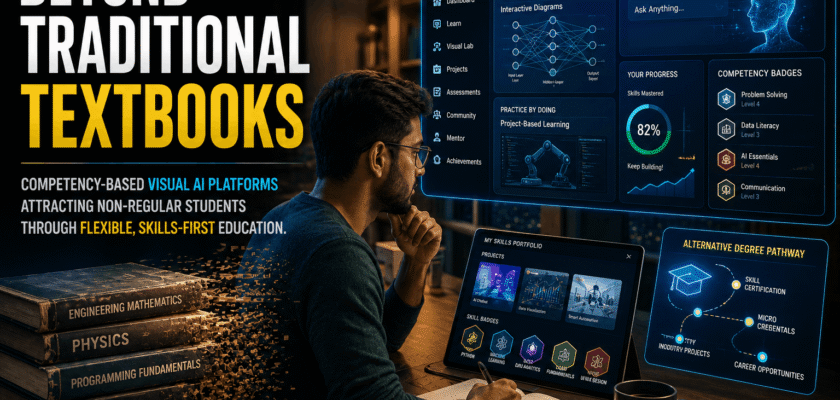
Competency-based visual AI platforms are gaining attention because many learners no longer fit the traditional full-time college model. Working adults, career switchers, parents, rural learners, students with interrupted education and people who already have job experience often need a more flexible route.
Traditional textbooks move every learner through the same chapter sequence. Competency-based systems focus on whether the learner can demonstrate a skill. Visual AI layers can explain concepts through diagrams, simulations, interactive maps, adaptive videos, step-by-step demonstrations and instant feedback.
This combination is creating an alternative degree gateway: learn at a flexible pace, prove what you can do and build evidence that employers can understand.
Why Non-Regular Student Enrollment Matters in 2026
Non-regular students include part-time learners, adult learners, distance students, workers, returners, people with previous college credits and learners using short credentials before deciding on a full degree.
The U.S. Department of Education recognizes competency-based education and direct-assessment programs as formal program models. These systems organize progress around demonstrated competency rather than only time spent in class.
In India, the government said in March 2026 that SWAYAM offered more than 110 free AI courses from IITs and IISc and had more than 41.2 lakh enrollments. That scale shows that flexible digital learning is no longer a niche option.
What Is Competency-Based Education?
Competency-based education, or CBE, measures learning through demonstrated knowledge and skill. A learner progresses after showing mastery, not simply after attending a fixed number of weeks.
A CBE program may use projects, practical demonstrations, simulations, portfolios, quizzes, oral explanations and workplace evidence. The most important question is not “How long did you sit in class?” It is “Can you perform the required task?”
This model can help experienced adults avoid repeating material they already understand.
What Makes a Platform “Visual AI”?
A visual AI learning platform uses artificial intelligence to create, organize or adapt visual explanations. It may convert text into diagrams, show a process as animation, generate practice scenarios, label images, explain mistakes visually or build an interactive project around a learner’s goal.
Useful features may include:
• Visual concept maps
• AI-generated diagrams
• Interactive simulations
• Video-based demonstrations
• Adaptive practice
• Instant feedback
• Multilingual captions
• Project dashboards
• Skill evidence portfolios
• Accessibility controls
The value comes from combining clear visuals with responsible teaching design.
Why Traditional Textbooks Do Not Work for Every Learner
Textbooks remain valuable, but they assume long reading time, stable schedules and strong academic confidence. Non-regular learners may be studying after work, caring for family members or returning after years away from education.
Common barriers include:
• Dense academic language
• Long fixed chapters
• Limited examples
• No instant feedback
• Weak connection to workplace tasks
• One pace for everyone
• High fear of failure
• Limited accessibility
Visual AI can reduce some barriers by making difficult ideas easier to see, practice and revisit.
How AI Supports Personalized Learning
AI can help platforms adjust examples, practice levels and explanations based on learner performance. A learner struggling with accounting may receive a visual cash-flow exercise. A learner who already understands the basics may move directly to a more advanced project.
Personalization can support:
• Different starting levels
• Flexible pacing
• Targeted revision
• Immediate practice
• Multiple explanation formats
• Language support
• Learning reminders
• Early risk detection
However, the learner should still know why the system recommends a task. Hidden or biased automation can create unfair outcomes.
Why Visual Learning Helps Adult Learners
Adult learners often connect new learning with practical experience. Visual examples can make that connection faster.
A warehouse worker learning supply-chain analytics may understand a flow map faster than a long theoretical chapter. A healthcare worker may benefit from an interactive patient pathway. A small-business owner may learn finance through a live cash-flow dashboard.
Visual learning is most useful when it supports understanding rather than decoration.
The Skills-First Hiring Shift
Many employers are paying more attention to skills, portfolios and work samples. Micro-credentials and competency records can help learners show specific abilities without waiting years for a traditional degree.
A strong skills-first profile may include:
• Verified project work
• Digital badges
• Skills assessments
• Employer-reviewed tasks
• GitHub or portfolio links
• Work-based evidence
• Industry certificates
• Communication samples
The qualification must still be credible. A badge with no clear assessment has limited value.
Micro-Credentials as a Bridge to a Degree
Micro-credentials can work as smaller building blocks. A learner may complete data visualization, business communication and AI ethics credentials before moving into a diploma or degree.
A good stackable system should clearly show:
• Learning outcomes
• Assessment method
• Credit value
• Transfer rules
• Issuing institution
• Level of difficulty
• Expiry or renewal rules
• Employer relevance
This helps learners avoid paying for disconnected certificates.
Why Non-Regular Students Prefer Flexible Pacing
A fixed timetable can exclude people with jobs, health needs or family responsibilities. Competency-based platforms let learners accelerate when they have time and pause when life becomes difficult.
Flexible pacing works best when the platform also provides deadlines, mentors and progress reminders. Complete freedom without support can lead to dropout.
The ideal system combines flexibility with structure.
Prior Learning Assessment Can Reduce Repetition
Many adults already possess valuable skills from work, military service, freelancing, caregiving or previous study. Prior learning assessment can evaluate that experience for credit or advanced placement.
Evidence may include:
• Work portfolios
• Employer letters
• Certifications
• Practical demonstrations
• Challenge exams
• Interviews
• Previous transcripts
A transparent assessment saves time while protecting academic standards.
Why Mentors Still Matter
AI can explain and recommend, but mentors help learners make decisions, recover after setbacks and connect study with career goals.
Mentors can support:
• Course planning
• Motivation
• Project feedback
• Career choices
• Academic confidence
• Human escalation
• Ethical questions
• Networking
The strongest alternative programs use AI for scale and humans for judgment.
Visual AI and Multilingual Access
Language is a major barrier for many learners. Visual lessons, translated captions and speech-based explanations can make education more inclusive.
Platforms should support:
• Regional languages
• Simple English
• Accurate captions
• Text-to-speech
• Speech-to-text
• Local examples
• Glossaries
• Downloadable low-bandwidth content
Translation must be reviewed because technical mistakes can mislead learners.
Accessibility for Learners with Disabilities
Visual platforms must not assume every learner can see, hear, type or process information in the same way.
Inclusive design includes:
• Screen-reader compatible text
• Alt text for images
• Keyboard navigation
• High-contrast modes
• Captions and transcripts
• Adjustable speed
• Dyslexia-friendly layouts
• Clear focus indicators
• Multiple assessment formats
Accessibility should be part of the product from the beginning.
How Project-Based Assessment Builds Confidence
A practical project gives learners evidence of progress. Instead of memorizing only definitions, a learner can build a dashboard, design a campaign, create a prototype or solve a case study.
Project assessment can measure:
• Problem definition
• Technical accuracy
• Creativity
• Communication
• Ethical judgment
• Reflection
• Teamwork
• Revision ability
A visible portfolio can improve both confidence and employability.
The Risk of AI-Generated Shortcuts
Visual AI platforms can also make it easy to produce polished work without real learning. A learner may submit an AI-generated diagram or report without understanding it.
Platforms need:
• Process-based assessment
• Oral explanation
• Version history
• Reflection notes
• Practical demonstrations
• Clear AI-use rules
• Source checking
• Human review
The goal is AI-assisted learning, not AI-replaced learning.
Data Privacy and Student Rights
Education platforms may collect performance data, voice recordings, writing samples, identity information and behavioural signals. This data must be protected.
Students should know:
• What is collected
• Why it is collected
• Who can access it
• Whether it trains AI models
• How long it is stored
• How to delete it
• How automated decisions are reviewed
UNESCO’s AI guidance emphasizes a human-centred approach, agency, ethics and protection of learner rights.
Bias in Automated Recommendations
An AI system may recommend easier or harder paths based on historical data. If that data reflects inequality, the system can limit learners unfairly.
Institutions should audit:
• Recommendation patterns
• Completion gaps
• Language bias
• Disability impact
• Gender and regional disparities
• Error rates
• Appeal mechanisms
No learner should be trapped by an unexplained algorithm.
What Colleges Need Before Adopting These Platforms
A college should not buy a visual AI platform only because the interface looks modern.
It should first define:
• Academic outcomes
• Accreditation fit
• Faculty roles
• Assessment standards
• Data governance
• Accessibility requirements
• Technical support
• Cost per learner
• Transfer-credit rules
• Quality assurance
Technology should support the academic model, not replace it.
What Employers Should Check
Employers evaluating competency-based credentials should ask whether the assessment is rigorous and relevant.
Useful questions include:
• What exactly did the learner demonstrate?
• Was the work independently verified?
• Is the issuing institution credible?
• Is the skill current?
• Can the learner explain the project?
• Does the assessment match the job?
Clear competency records can make hiring more efficient.
What Students Should Check Before Enrolling
Students should avoid platforms that promise an instant degree with no serious assessment.
Check:
• Accreditation or recognition
• Total cost
• Refund policy
• Faculty and mentor support
• Assessment methods
• Credit transfer
• Employer acceptance
• Data privacy
• Accessibility
• Completion support
A flexible program should still be academically honest.
A Practical Enrollment Checklist
Before joining, ask:
1. Can I study part time?
2. Can previous learning count?
3. Are projects independently assessed?
4. Is the credential recognized?
5. Can credits stack into a larger qualification?
6. Is there human mentor support?
7. Are materials available offline?
8. Is AI use clearly explained?
9. Can I export my portfolio?
10. What happens if I pause the program?
These questions protect both time and money.
Why India Is a Major Opportunity Market
India has a large population of working learners, students outside major cities and people seeking job-ready credentials. SWAYAM’s large enrollment shows demand for flexible digital education.
A strong Indian model should combine:
• Affordable pricing
• Regional languages
• Mobile-first access
• Low-bandwidth modes
• Industry projects
• University recognition
• Credit transfer
• Mentorship
• Local employer partnerships
• Responsible AI use
The opportunity is large, but quality will decide trust.
Future of the Alternative Degree Gateway
The alternative degree gateway will likely combine universities, online platforms, employers and professional bodies.
Future models may include:
• Stackable credentials
• AI-guided study plans
• Work-based assessment
• Verified digital portfolios
• Short residential labs
• Remote simulations
• Employer-sponsored learning
• Cross-institution credit transfer
• Lifelong learning subscriptions
• Human mentor networks
The degree may become a flexible pathway rather than one fixed four-year block.
Final Verdict
Competency-based visual AI platforms are attracting non-regular students because they offer flexibility, practical assessment, personalized support and clearer links to employment. They can help adult learners, career switchers and students with interrupted education move beyond a one-size-fits-all textbook model.
However, technology alone cannot create a trusted qualification. Strong programs need credible assessment, accreditation, mentors, data protection, accessibility and transparent use of AI.
In simple words, the future is not “AI instead of education.” It is education redesigned around demonstrated skills, flexible access and responsible AI support.
The platforms that earn trust will be those that help learners prove real competence, not merely complete attractive screens.


