
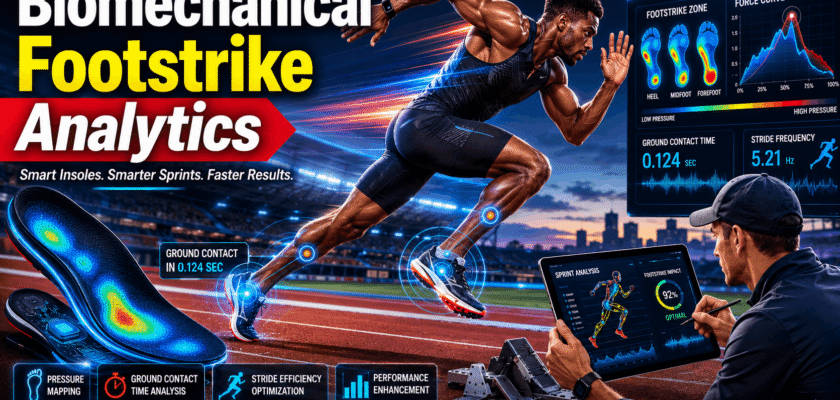
Biomechanical Footstrike Analytics: Why Sprinters Are Paying Attention
Biomechanical footstrike analytics is changing how sprint coaches review speed work. Earlier, many coaches had to depend on video, stopwatch splits and trackside observation. Those tools still matter. However, wearable insole sensors now add foot-level data that was once hard to collect outside a lab.
A smart insole can measure pressure, timing and contact patterns under the foot. As a result, coaches can study how each step changes during acceleration, maximum velocity and fatigue. This is useful because a sprint race is won through tiny timing differences.
Recent research supports the wider shift toward wearable biomechanics. A systematic review found that wearables are generally valid and reliable for running gait analysis compared with reference standards. In addition, newer work shows that insole pressure sensors can help reconstruct motion, estimate ground forces and support real-time feedback.
Therefore, track sprint training is moving toward a hybrid model. Coaches still use eyes and experience, but they now combine that with sensor data to find patterns faster.
| KEY TAKEAWAYWearable insole sensors do not replace sprint coaching. They give coaches another layer of evidence for contact time, force timing, asymmetry, fatigue and technical drift. |
Biomechanical Footstrike Analytics and Sprint Timing
Sprint performance depends heavily on time spent on the ground and time spent in the air. During acceleration, the athlete usually needs powerful contact. At maximum velocity, the goal shifts toward fast, stiff and efficient contact.
Biomechanical footstrike analytics can show whether an athlete is spending too long on the ground. It can also show whether contact time changes late in a session. When fatigue rises, small changes in timing can reveal form breakdown before the athlete feels it clearly.
This matters because sprinters often look smooth from the side, yet foot-level data may reveal left-right differences or pressure shifts. Coaches can then decide whether the issue is strength, technique, stiffness, recovery or footwear.
What High-Speed Wearable Insole Sensors Measure
✓ Ground contact time during each step.
✓ Footstrike pattern and strike angle signals.
✓ Pressure distribution from heel, midfoot and forefoot areas.
✓ Peak force timing and loading pattern.
✓ Left-right asymmetry during acceleration and max velocity.
✓ Fatigue-related changes across repeated sprints.
✓ Step rhythm, cadence and contact consistency.
✓ Footwear and surface response during training.
| COACHING LENSThe best metric is the one connected to a clear coaching question. Data becomes useful only when it helps explain a technical pattern or guide a safer training decision. |
Why Footstrike Data Matters More in Sprinting Than Jogging
Jogging allows more time for correction because each step carries lower force. Sprinting is different. The athlete must apply high force in a very short contact window.
Because of that, small timing errors can matter. A late contact, collapsing ankle, uneven pressure path or excessive braking force can reduce speed. Moreover, it can increase stress on tissues during repeated sessions.
Wearable insole sensors help coaches see these details during real track work. That is important because lab conditions do not always match race spikes, outdoor wind, curved lanes or competition fatigue.
How Coaches Can Use Insole Sensor Data
1. Acceleration Phase Review
In the first steps, the sprinter needs strong forward projection. Sensors can show whether pressure loads too far back or shifts too late.
If an athlete shows long contact time and weak force timing, the coach may adjust start position, strength work or drive mechanics.
2. Maximum Velocity Monitoring
At top speed, the foot should strike quickly and leave the ground fast. Insole data can help track whether contacts become slower during fly sprints.
A coach can compare fast reps with slower reps. Then the coach can see whether the athlete lost stiffness, rhythm or foot placement quality.
3. Fatigue and Injury-Risk Clues
Fatigue often changes mechanics before the athlete notices it. Contact time may rise, left-right differences may increase and pressure may shift.
However, sensors should not be used to diagnose injury. They can flag changes that deserve coaching attention, recovery planning or medical review.
The Science Behind Smart Insoles
Several studies show why smart insoles are attracting sports scientists. A 2020 Sensors paper used Loadsol wearable pressure insoles with machine learning to predict foot strike angle and classify foot strike patterns.
A 2018 sprinting study examined wireless pressure sensor insoles for measuring temporal variables and vertical force during sprinting. The authors noted that such tools could help sprinters and coaches monitor sprinting characteristics during daily training.
More recent 2026 research goes further. One paper proposed a wearable framework that predicts lower-limb joint kinematics, kinetics and ground reaction force in real time. Another 2026 paper combined IMUs with foot pressure data to reconstruct physically plausible human motion.
Together, these studies show a clear direction. Wearables are moving from simple step counters to field-ready biomechanics systems.
Benefits for Track Sprint Training
✓ More objective review of each sprint rep.
✓ Better comparison between warm-up, peak speed and fatigue reps.
✓ Earlier detection of asymmetry changes.
✓ Clearer feedback after footwear or spike changes.
✓ More useful data from outdoor track sessions.
✓ Support for return-to-sprint progress after injury clearance.
✓ Better communication between athlete, coach and sports scientist.
Risks and Limitations
⚠ Bad data can lead to bad coaching decisions.
⚠ Sensors may shift inside shoes if fitted poorly.
⚠ Different brands may calculate metrics differently.
⚠ Track surface, spikes and weather can affect readings.
⚠ Athletes may overthink mechanics if given too many numbers.
⚠ Data privacy must be handled carefully for youth and elite athletes.
⚠ Footstrike metrics should not be treated as injury diagnosis.
A Practical Workflow for Sprint Coaches
✓ Set one goal: Choose one question, such as contact time during acceleration or left-right asymmetry after fatigue.
✓ Collect a baseline: Record several normal reps before making technical changes.
✓ Match data with video: Use side and rear video so sensor numbers connect to visible movement.
✓ Change one variable: Adjust only one coaching cue, drill or footwear detail at a time.
✓ Review trends: Study repeated sessions instead of judging one strange rep.
✓ Protect the athlete: Use data to guide load and recovery, not to pressure the athlete into unsafe efforts.
How Athletes Should Understand Their Data
Athletes do not need to become data scientists. They need to understand a few clear signals. For example, they can learn whether contacts are getting slower, whether one side is changing, or whether fatigue appears earlier than expected.
At the same time, athletes should avoid chasing perfect numbers. Sprinting is a whole-body skill. Footstrike data is one piece of the picture, not the full picture.
The best use of wearable data is calm and consistent. Athletes should review trends with coaches, then turn the insight into simple drills, strength work or recovery changes.
Why Organic Search Interest Is Growing
Search interest around smart insoles, running gait analytics and wearable biomechanics is growing because athletes want lab-style feedback in real training. Coaches also need scalable tools for groups, academies and youth programs.
Market reports also show demand for sports and athletic insoles. One 2026 forecast values the global sports and athletic insoles market at more than $10 billion in 2026, with growth expected through 2033.
However, the strongest search opportunity is not only product demand. Readers want practical guidance. They want to know what these sensors measure, how they help and where the limits are.
Organic Search Summary for Readers
Biomechanical footstrike analytics helps coaches turn sprint foot contact into measurable information. It can show contact time, pressure path, strike pattern and asymmetry.
High-speed wearable insole sensors are useful because they collect data during real track sessions. Therefore, they can support better coaching conversations.
Still, the data must be used wisely. The best sprint programs combine sensor readings, video, strength testing, recovery tracking and expert coaching.
Conclusion
Biomechanical footstrike analytics is reshaping sprint training because it brings foot-level evidence into everyday practice. Coaches can now see more than the stopwatch shows.
High-speed wearable insole sensors can support acceleration review, maximum velocity monitoring, fatigue tracking and return-to-sprint planning. However, they work best when paired with video and expert coaching.
The future of sprint training will not be fully human or fully automated. It will be a smart blend of coaching eyes, athlete feel and reliable biomechanical data.
Frequently Asked Questions
Q. What is biomechanical footstrike analytics?
Biomechanical footstrike analytics is the study of foot contact timing, pressure, strike pattern and force signals during movement.
Q. Can wearable insole sensors improve sprint training?
They can support better coaching decisions by showing contact time, asymmetry and pressure patterns during real sprint sessions.
Q. Do smart insoles replace a sprint coach?
No. They provide data, but a coach must interpret it within training, technique and athlete context.
Q. Are footstrike sensors useful for injury prevention?
They can flag changes in load or asymmetry, but they do not diagnose injury. Medical concerns need qualified review.
Q. What should coaches track first?
Start with one or two metrics, such as contact time and left-right asymmetry, then match them with video.


