


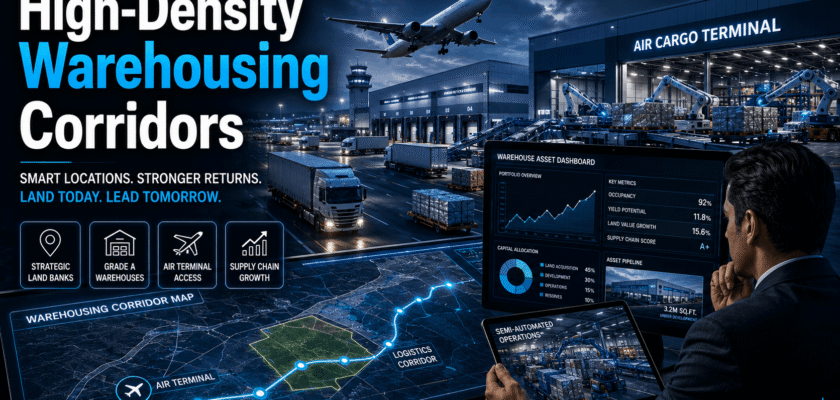
High-Density Warehousing Corridors: Why the Land Rush Is Growing
High-density warehousing corridors are becoming one of the strongest themes in industrial real estate. Modern supply chains need faster air cargo access, better automation support and shorter delivery routes. As a result, funds are paying closer attention to land near semi-automated air terminals.
The logic is clear. An airport-linked warehouse can serve e-commerce, pharma, electronics, quick commerce and high-value spare parts faster than a remote storage site. Moreover, semi-automated terminals improve cargo flow, which makes nearby warehouse land more useful.
India’s warehousing sector also remains active. Recent reporting says leasing in the top eight Indian cities rose 15% year-on-year in Q1 2026 to 19.3 million square feet. Manufacturing and third-party logistics firms drove much of that demand.
Therefore, high-density logistics land is no longer just a storage play. It is becoming a location, power and automation play.
| KEY TAKEAWAYSupply-chain funds are not only buying sheds. They are buying access to speed, power, cargo connectivity, automation and dense consumer markets. |
High-Density Warehousing Corridors Near Air Terminals
Air terminals matter because certain goods need speed more than low-cost distance. Pharmaceuticals, premium electronics, fresh products, emergency parts and high-value parcels benefit from faster cargo movement.
At the same time, semi-automated terminals can reduce manual bottlenecks. When cargo moves faster through the terminal, nearby warehouses can handle sorting, cross-docking, cold-chain handling and last-mile dispatch more efficiently.
Because of this, investors often look for land where airport access, highway links and dense urban demand meet. That combination can raise long-term occupancy strength.
Why Supply-Chain Funds Are Buying Before Demand Peaks
Real estate funds often invest before tenants fully arrive. They study where logistics demand is likely to move next. Then they secure land while pricing is still workable.
In logistics real estate, the best land is hard to replace. Once a corridor is built out, new land near an airport, ring road or cargo node becomes limited.
Consequently, supply-chain funds prefer early positions in corridors where infrastructure, tenant demand and automation needs are all moving in the same direction.
The Five Drivers Behind the Corridor Strategy
✓ Air cargo access helps time-sensitive sectors move goods faster.
✓ Grade A warehouse demand is rising as occupiers prefer better facilities.
✓ Automation needs stronger flooring, height, layout and power capacity.
✓ Quick commerce and urban delivery need smaller but faster fulfillment nodes.
✓ 3PL companies want locations that can serve several clients from one hub.
| INVESTOR LENSThe winning corridor is not simply close to an airport. It must also connect to highways, labor pools, power supply, cargo flow, tenant demand and future expansion land. |
Automation Is Changing the Meaning of Good Warehouse Land
Older warehouses were often judged by roof, rent and road access. Modern warehouses need more. They may need high clear height, strong floors, truck courts, charging space, fire safety, cold-chain capability and reliable power.
Prologis expects power-ready logistics facilities that can support automation and manufacturing to be a top location-selection factor globally in 2026.
Similarly, Link Logistics says modern warehouse operations increasingly need higher electrical infrastructure for robots, automated storage systems and conveyor networks. This makes power capacity a core real-estate feature.
India’s Grade A Warehousing Opportunity
India’s logistics market is shifting toward higher quality assets. CBRE’s India Logistics Market Outlook 2026 says warehousing rentals are likely to keep rising, supported by a flight to quality and higher costs.
Colliers also identified 30 high-potential industrial and warehousing corridors in India in February 2026. It linked the transformation to policy support, infrastructure growth, supply-chain recalibration and rapid technology adoption.
These signals matter because institutional capital usually prefers scale, quality and compliance. Grade A assets near cargo nodes can meet those needs better than scattered low-grade sheds.
What Tenants Want From Airport-Linked Warehousing
✓ Fast inbound and outbound cargo movement.
✓ Reliable temperature-controlled space for sensitive goods.
✓ Cross-dock areas for quick sorting.
✓ High dock-door count for vehicle movement.
✓ Clear height for vertical storage.
✓ Power capacity for automation, robotics and cold storage.
✓ Compliance-ready buildings with safety approvals.
✓ Access to labor, transport and city delivery routes.
Why Semi-Automated Air Terminals Raise Nearby Land Value
Semi-automated air terminals can improve speed, tracking and throughput. In turn, nearby warehouses become more valuable because they can connect quickly to cargo flow.
However, this value is not automatic. A warehouse still needs road access, truck parking, internal movement space and tenant-ready design.
Therefore, the strongest sites are the ones that connect terminal efficiency with warehouse efficiency. That is why funds study the full logistics ecosystem before buying land.
Risks Investors Should Not Ignore
⚠ Airport-linked land can become too expensive if bought late.
⚠ Zoning and approvals can delay projects.
⚠ Poor road access can weaken an otherwise strong site.
⚠ Power shortages can reduce automation value.
⚠ Tenant demand can shift if cargo routes change.
⚠ Speculative building without pre-leasing can raise vacancy risk.
⚠ Environmental and community concerns can slow expansion.
How Developers Can Make Corridors More Bankable
Developers need more than land. They need a plan that lenders, funds and tenants can trust.
First, they should map expected tenant categories. Next, they should design buildings for automation-ready operations. Finally, they should secure power, access, drainage and safety approvals early.
Because occupiers want uptime, developers that deliver reliable infrastructure can command stronger tenant interest. In addition, future-ready design can protect rental growth.
What This Means for Indian Real Estate Markets
Cities with strong cargo links, expressways, manufacturing clusters and high consumption may benefit the most. Mumbai, Delhi-NCR, Bengaluru, Hyderabad, Chennai, Pune, Ahmedabad and Nagpur can all support different versions of the corridor model.
Recent news also shows investor interest near airport-linked logistics. Times of India reported that XSIO Logistics bought a seven-acre land parcel near Mumbai airport for a planned urban logistics park, with temperature-controlled spaces planned for sectors such as quick commerce, pharmaceuticals and cloud kitchens.
That example shows the direction of demand. High-value urban logistics needs speed, density and specialized space.
Organic Search Summary for Readers
High-density warehousing corridors are rising because supply chains now need speed, automation and location quality. Airport-linked land can offer all three when the surrounding infrastructure is strong.
Supply-chain funds like these corridors because good logistics land is limited. Once tenant demand grows, entry costs may rise.
Still, the best investment case depends on approvals, tenant demand, power, road access and building quality. Location matters, but execution matters just as much.
Conclusion
High-density warehousing corridors are changing real estate investment strategy. Funds are moving beyond basic storage and focusing on air cargo access, automation-ready design and dense delivery markets.
Semi-automated air terminals make nearby logistics land more attractive because they improve cargo flow. However, the strongest projects also need Grade A buildings, reliable power and efficient road connectivity.
The next phase of logistics real estate will reward corridors that combine land, technology and transport speed. That is why airport-linked warehousing is becoming a serious capital theme.
Frequently Asked Questions
Q. What are high-density warehousing corridors?
They are logistics zones with strong warehouse concentration, transport access, tenant demand and infrastructure capacity.
Q. Why are funds buying land near air terminals?
Air terminals support faster movement for high-value, urgent and time-sensitive goods.
Q. What makes a warehouse automation-ready?
It needs strong floors, clear height, power capacity, truck flow, fire safety and digital operations support.
Q. Are airport-linked warehouses always better?
No. They are useful only when road access, tenant demand, approvals and power supply are also strong.
Q. Which sectors may use these corridors?
E-commerce, 3PL, pharma, electronics, quick commerce, cold chain and high-value spare parts can benefit.


